“For three hundred years, the professions were paid for what clients didn’t know. That era is ending — not in a decade, but in the window between now and when this book goes out of print.”
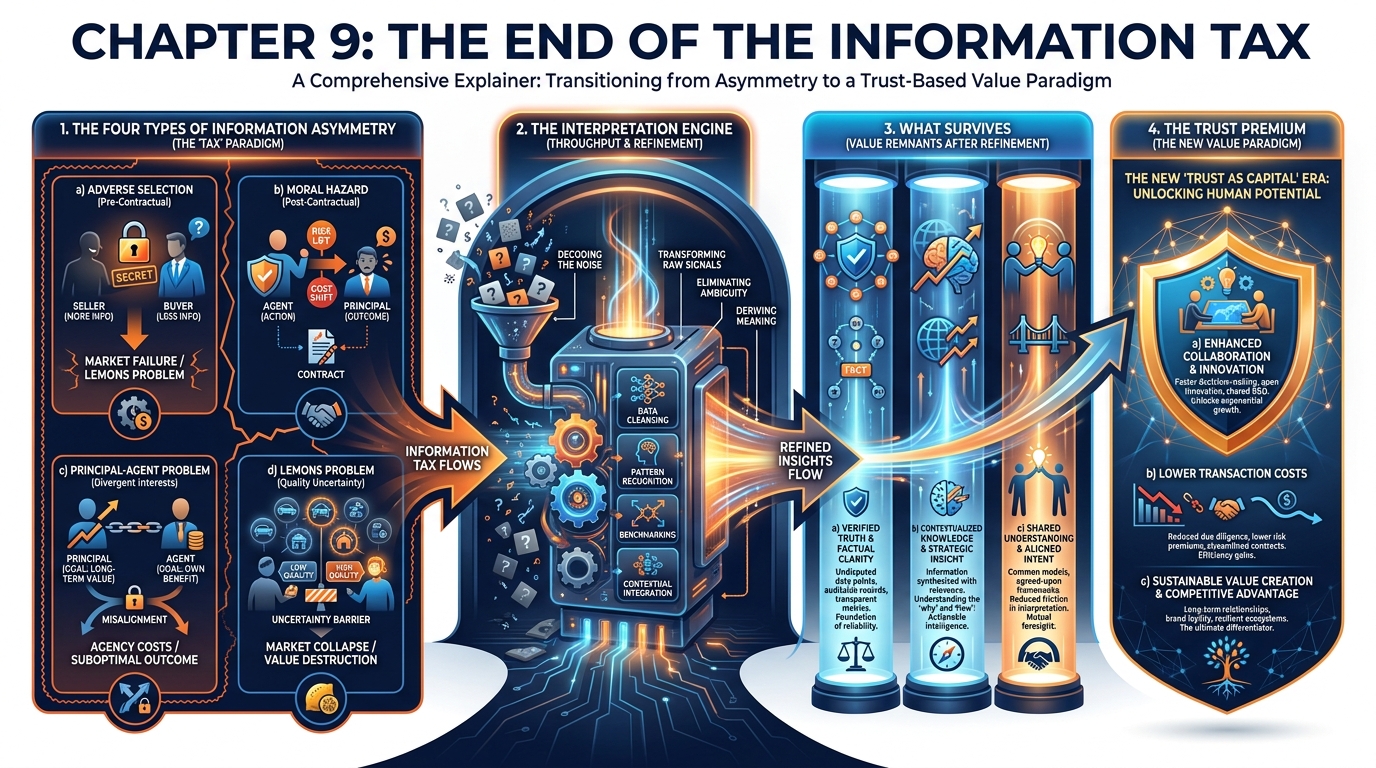
Figure 1:Chapter 9 in one frame: the four types of information asymmetry, what the internet did and did not collapse, the interpretation engine, what survives, and how to position your venture on the right side of the reallocation.
1Learning Objectives
By the end of this chapter, you will be able to:
Define the four types of information asymmetry — Knowledge, Process, Access, and Interpretation — and identify which type each professional services industry most depends on.
Explain why the internet disrupted Access Asymmetry but left the other three types largely intact, and why large language models are categorically different.
Apply the asymmetry framework as a diagnostic tool to score the vulnerability of any professional services business to AI-driven disruption.
Identify the four pillars of durable professional value — judgment, accountability, relationships, and presence — and design a venture strategy that rests on them.
Articulate a coherent “trust premium” for your venture and defend it against the asymmetry collapse scenario.
Revisit your full-semester venture through the capstone integration lens: pitch, MVP, agents, funnel, and the new slide that matters most.
29.1 — What Information Asymmetry Actually Is
Let’s start with a story you’ve never heard told this way.
In 1970, a young economist named George Akerlof submitted a paper to three journals in succession. All three rejected it. The American Economic Review called it trivial. The Review of Economic Studies called it uninteresting. The paper was finally published in the Quarterly Journal of Economics, under the dry title “The Market for ‘Lemons’: Quality Uncertainty and the Market Mechanism.”
Thirty-one years later, Akerlof shared the Nobel Prize in Economics. His “trivial” paper was cited as one of the most important contributions to economic theory in the twentieth century.
What did Akerlof discover? That when one party knows something the other doesn’t — when information is asymmetric — markets don’t just function imperfectly. They can fail completely. His example was used cars: the seller knows whether the car is a lemon; the buyer doesn’t. Because buyers can’t tell, they’ll only pay an average price. But sellers of good cars won’t accept average prices. So good cars leave the market. Only lemons remain — not because good cars don’t exist, but because of the information gap.
This insight — that information asymmetry fundamentally distorts markets — earned Akerlof his Nobel alongside two other economists who built on his foundation.
The Nobel Economics of Information: Akerlof, Spence, and Stiglitz
George Akerlof established the foundational problem: information asymmetry destroys markets because it creates adverse selection — the worst goods and the worst counterparties drive out the best.
Michael Spence examined the seller’s response: how do high-quality parties signal their quality when buyers can’t verify it directly? His answer — education as signaling — is both brilliant and disturbing. Spence showed that costly, difficult-to-fake signals (like a law degree) communicate quality even when the signal itself adds no productive value. The diploma signals competence whether or not the coursework caused it. Spence’s Nobel lecture is essential reading for anyone building a credentialed profession.
Joseph Stiglitz examined the buyer’s response: when you don’t know quality, you screen. Insurance companies charge older customers more. Employers require résumés. Lenders demand credit scores. Stiglitz’s contribution was showing that screening mechanisms create their own inefficiencies — they exclude qualified parties, they incentivize gaming, and they transfer costs from the party with information to the party without it.
Together, the three economists built a complete theory of why knowledge work is structured the way it is — and why it is enormously vulnerable to any technology that redistributes information.
All three won the 2001 Nobel Prize in Economic Sciences. Read the press release. It is unusually readable. It will reframe everything you thought you understood about professional services markets.
Now. Let’s apply this to your career.
The professions — law, medicine, accounting, financial advice, real estate brokerage, insurance, architecture — have not simply been paid for expertise. They have been paid for a specific structure of expertise. The structure is this: the professional knows something the client doesn’t, and the client cannot easily acquire it.
That structure has four distinct types. Understanding all four is not optional. Your ability to position your venture for the next decade depends on being able to name them precisely.
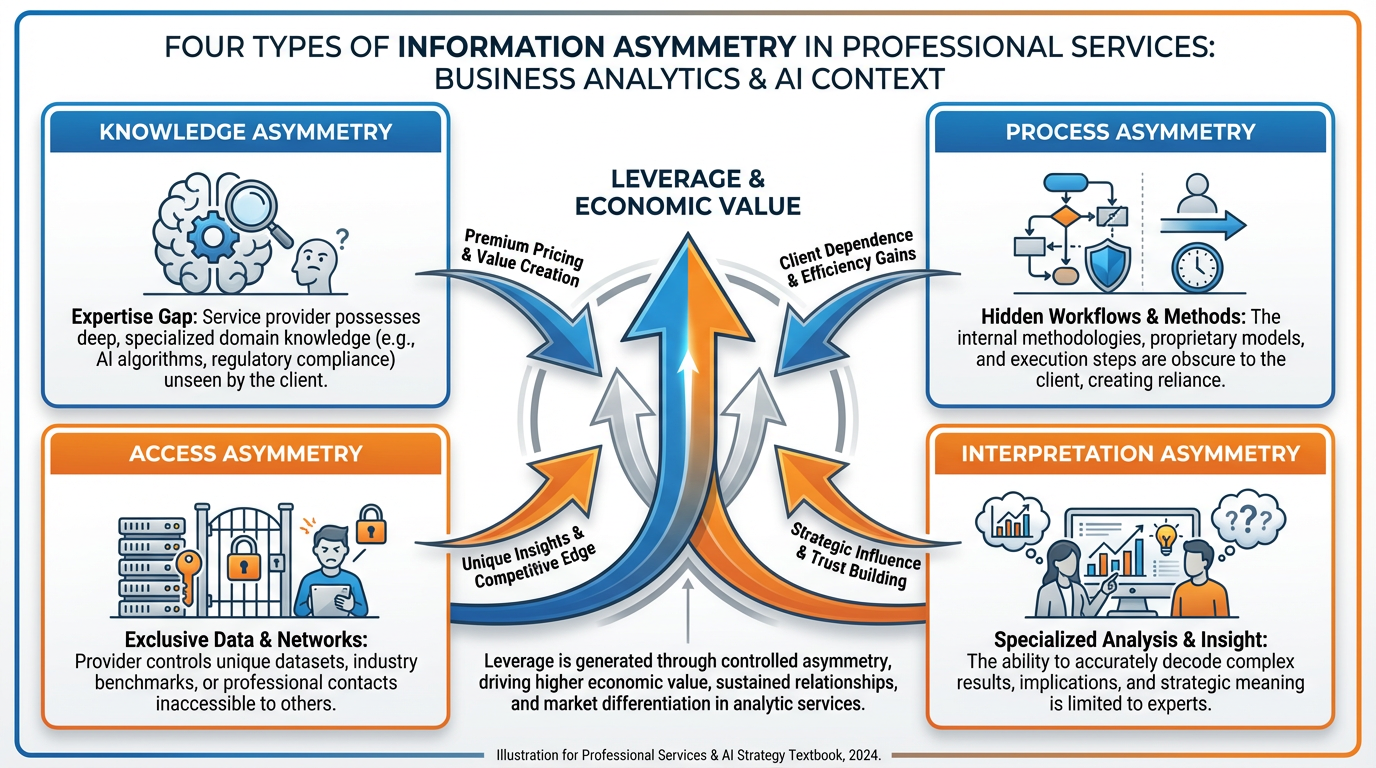
Figure 2:The four types of information asymmetry that structure professional services markets. Each type creates a different kind of leverage — and each has a different vulnerability to technology.
Type 1: Knowledge Asymmetry. One party simply knows more. The cardiologist knows the difference between a benign murmur and a structural defect. The tax attorney knows the implications of Section 1031 of the Internal Revenue Code. The structural engineer knows what a 50-year storm load looks like. This is the most intuitive form of asymmetry, and the one most people mean when they say “expertise.”
Type 2: Process Asymmetry. One party controls the workflow. The attorney knows how to file a motion, what forms are required, what sequence of steps must be followed in a particular jurisdiction, what deadlines govern what filings. Even if a client understood the law perfectly, they wouldn’t know how to operate the system. The process itself is the moat — and it is distinct from knowledge.
Type 3: Access Asymmetry. One party controls the data itself. The real estate broker had access to the MLS — the Multiple Listing Service — that the public didn’t. The insurance underwriter had access to actuarial tables that policyholders couldn’t see. The stock broker had access to price feeds that the retail investor lacked. Access Asymmetry is not about understanding the data — it’s about having the data.
Type 4: Interpretation Asymmetry. Both parties can see the data, but only one can read it. The radiologist and the patient both have access to the MRI scan. But only the radiologist can look at the grey gradations and distinguish artifact from tumor, benign from malignant, normal variation from early pathology. The CPA and the business owner both have the financial statements — but only the CPA can read the tax implications.
Four types. Each real. Each generating enormous value for the party who holds it.
Akerlof, Spence, and Stiglitz gave us the economics. Now we need to see how those economics became business models.
39.2 — How Markets Priced the Asymmetry
Let me be direct about something uncomfortable.
When you pay a $500/hour attorney, you are not simply paying for their knowledge. You are paying for the scarcity of people who have that knowledge, the inaccessibility of the process they navigate, and — most honestly — the inconvenience it would take you to acquire either of those things yourself. You are paying an asymmetry premium. And the legal profession, like most professions, has spent two centuries constructing and defending that premium.
This is uncomfortable to say. But it is true. And understanding it is the foundation of everything that follows.
Consider how the credentialing system actually works. The bar exam does not primarily test skills used in daily legal practice. What it does, unambiguously, is restrict supply — creating a bottleneck that limits the number of practitioners in each jurisdiction. That bottleneck is not purely about protecting the public from incompetent lawyers. It is also about protecting competent lawyers from price competition.
Spence’s insight is illuminating: the credential signals quality and functions as a barrier to entry. Over time, incumbents have every incentive to raise the barrier regardless of whether the incremental difficulty maps to actual quality improvement. The result is credential inflation — the MBA that differentiated in 1980 became a minimum requirement by 2000.
Complexity became a business model. Jargon is not accidental. Latin legal phrases serve communication functions among specialists — but also gatekeeping functions for non-specialists. When your lease has 47 paragraphs of fine print and your attorney says “it’s standard,” the opacity is deliberate. Opacity creates dependency. Dependency creates fees.
Every profession has evolved its own version of this architecture — and every profession’s incumbents have lobbied, litigated, and legislated to keep that architecture high and expensive to climb.
None of this is a conspiracy. It is rational behavior by rational actors. The attorneys who lobbied for stricter bar requirements genuinely believed they were protecting the public. The physicians who fought HMO price controls genuinely believed they were protecting patient care quality. The instinct to protect a valuable skill is human. What matters for our purposes is not the motivation — it is the effect.
The effect is a multi-trillion dollar structure in which a significant fraction of what people pay for professional services is not a payment for value created. It is a payment for information withheld. An information tax.
And that tax is now being challenged at its foundation.
49.3 — What the Internet Did and Did Not Do
For a moment in the mid-1990s, it seemed like the internet was going to collapse everything. Real estate brokers panicked when Zillow appeared. Travel agents panicked when Expedia appeared. Encyclopaedia Britannica went bankrupt when Wikipedia appeared.
And something real did happen.
The internet shattered Access Asymmetry almost completely. The MLS opened via Zillow and Redfin. Drug interaction databases became freely available via the NIH. Legal cases that required a Westlaw subscription became findable on Google Scholar. Stock prices that required a broker became real-time on Yahoo Finance. The asymmetry of having data largely collapsed over twenty years.
And yet. The 500 an hour. The physician is still booked six weeks out. Medicine, law, and accounting did not disrupt the way travel agencies disrupted. They adapted. They bent. They did not break.
Why? Because Access Asymmetry was only one of four types. And the internet, for all its power, could not touch the other three.
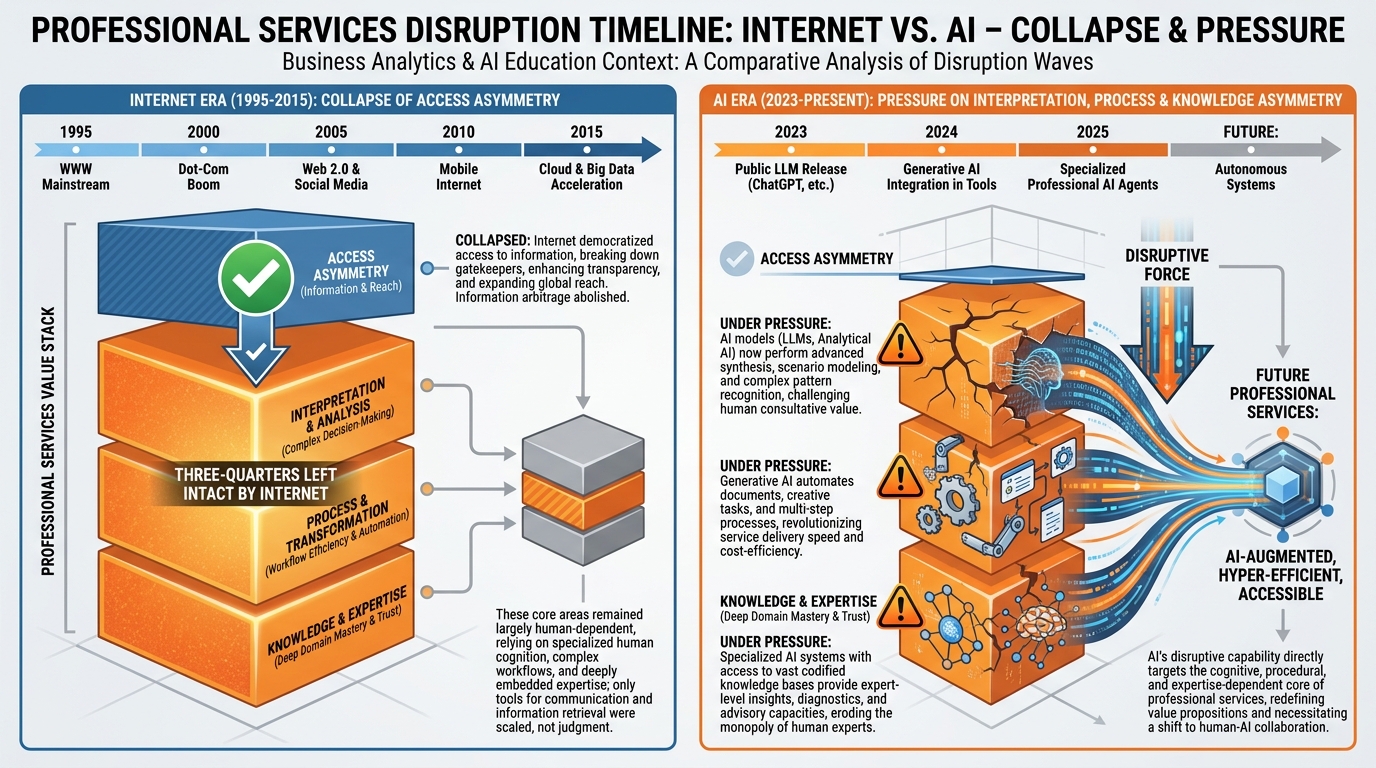
Figure 3:The internet collapsed one of four asymmetry types. AI is now finishing the job — and the three types that survived the internet are precisely the ones that created the highest professional premiums.
You can Google “symptoms of appendicitis.” But you still cannot diagnose yourself. The information is available. The interpretation is not. Google gave you Access. It did not give you Interpretation.
You can download a standard LLC operating agreement. But you still don’t know which provisions are critical in your jurisdiction or what language will survive a challenge twenty years from now. Google gave you Access. It did not give you Process or Knowledge.
The key insight: the internet increased visibility of the remaining asymmetry gaps. It made clients aware of what they didn’t know — and in some ways strengthened the premium, because clients understood enough to know they didn’t understand enough.
This is the incompleteness that AI is now finishing.
59.4 — The Interpretation Engine
Here is where everything changes.
Large language models are not search engines with better design. They are not chatbots with larger training sets. They represent something categorically different: the first general-purpose interpretation technology in human history.
Let that sink in for a moment.
For the entirety of human civilization, interpretation was personal. The text existed — but the act of reading it, contextualizing it, synthesizing it against prior knowledge, weighing competing interpretations, and arriving at a judgment was something that happened inside a human mind. That was always true. The printing press made texts available to everyone. But it did not give everyone the ability to interpret them. The internet made all texts available simultaneously. But it did not give everyone interpretation.
LLMs are not retrieval systems. They do not look up answers. They reason about information. They contextualize. They synthesize. They identify what is relevant and what is noise. They recognize patterns across multiple documents and produce coherent judgments about what those patterns mean.
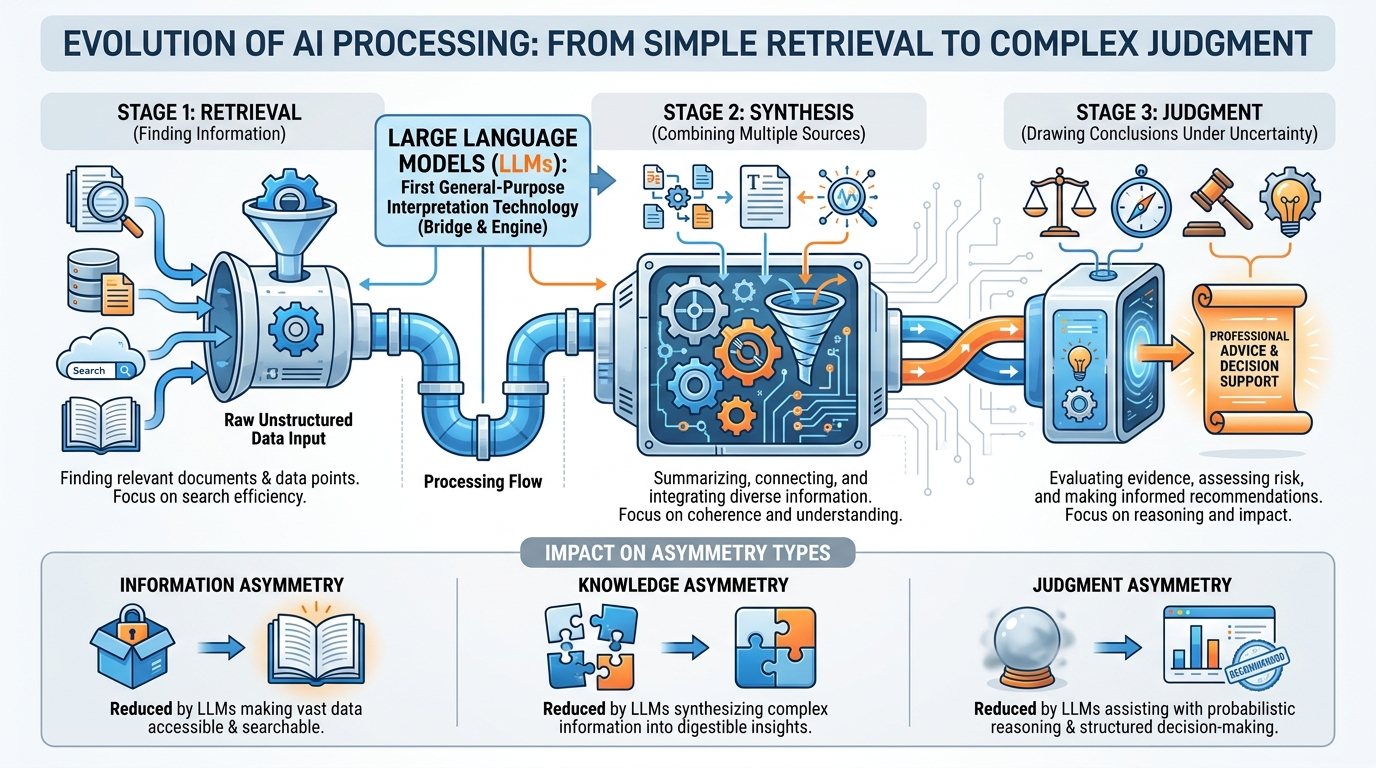
Figure 4:The Interpretation Engine: from retrieval to synthesis to judgment. Large language models are the first technology that can operate at the interpretation layer — the layer that professional services have monopolized for three centuries.
This is not hype. A modern LLM can:
Read 200 pages of depositions, synthesize factual inconsistencies, and produce a cross-examination strategy. (Process + Interpretation Asymmetry)
Read a radiology report, prior history, and symptom presentation, and produce a differential diagnosis ranked by probability. (Knowledge + Interpretation Asymmetry)
Read ten years of financial statements, industry comps, and macro context, and produce an investment thesis with identified risks. (Knowledge + Interpretation Asymmetry)
Read a property’s title history, comparable sales, demographic trends, and zoning regulations, and recommend buy, wait, or pass. (Access + Process + Interpretation Asymmetry)
The word “general-purpose” matters. Previous technologies disrupted interpretation in narrow domains — the calculator eliminated arithmetic interpretation, CAD reduced engineering calculation burdens. LLMs operate across all interpretation domains simultaneously, with no domain-specific configuration required by the user.
What does this do to the invoice? Think about what you’re billed for when you hire a knowledge worker: genuine judgment (settle or go to trial), accountability (someone’s name on the document, someone liable), relationship (you trust this person), and — the largest fraction of billable hours — interpretation labor. The reading. The synthesizing. The translating of complexity into something you can act on.
That last fraction is now the most vulnerable line item in the professional services invoice.
69.5 — Industry by Industry
Let’s be systematic about this. The asymmetry framework applies to every professional services industry — and each industry has a different vulnerability profile. Understanding your industry’s profile is the first step in building a defensible position within it.
The vulnerability score below is assessed on each of the four asymmetry types: H (High dependency, high vulnerability), M (Medium dependency), L (Low dependency, more durable).
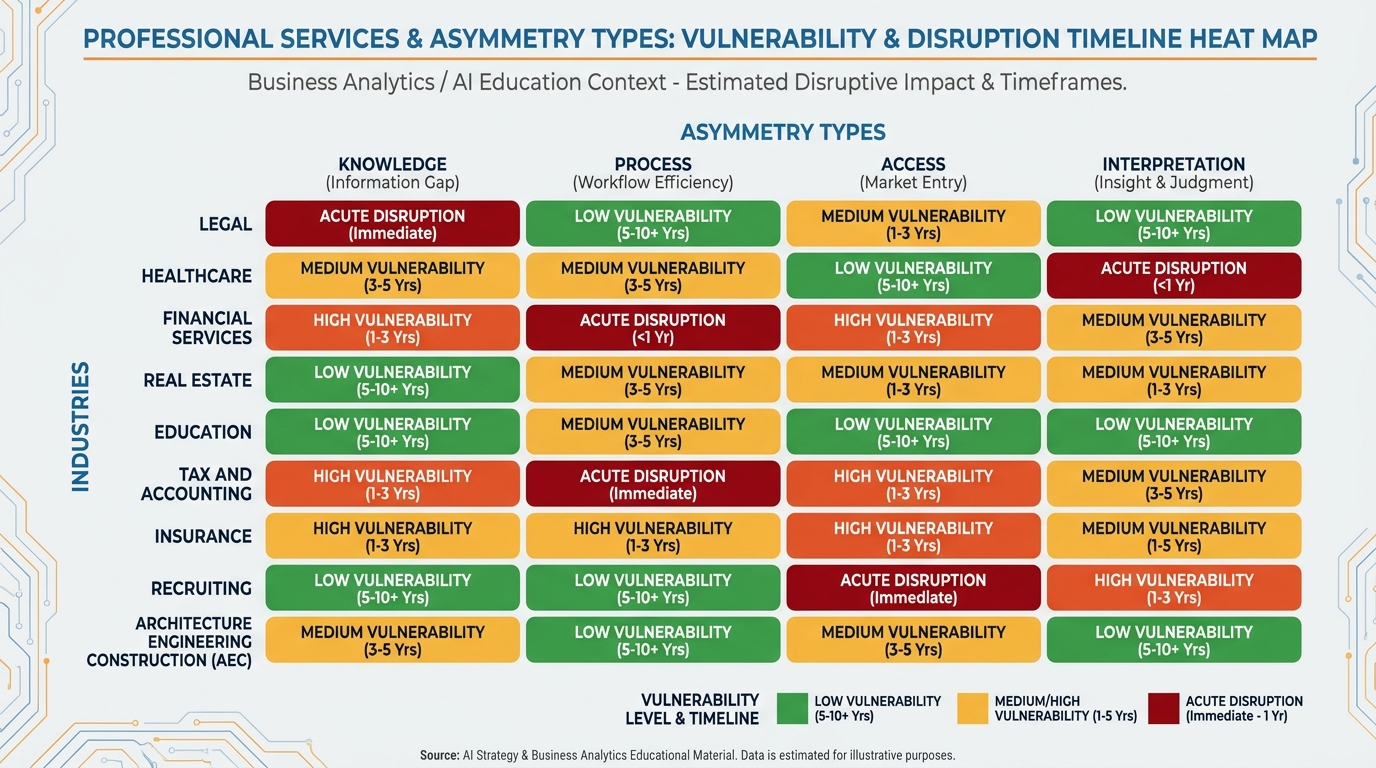
Figure 5:The Industry Vulnerability Matrix: nine professional services industries scored across the four asymmetry types. Orange/red cells indicate current or near-term disruption. Green cells indicate relative durability.
Legal Services — Primary asymmetries: Knowledge (H), Process (H), Interpretation (Very H). Access already breached by Google Scholar and LexisNexis.
Acute vulnerability: Interpretation (1–4 years), Process (3–7 years). Standard contract review, due diligence, legal research — all collapsing in price.
What survives: Courtroom advocacy. Negotiation. Complex deal structuring. Regulatory relationships built over years. The attorney who can look a client in the eye before trial and say “I’ve seen worse. Here’s why we win.” That attorney survives. The attorney charging $450/hour to review a standard vendor contract does not survive that fee.
Healthcare — Primary asymmetries: Knowledge (Very H), Process (H), Interpretation (Very H). Access partially breached by WebMD, NIH, and patient portals.
Acute vulnerability: Interpretation (3–8 years), especially radiology, dermatology, and pathology where AI systems already outperform average specialists on specific imaging tasks.
What survives: Emergency and procedural medicine — surgery, interventional cardiology, trauma. These require physical presence, manual dexterity, and life-or-death judgment that no remote system replicates. The physician-patient relationship, especially in chronic disease management, also retains high durability.
Financial Services — Primary asymmetries: Access (collapsed), Knowledge (H), Interpretation (H). The retail broker and load-fund salesperson are already gone. What remains is under pressure.
Acute vulnerability: Interpretation (1–4 years). AI-assisted portfolio analysis, tax optimization, and basic financial planning are compressing margins at every tier below ultra-high-net-worth.
What survives: Behavioral coaching — helping clients not panic during downturns, not overconcentrate, not make the emotional mistakes that destroy compounding. The fee-only financial planner serving as a thinking partner across a client’s full life is highly durable. The stock-picker charging 1.5% AUM for returns that don’t beat Vanguard is not.
Real Estate — The MLS was the foundation. Zillow, Redfin, and Realtor.com blew it open. The landmark NAR settlement on commission structures was the market’s verdict: when Access Asymmetry collapses, so does the value proposition built exclusively on it.
Acute vulnerability: All remaining asymmetry types (2–6 years). Standard residential transaction brokerage is in terminal margin compression.
What survives: Negotiation. Off-market relationships. The agent who closes in a multiple-offer situation because they know the listing agent personally. Deep hyper-local knowledge that no database captures — what makes a specific block desirable, which HOA is dysfunctional, which seller will take less for a clean close.
Education — Primary asymmetries: Knowledge (H), Process (Very H via credentialing), Access (H via library and databases). The signaling function of the credential — Spence’s framework — remains intact as long as employers demand it.
Acute vulnerability: Knowledge transfer (3–8 years). The lecture as primary pedagogical model is collapsing. The $3,000/credit-hour course where the value-add is a video of someone reading slides is indefensible.
What survives: Mentorship. The professor who changes a student’s intellectual trajectory through direct engagement. Research at the frontier. Credentialing that regulators and employers still require. The campus experience as a social and professional formation environment.
Tax & Accounting — Perhaps the most acutely vulnerable professional services category. TurboTax breached the simple-return market in 1984. AI is now breaching the complexity layer that survived TurboTax — the multi-entity business, the high-net-worth individual, the cross-jurisdictional estate.
Acute vulnerability: Both Knowledge and Interpretation are Very High vulnerability, 1–5 year timeline. The core deliverable — read the code, apply it to the facts, produce a strategy — is exactly what large language models do well.
What survives: IRS negotiation and representation. Advisory relationships with founders and high-net-worth individuals who need a trusted thinking partner. The CPA whose name and license are on the return, who bears professional liability for the position taken.
Insurance — One of the most comprehensively asymmetric structures in the economy. Actuarial tables were proprietary, policy language was deliberately opaque, the underwriting process was black-boxed. All four types present. All four under pressure.
Acute vulnerability: Process (4–9 years) and Interpretation (2–5 years). AI underwriting models are already outperforming actuarial tables in several risk categories.
What survives: Underwriting judgment on novel risk classes — cyber liability, climate-catastrophe exposure, pandemic business interruption. Claims advocacy in complex disputes. Relationship-based commercial brokerage where the broker understands the client’s business deeply enough to structure genuinely customized coverage.
Recruiting — LinkedIn demolished Access Asymmetry. AI is now demolishing Interpretation Asymmetry — the ability to read a résumé and interview performance and predict job success. The retained search firm charging 33% of first-year compensation to find and screen candidates is in acute structural crisis.
Acute vulnerability: Interpretation (1–3 years). Screening, scoring, and matching — the core technical function of recruiting — is being automated rapidly.
What survives: The recruiter-candidate relationship across multiple career transitions. The ability to read a room and manage a difficult offer negotiation. The niche specialist — the recruiter who has placed fifty data scientists and evaluates technical depth in ways that algorithms cannot yet replicate.
Architecture & Engineering — AEC has relied almost entirely on Knowledge and Process Asymmetry. BIM software began eroding Process Asymmetry a decade ago. AI is now entering Knowledge and Interpretation territory — generating floor plans, running structural calculations, flagging code violations.
More durable than most: Physical presence requirements and licensed accountability (the engineer’s stamp on a permit) create regulatory moats. Timeline is longer — 5–15 years depending on task.
What survives: Aesthetic judgment. The architect who advocates for a vision against budget pressure and client whim. Engineering judgment on genuinely novel problems. The licensed professional whose signature and insurance policy are required on every permitted structure.
The pattern that emerges from this analysis is not subtle. Every industry that depends heavily on Interpretation Asymmetry — law, tax, financial advisory, recruiting, insurance underwriting — is in a three-to-seven-year window of acute disruption. Industries with strong physical presence requirements (medicine, architecture) or with credentialing systems backed by regulatory enforcement (law, medicine) have somewhat longer runways. But no industry is immune.
79.6 — What Survives
We’ve spent considerable time on what’s collapsing. Now let’s talk about what doesn’t.
This is not a chapter about despair. It is a chapter about precision. The professionals — and the ventures — who will thrive in the next decade are not the ones who deny the asymmetry collapse. They are the ones who understand exactly which elements of value are durable, and who build everything else on top of those elements.
There are four pillars. They are not abstract. Every one of them has a human story behind it.
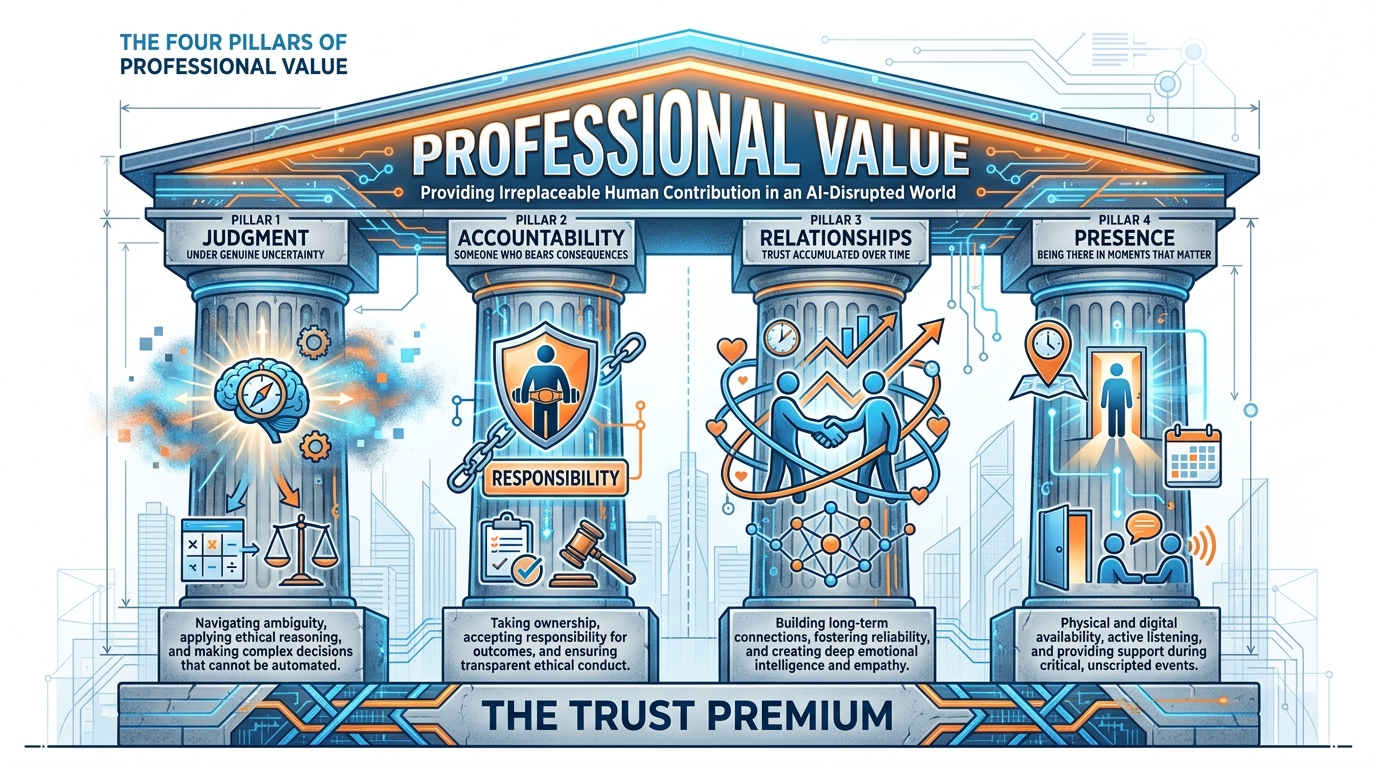
Figure 6:The four pillars of durable professional value. These are not platitudes — they are the specific characteristics that information asymmetry collapse leaves untouched.
Pillar One: Judgment Under Genuine Uncertainty
There is a difference between complex problems and genuinely uncertain ones. Complex problems have solutions — they are just hard to find. An LLM, given enough context, can solve them. Genuinely uncertain problems are different. They have no correct answer at the time of decision. The outcome depends on variables that are currently unknown, in combinations that no model can predict.
The venture capitalist deciding whether to lead a $10 million Series A in a company with three employees and a demo is facing genuine uncertainty. The general deciding whether to hold a position or retreat in a fog-of-war environment is facing genuine uncertainty. The physician deciding whether a patient’s non-specific pain warrants aggressive investigation or watchful waiting is facing genuine uncertainty. The senior partner deciding whether to take a case that could be career-defining or career-destroying is facing genuine uncertainty.
AI can model these scenarios. It can surface relevant precedents, estimate probabilities, and structure the decision. But the judgment — the weighting of values, the acceptance of consequences, the personal commitment to a course of action under irreducible uncertainty — that remains human. Not because humans are better at probability estimation. (We aren’t.) But because judgment requires someone who will live with the outcome. An algorithm does not bear consequences. A person does.
Pillar Two: Accountability
This is the most underappreciated durable value in professional services.
When an attorney puts their bar number on a court filing, something important happens. They are liable. Their license, their reputation, and potentially their freedom are on the line. No AI system has a bar number. No AI system can be held in contempt of court. No AI system has malpractice insurance. No AI system can be disbarred.
The function of professional accountability is not symbolic. It is structural. Markets require accountability mechanisms to function — especially markets for services whose quality can only be assessed after delivery (what economists call experience goods). The professional’s license, their insurance policy, and their reputational stake are all mechanisms that align the professional’s interests with the client’s interests over time.
AI may be able to do the analysis. But as long as someone needs to be responsible for the outcome — legally, professionally, ethically — that someone creates irreducible value.
Pillar Three: Relationships — Trust Accumulated Over Time
Rajesh Shah has banked with the same wealth manager for eighteen years. The wealth manager knows Rajesh’s daughters, his parents in India, his visceral fear of being forced to sell during a downturn — not because it’s in a database, but because of forty-seven conversations over two decades, several of them during crises.
An AI can access Rajesh’s portfolio. It cannot access those eighteen years. It cannot call Rajesh during a downturn, in a voice he recognizes and trusts, and say: “I’ve seen this movie. Here’s what we do.”
Relationships are the accumulated result of presence, consistency, honesty, and shared experience. That accumulation cannot be shortcut by processing power.
Pillar Four: Presence — Being There in the Moments That Matter
The attorney sitting next to the defendant as the jury files in. The hospice physician holding a patient’s hand at end of life. The architect walking a site with a family, watching their faces as they stand in the space that will become their home.
Presence is not information delivery. It is being with someone in a moment that matters. No remote system substitutes for it. It is inherently, irreducibly human.
89.7 — The Trust Premium
Here is the economic consequence of everything we’ve discussed.
As AI erodes Interpretation and Process Asymmetry, the commodity tier of professional services collapses in price. Standard contract review. Routine tax returns. Basic financial plans. Boilerplate wills. These move toward marginal cost — which, for AI-assisted work, approaches zero.
This creates a barbell distribution. The commodity tier races toward free. Simultaneously, the trust tier — judgment, accountability, relationships, presence — commands a higher premium, not a lower one.
Why higher? Because as the commodity tier collapses, clients increasingly cannot distinguish good AI-assisted advice from confidently wrong AI-assisted advice. Akerlof’s lemons problem reappears in a new form: quality is hard to assess, so buyers discount everything. The professionals who offer credible signals of quality — through demonstrated relationships, verifiable accountability, real consequences attached to their name — become worth more in a world of AI noise, not less.
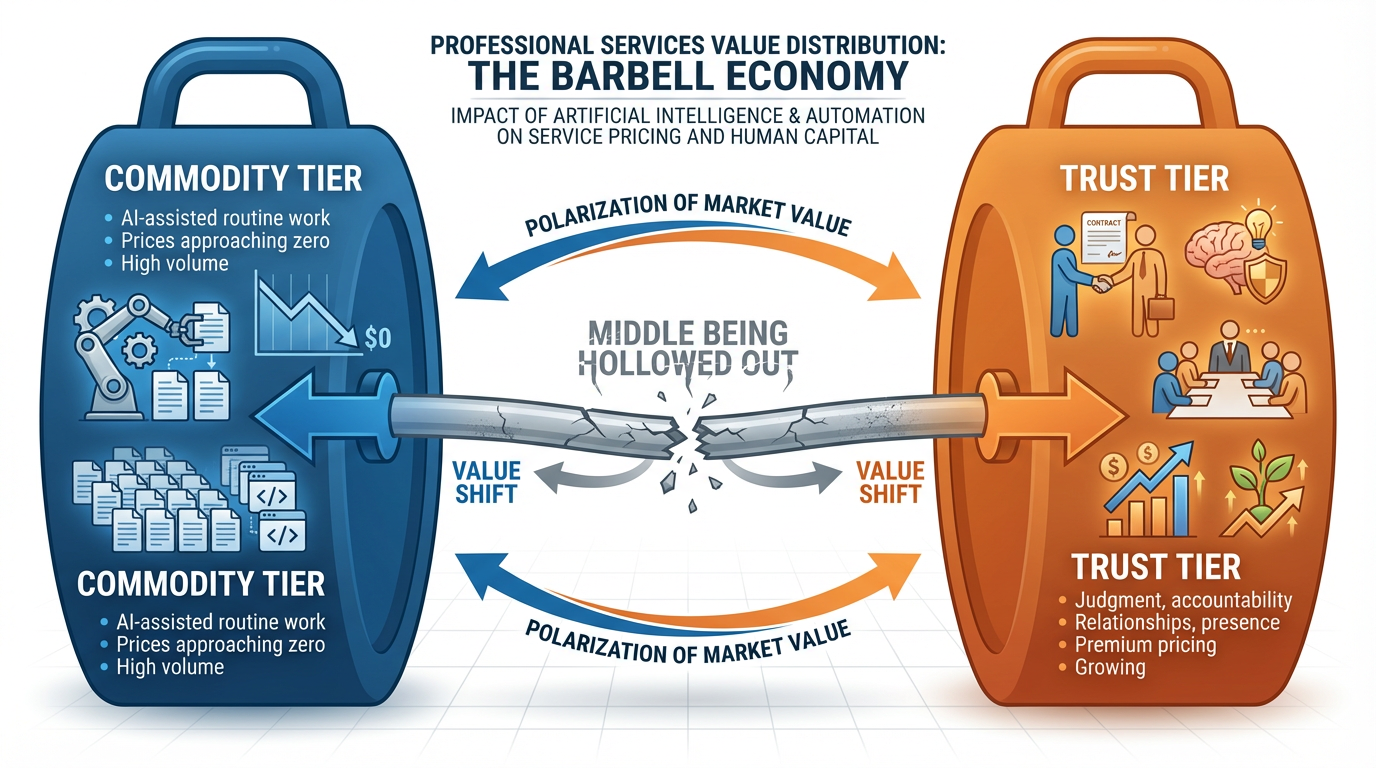
Figure 7:The barbell economy in professional services: the commodity tier races toward marginal cost while the trust tier commands an increasing premium. The dangerous zone is the middle — the professional who is neither cheap enough to compete on price nor distinctive enough to command the trust premium.
The dangerous position — the one that will produce the most career casualties — is the middle. The attorney who is neither a high-volume document automator nor a trusted strategic advisor. The financial advisor who is neither a dirt-cheap index fund platform nor a deeply integrated life planning partner. The middle is being hollowed out.
Over a thirty-year career horizon, the strategic imperative is clear: move toward the trust tier, or move toward the commodity tier with operational discipline. Do not straddle. The barbell does not support standing in the middle.
The investments that matter most:
Depth of expertise in a specific domain — enough to offer genuine judgment under uncertainty
A track record of good calls, publicly attached to your name
Clients who trust you personally and will follow you across platforms
The willingness to be accountable — to put your name on things and bear consequences
A reputation for presence in the moments that matter
These are not scalable in the traditional sense. They are built slowly, through showing up, through being right often enough and honest when you weren’t. No LLM builds them. No agent accumulates them. They are yours alone.
99.8 — The Regulator’s Dilemma
Let us be clear-eyed about something.
The asymmetry collapse will not proceed in a straight line. It will be fought.
The incumbents who benefit from existing asymmetry structures are organized, well-funded, and deeply connected to the regulatory bodies that enforce the rules they benefit from. The bar associations, the state medical boards, the financial industry self-regulatory organizations — these bodies exist to protect the public, yes. But they also exist, in practice, to protect their members from competition.
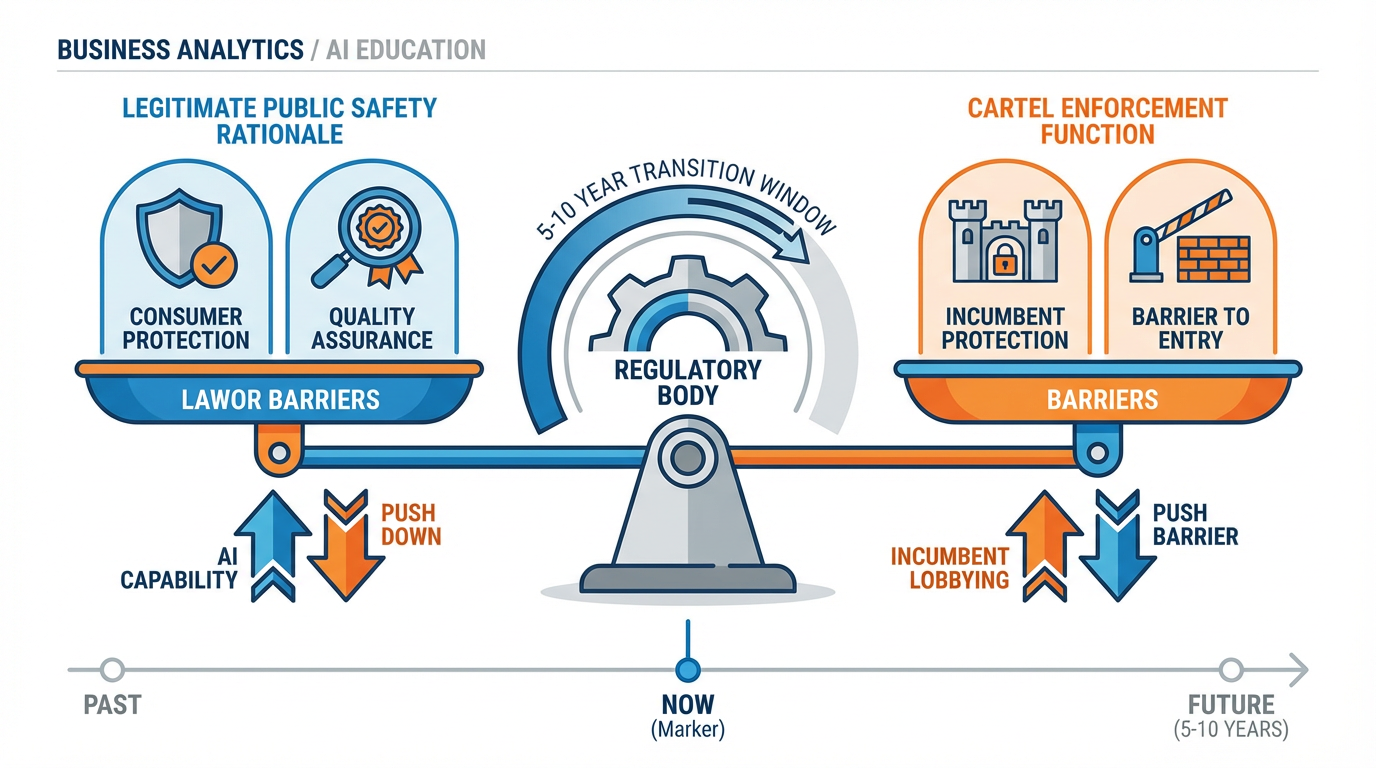
Figure 8:The Regulator’s Dilemma: every regulatory framework that protects professional asymmetry has a legitimate safety rationale and a cartel enforcement function. Separating them is the key challenge of the transition window.
The Unauthorized Practice of Law (UPL) doctrine prohibits non-attorneys from providing legal advice. The original rationale was consumer protection. That rationale is legitimate. But in practice, UPL is enforced most aggressively against affordable, technology-enabled alternatives — document automation companies, AI legal tools, online dispute resolution platforms. The entities most likely to bring UPL complaints are not consumer protection agencies. They are state bar associations.
Every licensed profession has a version of UPL — a rule restricting practice to licensed practitioners, enforced by an association of those practitioners. The legitimate safety rationale is real. The cartel enforcement function is also real. Separating them is the work of the next decade.
Expect a five-to-ten year transition window that is messier than the technology suggests. LLMs will be capable of high-quality legal analysis years before that analysis is legally permitted to reach clients without attorney supervision. The lag between capability and regulatory permission creates both arbitrage opportunities and legal risk.
The companies that navigate this well — like Modernizing Medicine, Clio, or Betterment — work with regulatory frameworks rather than against them. The companies that attempt to leapfrog regulation entirely tend to generate injunctions and congressional hearings. Build regulatory relationships as deliberately as you build customer relationships.
109.9 — Positioning Your Venture
You’ve spent an entire semester building something. A Business Model Canvas. A pitch. An MVP. A set of synthetic agents. A marketing funnel. Real cognitive investment in a venture idea you believe in.
Now hold it up against the harshest possible lens.
Question 1: What is the primary asymmetry your venture exploits?
Knowledge Asymmetry — you know something your customers don’t? Process Asymmetry — you control a workflow they can’t navigate alone? Interpretation Asymmetry — you can read data they can see but can’t make sense of?
Question 2: Which of those asymmetries is vulnerable to AI in the next five years?
Interpretation Asymmetry — watch out. That is the most acute disruption zone. Process Asymmetry — a few more years, but agent-based automation is coming. Knowledge Asymmetry — the most runway, but not unlimited runway.
Question 3: What is your trust premium?
If AI erases your asymmetry, what remains? Is there a version of your venture that survives on judgment, accountability, relationships, and presence? What would that version look like?
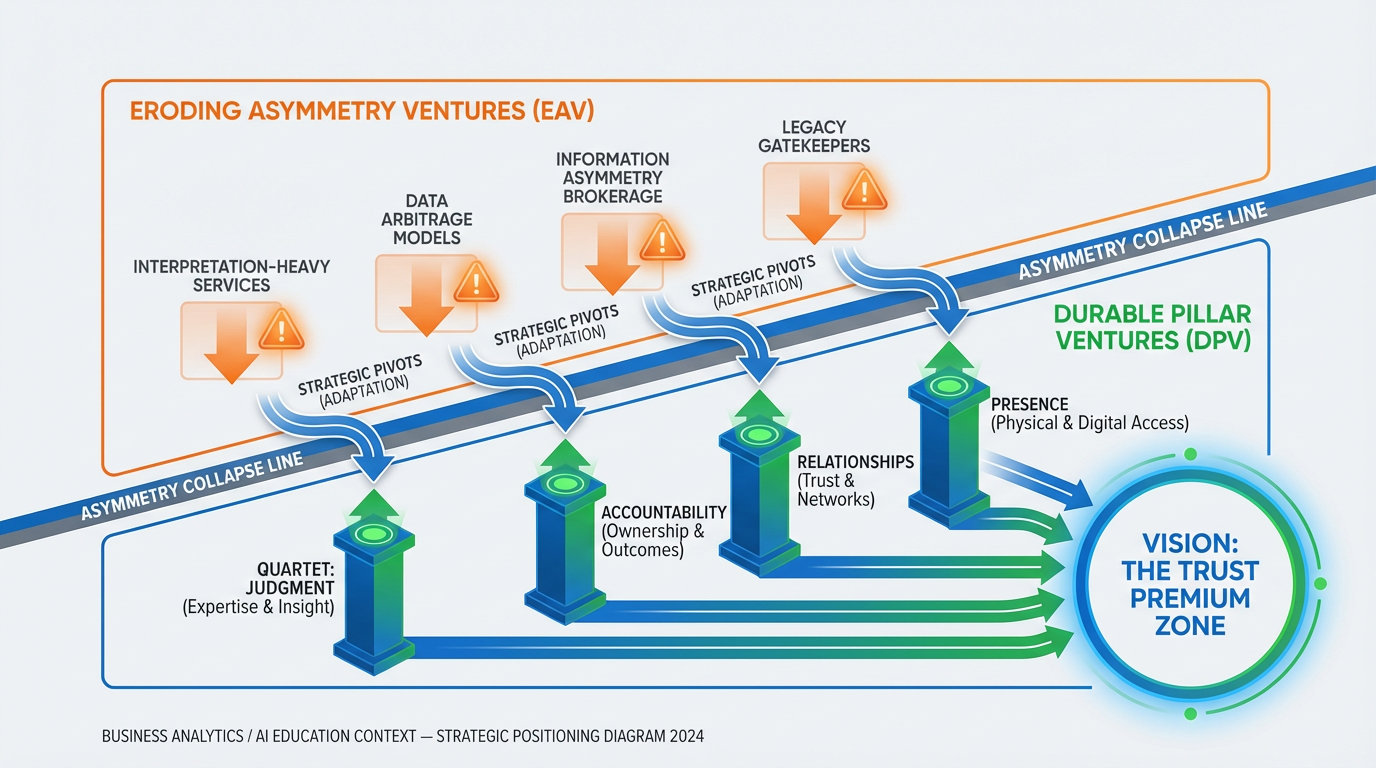
Figure 9:Positioning above vs. below the asymmetry collapse line. Ventures built primarily on Interpretation Asymmetry are above the line — their moat is being eroded. Ventures built on the four durable pillars are below the line — their moat strengthens as the commodity tier collapses.
Question 4: Are you building on top of asymmetry or underneath it?
Building on top means your value proposition depends on the asymmetry continuing to exist — a time-limited bet. Building underneath means your value proposition increases as the asymmetry collapses, because you are positioned in the trust tier that becomes more valuable as the commodity tier disappears.
LegalZoom — document automation that competes on price with attorney-drafted documents — is building on top of a collapsing asymmetry. As AI drives attorney fees for standard work toward zero, LegalZoom faces margin pressure from both directions simultaneously.
Contrast that with a venture that aggregates accountability — using AI to do the analytical work, but putting licensed professionals with real liability on every deliverable, charging a trust premium for that accountability, and building long-term relationships through a track record of being right. That venture becomes more valuable as AI commoditizes analysis, because it is the only place in the market offering genuine professional accountability at scale.
Which side of the barbell are you on?
11Capstone Integration
This is what the whole semester has been building toward.
You came into this course with an idea. Over eight chapters, you built the scaffolding: a Business Model Canvas that forced you to articulate your value proposition, customer segments, and revenue streams. A pitch that had to survive interrogation. An MVP that had to actually work. Synthetic agents that extended your capabilities. A marketing funnel that could find and convert customers without requiring you in every transaction.
Every element was built with assumptions. Some of those assumptions involved information asymmetry — perhaps without you naming it. Now is the time to name it.
The capstone integration is not a new deliverable. It is a re-evaluation of everything you’ve built through the lens of this chapter. Go back to your BMC. Find the value proposition. Ask: what asymmetry does this rest on? Go back to your pitch. Find the moat. Ask: is that moat a form of asymmetry that AI will erode?
Then add one slide. The single most important slide in your venture’s pitch, going forward:
“Why We Survive the Asymmetry Collapse.”
This slide must be honest. It must identify which value drivers depend on asymmetry, how vulnerable those asymmetry types are on a five-year timeline, and what trust premium survives when the asymmetry is gone.
Ventures that cannot answer this question are not failed ventures — they are ventures with an unexamined risk. If the answer isn’t there yet, redesign until it is. Move up-market toward judgment-intensive work. Build an accountability layer competitors won’t match. Invest in relationship infrastructure. Pivot from information arbitrage to outcomes-based accountability.
The semester gave you the tools. This chapter gives you the test. Pass it.
12Case Study: Two Accounting Firms, Three Years
Let us make this concrete.
The industry is tax accounting and advisory services. Both firms serve small-to-midsize businesses. Both have roughly thirty professional staff. Both were founded before the current wave of AI disruption. They are responding to the same market conditions — and making opposite bets.
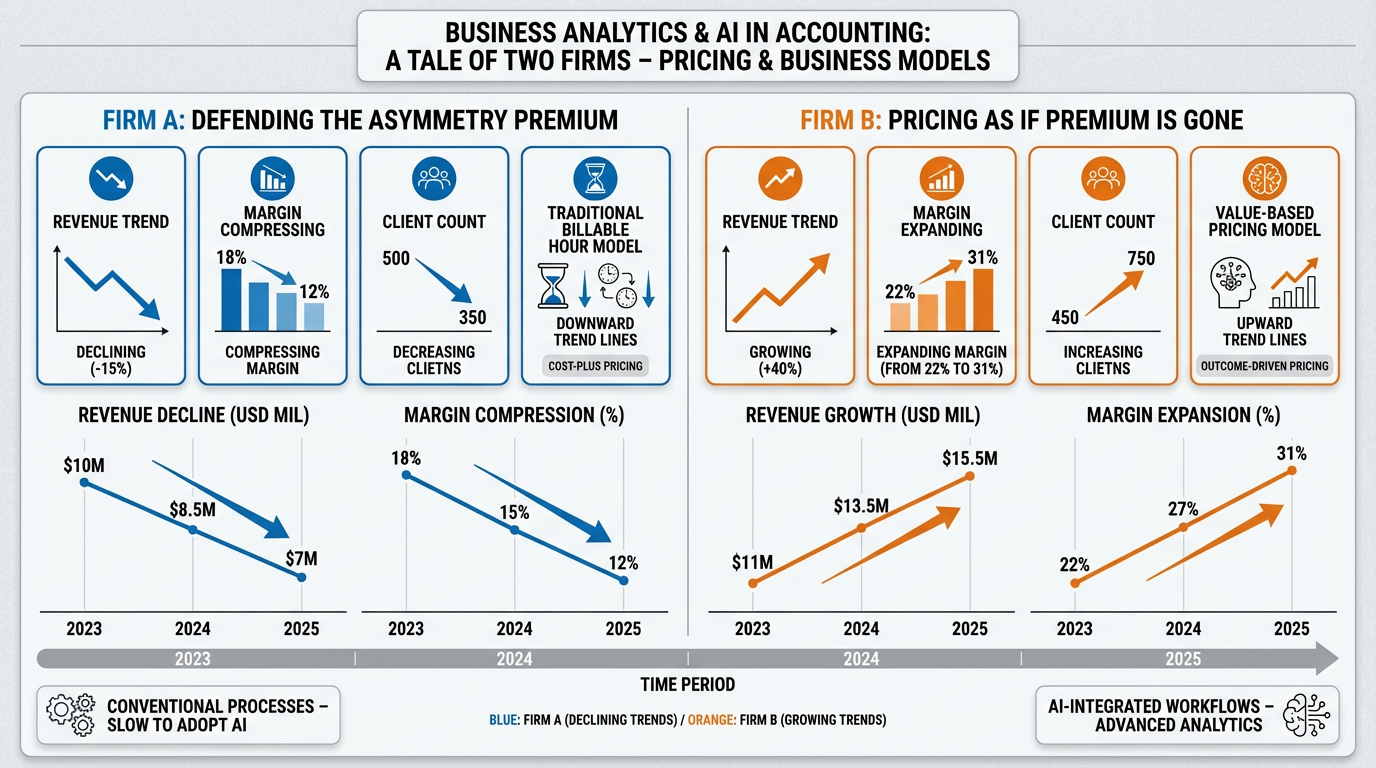
Figure 10:Two accounting firms, same industry, opposite strategies: one defending the asymmetry premium, one pricing as if it’s already gone. Three-year trajectories reveal which bet is winning — and what a firm looks like on both sides of the transition.
Firm A: Defending the Premium
Firm A has responded to AI disruption by emphasizing credentials, longevity, and complexity. Billing model: 550/hour depending on seniority. Marketing: depth of CPA expertise, track record with complex structures.
Year 1: Lost four clients to AI-assisted flat-fee competitors. Revenue held, but margin compressed as straightforward work — the work that subsidized overhead — migrated to cheaper alternatives. Year 2: Seven more departures. AI tool integration attempted; culture resisted. Partners built on billable hours had no incentive to become efficient. Revenue down 11%. Year 3: Strategic crisis. Long-standing clients retained — they value the relationship and accountability. New pipeline has dried up. The brand that worked for twenty years no longer attracts the clients who represent the market’s future.
Firm B: Pricing Like the Premium Is Already Gone
Firm B’s managing partner restructured the firm around one thesis three years ago: stop charging for interpretation; start charging for outcomes and accountability.
Billable hours eliminated. AI tools deployed aggressively — document analysis, tax research, financial modeling — dropping standard tax preparation prices 40%. Positioning: “We use AI to do the analysis. You pay us for the judgment, the accountability, and the relationship.”
Year 1: Client acquisition accelerated. Clients frustrated by national firm opacity came to them. Year 2: Added twelve clients with zero additional professional staff. Margin expanded from 22% to 31%. Year 3: Capacity constraint at the advisory tier — clients want more judgment, more presence, more relationship time. The firm’s problem is now a good problem: scarcity of trust, not scarcity of clients.
The Lesson
Firm A is not failing because its people are less competent. Firm A is failing because it is defending an asset — the asymmetry premium — that technology is eroding. Firm B is winning because it correctly identified which components survive the collapse and built its model on them.
The lesson is not to discount your services. The lesson is to be unflinchingly honest about which parts of your value are permanent and which are contingent on asymmetries that are disappearing.
13Lab 9: The Post-Asymmetry Business Plan
Assignment: Write a 10-page Post-Asymmetry Business Plan for your venture — the capstone written deliverable for the semester. Graded on rigor, self-honesty, and strategic clarity. A venture with a weak asymmetry position that diagnoses itself honestly will outperform one with a strong position that never examines it.
Required sections:
Executive Summary (1 page) — Current value proposition, primary asymmetry type(s) identified, survival thesis.
Asymmetry Audit (2 pages) — Four-type framework applied systematically; dependency score (0–10) and disruption timeline for each type; at least 3 external citations.
Vulnerability Score (1 page) — Honest overall assessment. High score + honest analysis = full credit.
Trust Premium Analysis (2 pages) — Judgment, accountability, relationships, presence: concrete operational description of each pillar in your venture and why AI cannot replicate it.
Proposed Pivots (2 pages) — 2–3 specific, actionable pivots toward greater durability over 10 years.
10-Year Positioning Statement (1 page) — Where you are and what your trust premium is if the pivots succeed.
The “Why We Survive” Slide (1 page) — Honest, specific, defensible.
Grading: Rigor of asymmetry analysis (30%) · Self-honesty about vulnerabilities (25%) · Quality of pivots (25%) · Strategic clarity (20%)
14AI Studio Build: The Asymmetry Diagnostic
Objective: Build a long-context AI Studio app that ingests 3–5 documents about any professional services industry and produces a structured asymmetry diagnosis.
Output for each asymmetry type: dependency score (0–10), vulnerability score (0–10), disruption mechanism narrative, venture recommendation, source citations.
Capability Introduced: Long-context document synthesis and grounded multi-source reasoning — reading multiple complex documents simultaneously, synthesizing claims, and tracing each conclusion back to a source document.
Build it: In AI Studio, write a system prompt that establishes the four-type asymmetry framework and instructs the model to read all uploaded documents before producing output, quote specific passages for each score, explain reasoning rather than just reporting numbers, and format output as a structured diagnostic report.
Student Assignment: Run the diagnostic on (1) your own target industry and (2) one industry you don’t serve. Upload 3–5 documents per industry — annual reports, regulatory filings, industry association papers, trade publications. Submit both diagnostic outputs with a 2-page comparative analysis: what do the relative vulnerability scores reveal, and what are the implications for your venture positioning?
What to notice: Output quality is a direct function of input quality. That is itself a lesson about AI-assisted knowledge work.
15A Closing Note to Students
You are studying business in a period that has no precedent in the lifetime of anyone teaching you. The frameworks in this book are the best available tools for navigating it — but they are tools, not commandments. The professionals who will define the next decade are the ones who learn to hold these frameworks loosely: firm enough to act, loose enough to abandon when reality disagrees.
The asymmetry collapse is not a threat. It is a reallocation. It moves trillions of dollars of waste out of gatekeeping and into genuine value creation. Your job, as a graduate of this course, is to be on the value-creation side of that reallocation — and to build ventures that would make the people you love proud of the work you chose.
Build accordingly.
— Dr. Ernesto Lee
16Discussion Prompts
Prompt 1 — The Accountability Gap
George Akerlof showed that information asymmetry creates adverse selection — the worst counterparties drive out the best because buyers cannot distinguish quality. As AI produces an enormous volume of professional-grade analysis at near-zero cost, a new version of the lemons problem may emerge: clients cannot distinguish AI-produced advice that is accurate from advice that is confidently wrong. Drawing on Akerlof’s original framework and at least one recent empirical paper on AI accuracy in a professional services context, argue: will the accountability gap (the absence of a human who bears consequences for AI advice) strengthen or weaken demand for licensed human professionals? Support your argument with specific evidence and be explicit about the conditions under which your conclusion might not hold.
Prompt 2 — The Regulator’s Legitimate Interest
This chapter argues that professional licensing has a legitimate public safety rationale and a cartel enforcement function, and that the two are difficult to separate. Find a current example — a regulatory body, a pending legislation, a court case, or a published regulatory opinion — in which one of the licensed professions is engaged in a legal or regulatory dispute about the boundaries of what AI can do without professional supervision. Analyze the dispute using the asymmetry framework: which type of asymmetry is being defended, what is the legitimate safety rationale, and what is the incumbent protection function? Cite primary sources (the regulatory document, court filing, or official body opinion) as well as at least one scholarly analysis of professional licensing economics.
Prompt 3 — Career Design Under the Barbell
This chapter argues that the barbell economy requires professionals to move toward either the commodity tier (high-volume, AI-assisted, low-price) or the trust tier (judgment, accountability, relationships, presence) — and that the middle is being hollowed out. Apply this framework to your own intended career trajectory. Identify which tier you are positioning toward, what specific investments you are making or plan to make in your asymmetry durability, and what your trust premium will be in fifteen years. Cite at least one empirical study on labor market polarization or AI’s differential impact on high-skill vs. routine knowledge work, and at least one practitioner source (case study, industry report, or founder interview) that provides evidence about how professionals in your target industry are currently responding to AI disruption.
17Glossary
Adverse Selection — Akerlof’s finding that information asymmetry causes markets to fill disproportionately with lower-quality counterparties, as higher-quality participants exit when terms don’t reflect their true value.
Asymmetry Premium — The portion of professional fees attributable to the client’s inability to access the same knowledge, process, or interpretation independently — fees paid for information withheld, not value created.
Barbell Economy — A market structure in which the middle tier collapses while the low-cost commodity tier and the high-trust premium tier both grow, rewarding either operational scale or deep relational value.
Billable Hour — The dominant pricing model in professional services, in which work is billed per unit of time — structurally rewarding quantity of labor rather than outcomes.
Cognitive Arbitrage — Generating value by moving information or interpretation from a domain where it is scarce to one where it is needed; what knowledge workers do, and what AI now does faster and cheaper.
Credentialing as Supply Control — The use of licensing and certification to restrict entry into a profession, sustaining price floors by limiting supply independent of quality effects.
Experience Good — A product or service whose quality can only be assessed after consumption; most professional services are experience goods, making accountability signals essential.
Fiduciary Rule — A legal standard requiring financial advisors to act in clients’ best interests rather than recommending merely “suitable” products; simultaneously a consumer protection and a barrier to lower-cost AI alternatives.
General-Purpose Interpretation Technology — A technology capable of reading, synthesizing, and drawing conclusions from information across all domains without domain-specific configuration; large language models are the first example in history.
Information Asymmetry — A condition in which one party to a transaction has materially more or better information than another, creating distortions that range from inefficiency to complete market failure.
Information Tax — The markup that asymmetry supports above the true cost of delivering a service — fees paid because the client has no alternative, not because value proportional to the fee was created.
Interpretation Asymmetry — The condition in which both parties see the same data but only one can derive meaning from it; the asymmetry type most acutely disrupted by large language models.
Knowledge Asymmetry — The condition in which one party simply knows more than another, typically through years of education and experience the other party has not undergone.
Market for Lemons — Akerlof’s 1970 model showing that information asymmetry can cause markets to fail entirely, as low-quality goods drive out high-quality ones when buyers cannot distinguish them.
Moat — A durable competitive advantage protecting a business from competition; the chapter’s central argument is that asymmetry-based moats are not durable, while judgment-, accountability-, relationship-, and presence-based moats are.
Process Asymmetry — The condition in which one party controls the workflow or regulatory steps of a process the other could not navigate alone, even with full domain knowledge.
Screening — Stiglitz’s concept of how parties lacking information use observable signals (credit scores, résumés, insurance premiums) to infer unobservable quality, transferring costs to the screened party.
Signaling — Spence’s concept of how parties with private information use costly, hard-to-fake signals such as credentials to communicate quality to parties who cannot directly observe it.
Trust Premium — The price premium a professional commands through credibility, accountability, and relationship — the durable value tier that remains after asymmetry collapses.
Unauthorized Practice of Law (UPL) — The doctrine prohibiting non-attorneys from providing legal advice; simultaneously a consumer protection mechanism and a barrier that incumbents invoke against AI-assisted legal tools.
Value-Based Pricing — Pricing set according to value delivered to the client rather than time invested by the professional; the model aligned with the trust-premium economy.
Vulnerability Score — A composite measure of how exposed a professional services industry or venture is to AI-driven disruption, assessed across each of the four asymmetry types.
18Readings and Resources
18.1Foundational Academic Sources
Akerlof, G. A. (1970). The market for “lemons”: Quality uncertainty and the market mechanism. Quarterly Journal of Economics, 84(3), 488–500.
Spence, M. (1973). Job market signaling. Quarterly Journal of Economics, 87(3), 355–374.
Stiglitz, J. E. (1975). The theory of ‘screening,’ education, and the distribution of income. American Economic Review, 65(3), 283–300.
Nobel Prize in Economics 2001 — Press Release: Akerlof, Spence, and Stiglitz. Royal Swedish Academy of Sciences.
Spence Nobel Lecture — 2001: “Signaling in Retrospect and the Informational Structure of Markets.”
Stiglitz Nobel Lecture — 2001: “Information and the Change in the Paradigm in Economics.”
18.2Professional Disruption
Susskind, R., & Susskind, D. (2015). The Future of the Professions: How Technology Will Transform the Work of Human Experts. Oxford University Press.
Kahneman, D. (2011). Thinking, Fast and Slow. Farrar, Straus and Giroux. (Chapters on expert judgment under uncertainty are essential context for what survives the asymmetry collapse.)
Reddy, K. P. (2020). Rise of the Chief Augmentation Officer. The arguments about augmentation versus replacement in knowledge work directly apply to the trust premium thesis.
18.3Current Research and Practice
Christensen, C. M., Grossman, J. H., & Hwang, J. (2009). The Innovator’s Prescription: A Disruptive Solution for Health Care. McGraw-Hill.
Henderson, R. (2020). Reimagining Capitalism in a World on Fire. PublicAffairs.
Stanford RegLab research on AI in legal services: law
.stanford .edu /codex -the -stanford -center -for -legal -informatics/ American Bar Association reports on AI and unauthorized practice of law: americanbar.org
National Association of Realtors settlement analysis and commission structure disruption coverage, no more than two years old.