“The funnel is no longer built by an agency over six months. It is built by you, over a weekend, and improved by agents every day after.”
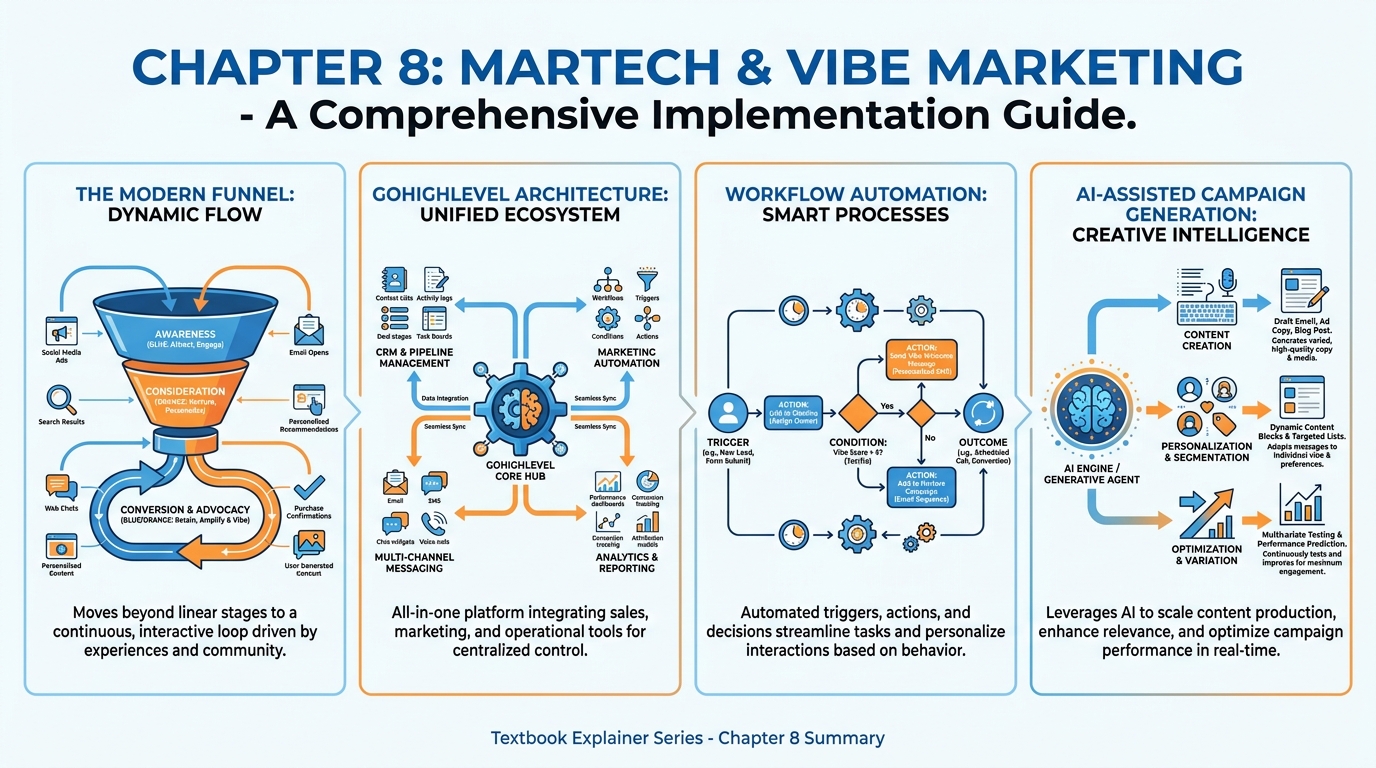
Figure 1:Chapter 8 in one frame: the modern MarTech landscape, the six-stage funnel, GoHighLevel as a complete marketing OS, vibe marketing with AI assistance, and the stack integration that ties everything from Chapter 5 through Chapter 7 together.
1Learning Objectives
By the end of this chapter, you will be able to:
Explain the consolidation thesis and why the sprawling 50-tool MarTech stack is giving way to integrated platforms.
Map the six stages of the modern funnel — Traffic, Capture, Nurture, Offer, Close, Retention — and identify the AI leverage points at each stage.
Navigate GoHighLevel as a complete marketing and sales operating system, including contacts, pipelines, workflows, calendars, and reporting.
Design and deploy at least four workflow automation patterns that convert leads into customers without manual intervention.
Practice vibe marketing — using AI to accelerate ideation, copy, and creative — while avoiding the slop problem through brand voice systems and human review gates.
Integrate the GHL stack with the Chapter 6 MVP, Chapter 7 synthetic agents, and the Chapter 5 pricing architecture.
28.1 The MarTech Landscape
The Marketing Technology landscape directory has catalogued over 14,000 software products. In 2015 the number was under 2,000. The explosion was real — and so is the hangover.
A company that followed conventional wisdom assembled a stack that might look like this: one CRM, one email platform, one SMS tool, one funnel builder, one booking calendar, one proposal tool, one review request platform, one social scheduler, one ad attribution dashboard, one analytics suite, and one customer success portal. Eleven vendors. Eleven subscriptions. Eleven sets of credentials. Eleven APIs that need to talk to each other. Eleven renewal conversations per year.
2.1Point Solutions, Platforms, and Suites
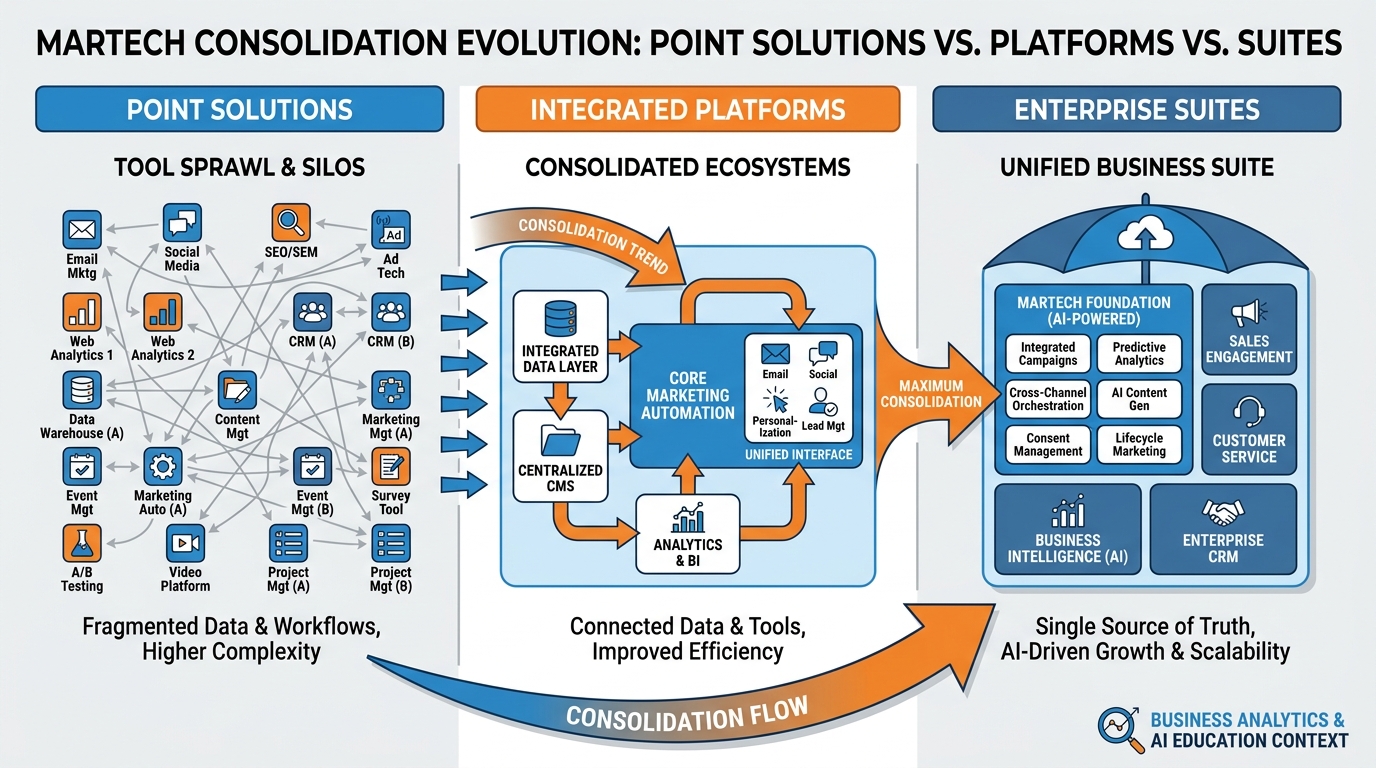
Figure 2:Three eras of MarTech: the point solution explosion of the mid-2010s, the platform layer that emerged to coordinate tools, and the integrated suite that collapses the stack into one operational layer. The consolidation arrow points right.
Point solutions solve one problem well. Calendly books appointments. Mailchimp sends emails. Stripe accepts payments. Each is excellent at its single job. The cost is integration debt: every handoff between tools is a place where data gets lost, leads fall through, and automation breaks.
Platforms add coordination. They provide a central data model and connect point solutions around it. Zapier and Make.com (formerly Integromat) are classic integration platforms — they stitch together the sprawl without eliminating it.
Suites go further. They absorb the point solutions into a single product with a unified data model, workflow engine, and reporting layer. HubSpot started as an inbound marketing platform and is now a suite covering CRM, marketing, sales, service, and operations. Salesforce built a similar empire through acquisition. GoHighLevel took a different approach: instead of going upmarket to enterprise, it built a white-label suite purpose-built for agencies and small-to-medium businesses, priced at a fraction of the enterprise alternatives.
2.2The Consolidation Thesis
The argument for consolidation is not that best-of-breed tools are bad. It’s that switching costs compound. Every tool added requires setup time, integration maintenance, team training, and produces data fragmentation as customer records scatter across systems. When one platform handles 80% of what ten tools handle, and the integration tax on the remaining 20% is lower than the cost of running ten platforms, consolidation wins.
2.3GoHighLevel as an Integrated Case Study
GoHighLevel (GHL) is the clearest current example of the consolidation thesis in practice for the SMB and agency market. A single GHL subscription gives you:
Full CRM with contacts, companies, and activity tracking
Email marketing with drag-and-drop builder and deliverability tools
SMS marketing with two-way texting
Funnel and website builder (no separate ClickFunnels needed)
Landing page A/B testing
Appointment scheduling and calendar management
Pipeline and opportunity management
Workflow automation with branching logic
Voice AI for inbound and outbound calls
Reputation management and review requests
Membership areas and course hosting
Social media planner
Reporting and attribution
The agency structure is particularly powerful: GHL uses sub-accounts, where an agency or founder can spin up a separate environment for each client or business unit, all managed from a single master account.
2.4When Alternatives Beat GHL
Best for: Agencies, coaches, consultants, service businesses, anyone building a client-facing funnel machine. GHL excels when you need the full stack — CRM + automation + funnels + Voice AI — in one place without enterprise pricing. Starting around 297/month for the agency plan with unlimited sub-accounts.
Weaknesses: The interface is dense. The learning curve is real. B2B SaaS companies with complex deal structures may find the CRM less flexible than Salesforce or HubSpot. Native analytics lack the depth of standalone tools.
Best for: B2B companies with longer sales cycles, inbound-heavy content strategies, and teams that need strong reporting out of the box. HubSpot’s free CRM tier and the depth of its Marketing Hub are genuinely excellent. The blogging and SEO tools are among the best in the market.
Weaknesses: Pricing scales steeply. Once you unlock the features that compete with GHL’s paid tiers, HubSpot becomes significantly more expensive. The funnel builder is less flexible than GHL’s drag-and-drop builder.
Best for: Email-first businesses with sophisticated automation needs and smaller budgets. ActiveCampaign’s automation builder is one of the most powerful in the market for conditional, behavior-triggered sequences. Strong for e-commerce and info-product businesses.
Weaknesses: CRM is functional but not the focus. No built-in funnel builder or SMS infrastructure comparable to GHL. Voice AI and appointment scheduling require third-party integrations.
Best for: Inside sales teams with high call volume. Close is built around the phone — its built-in calling, SMS, and email are optimized for SDR workflows where reps are doing 50+ touches per day. Power dialer, predictive dialer, and call recording are native.
Weaknesses: Not a marketing platform. You won’t build funnels or run email campaigns from Close. It works best when paired with a marketing platform upstream, making it a complementary tool rather than a consolidation play.
38.2 The Modern Funnel
Funnels exist because people rarely buy on first contact. The funnel is the system that takes a stranger and moves them, through a sequence of interactions, to becoming a paying customer and eventually a loyal advocate. Understanding each stage — and the AI leverage available at each — is foundational to everything that follows.
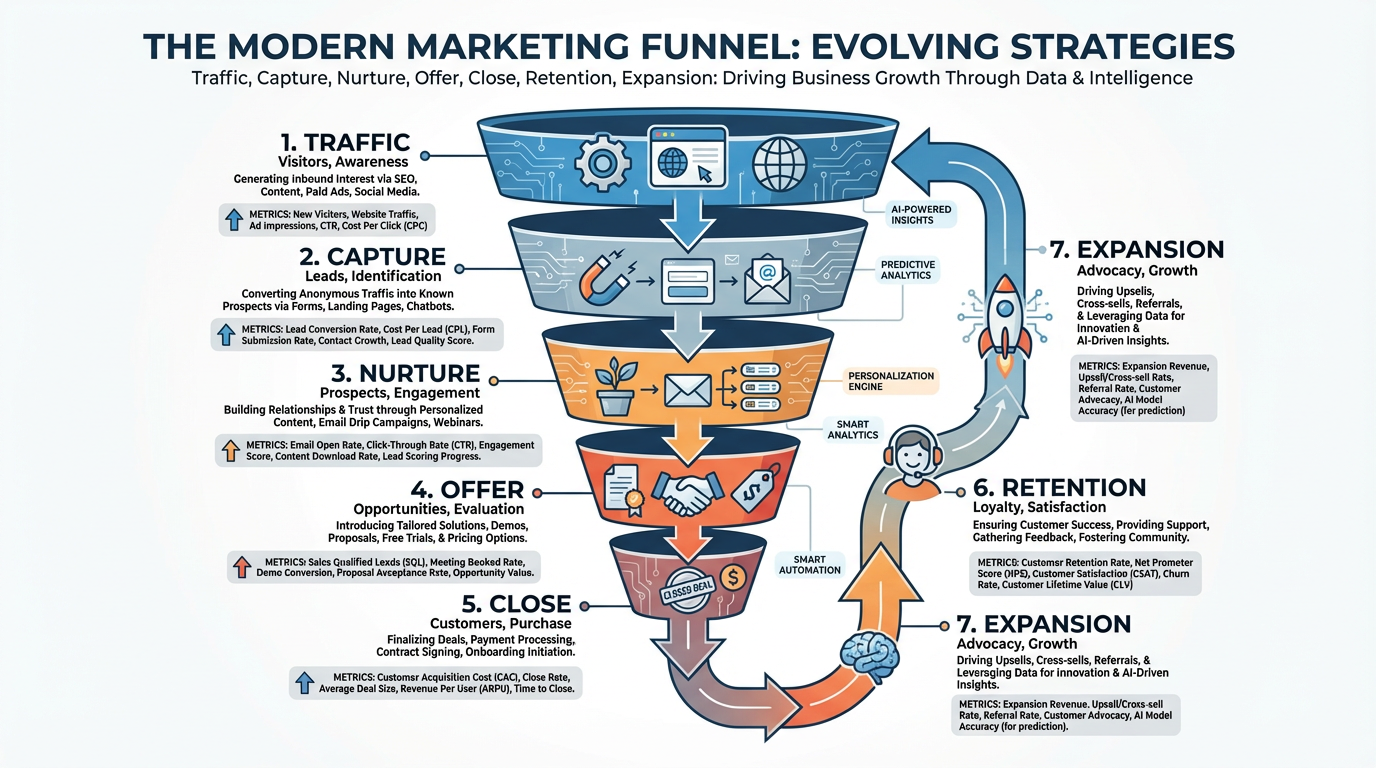
Figure 3:The six stages of the modern funnel. Each stage has a distinct job, a distinct metric, and a distinct set of AI leverage points. Most businesses over-invest in Traffic and under-invest in Retention.
3.1Traffic: The Five Channels
Traffic is not a single thing. It is a portfolio. The most resilient businesses diversify across at least three of these five channels:
Paid traffic (Google Ads, Meta Ads, YouTube Ads, LinkedIn Ads) provides predictable, scalable volume — if your unit economics hold. You control the message, the audience, and the timing. You pay per click or impression. AI tools now assist at every layer: audience research, creative generation, bid optimization, and performance reporting.
Organic traffic (SEO, YouTube, podcasting, long-form content) compounds over time. An article that ranks on page one today generates leads for years without additional spend. The investment is time and quality — and AI dramatically compresses the time cost of producing high-quality content.
Referral traffic comes from existing customers, affiliates, and partners who send you leads because it benefits them. Referral programs, affiliate structures, and partner integrations all fall here. Conversion rates from referrals typically exceed paid traffic significantly because trust transfers.
Partner traffic is a deliberate business development channel — co-marketing agreements, podcast appearances, newsletter swaps, joint webinars. Each partner gives you access to their existing audience.
Community traffic grows from owned or participated-in communities: a Facebook group, a Discord server, a Slack community, a LinkedIn following. Community channels are high-trust but slow to build.
3.2Capture: Lead Magnets That Earn the Email
A lead magnet is an exchange: the visitor gives you their email address; you give them something valuable. The operative word is valuable. The internet is saturated with generic PDF guides and checklists that no one opens.
A lead magnet that actually earns the email solves a specific, urgent problem for a specific person in a format they can consume in under fifteen minutes. The best lead magnet formats in the current environment are:
Interactive calculators (ROI calculator, pricing estimator, savings projector)
Audit tools (a questionnaire that scores the visitor’s current state and produces a personalized report)
Swipe files and templates (things they can copy, paste, and deploy immediately)
Mini-courses (a 3–5 email sequence delivered over a week that genuinely teaches something)
Waitlist with social proof (scarcity and FOMO as the magnet)
AI accelerates lead magnet creation dramatically. A skilled prompt engineer can produce a credible 10-page guide, a functioning calculator template, or a swipe file in hours rather than weeks.
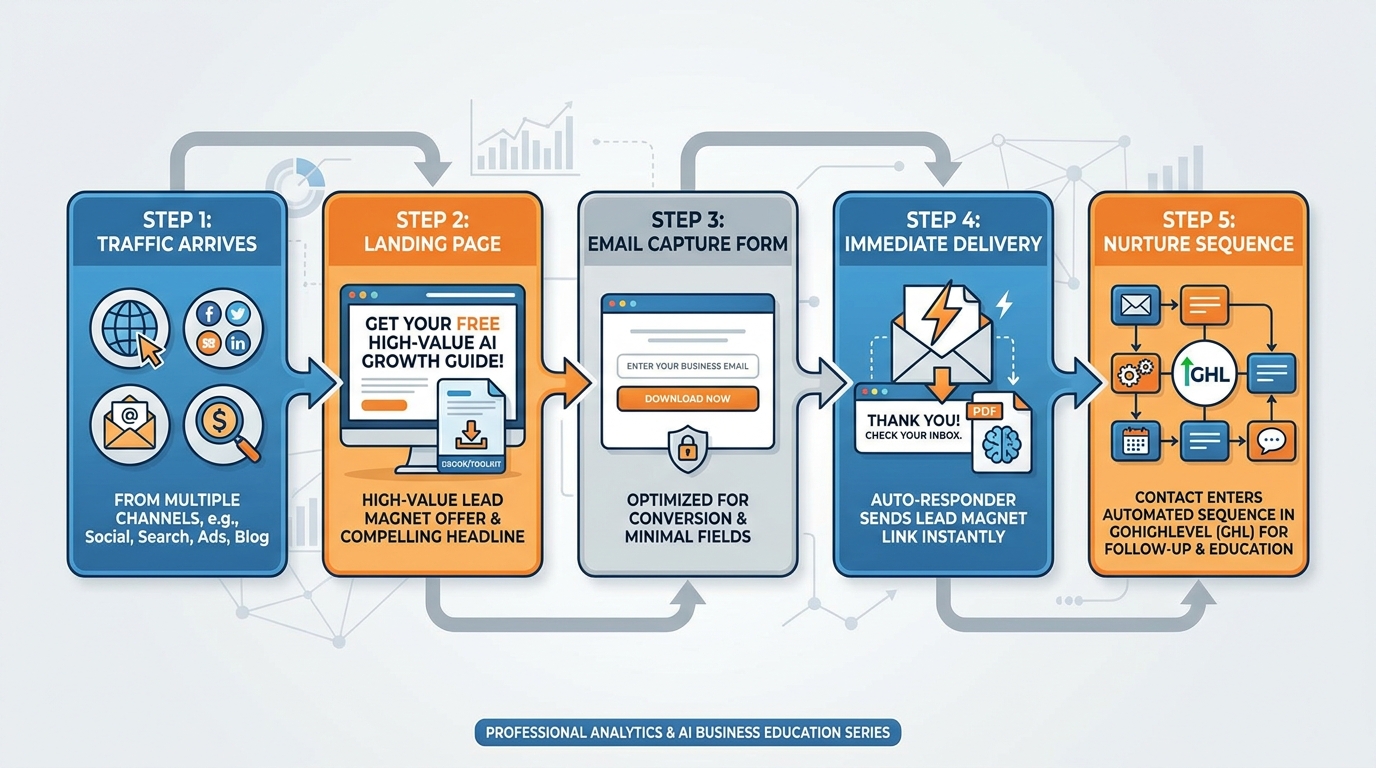
Figure 4:The capture flow: traffic arrives at a landing page, encounters a high-value lead magnet offer, exchanges email for access, and is immediately routed into the first nurture sequence. Each step can be automated inside GHL.
3.3Nurture: Sequences That Educate, Not Pester
Nurture is where most businesses fail. They capture the email and then send a weekly newsletter that reads like a company announcement, or they go dark for two months and then blast a sales email that feels like it came from a stranger.
A nurture sequence’s job is to advance belief. Every email should move the subscriber one step closer to believing that (a) their problem is real and urgent, (b) your approach to solving it is credible, and (c) your offer is the right vehicle. That is three distinct jobs — and they require a planned sequence, not a random stream.
The baseline nurture architecture:
Immediate delivery email — delivers the lead magnet, sets expectations for what comes next
Problem articulation email — names the specific pain in their own language; no pitch
Mechanism email — introduces your unique approach to solving the problem
Social proof email — a case study or testimonial that demonstrates the mechanism working
Offer introduction email — introduces the product or service as the natural next step
Objection handling email — addresses the top two or three reasons people hesitate
Call to action email — a clear, specific ask with a deadline or reason to act now
3.4Offer, Close, Retention
The Offer is the bridge between interest and revenue. The offer must have a clear mechanism (how it works), a clear outcome (what they get), a clear price (what it costs), and a clear reason to act now (why not wait). An AI product can help generate offer language, test headlines on landing pages, and optimize CTAs — but the underlying offer logic must be sound.
The Close happens at a moment of high intent. It might be a checkout page, a proposal sent after a discovery call, a DocuSign contract, or a pricing page reached after a free trial. The job at this stage is to eliminate friction, reduce fear, and make the next action obvious.
Retention and Expansion is where the economics become remarkable. Acquiring a new customer costs five to seven times more than retaining an existing one. The entire CAC invested in getting someone to close can be recovered many times over if they stay, expand, and refer. Onboarding sequences, success check-ins, upsell workflows, and referral programs all live here — and all can be automated inside GHL.
48.3 GoHighLevel Architecture
GHL is best understood as an operating system for marketing and sales — not a single application but a unified environment in which multiple applications run. This section is a working tour.
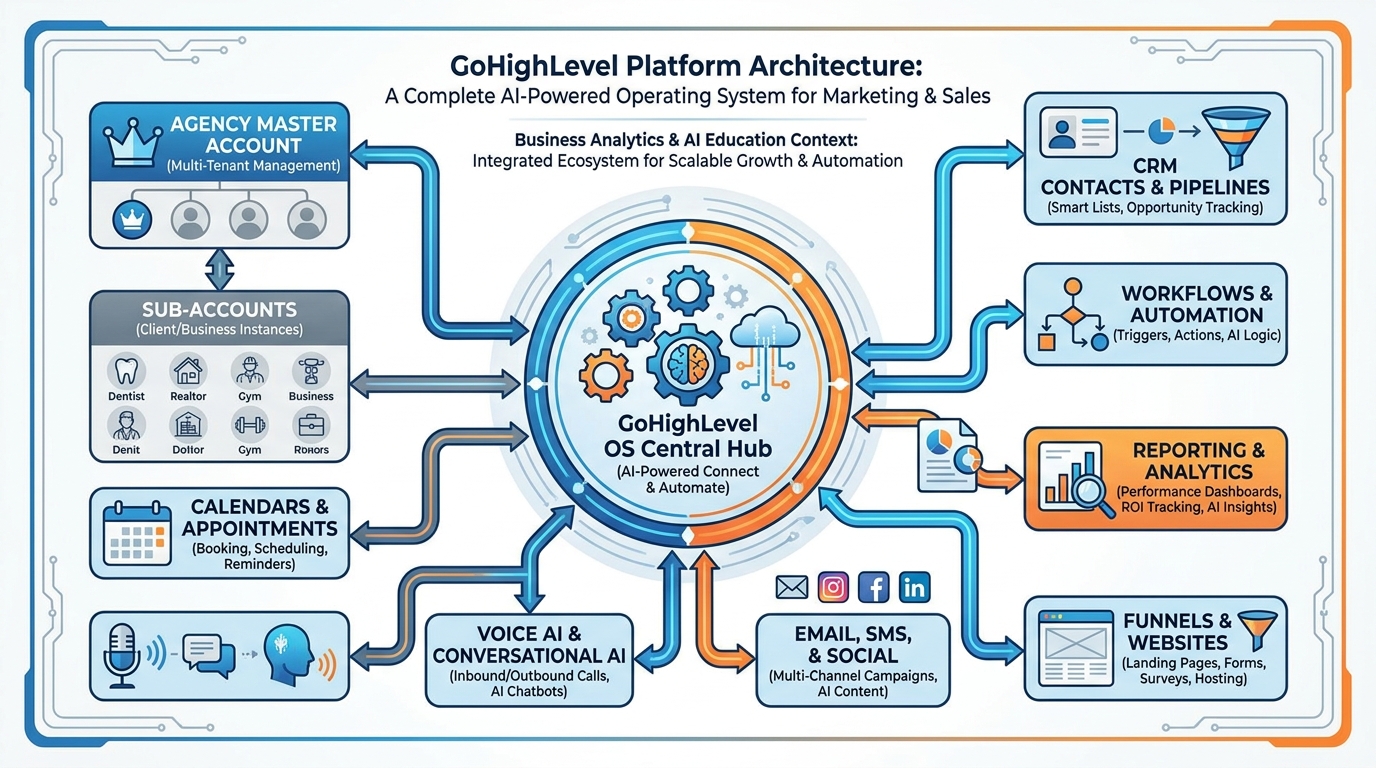
Figure 5:GoHighLevel’s architecture: a central contact and pipeline data model with specialized modules for every marketing and sales function. Sub-accounts allow agencies to manage multiple clients from one master environment.
4.1Sub-Accounts and Agency Structure
The GHL agency account holds unlimited sub-accounts — each a fully isolated environment with its own contacts, funnels, workflows, and settings. An agency builds a business by reselling access to sub-accounts. A founder with multiple brands creates a sub-account per brand. A course creator who works with clients builds their client’s entire funnel inside a dedicated sub-account, then hands it off.
4.2Contacts and Custom Fields
Every person in your GHL environment is a contact — a record that holds standard fields (name, email, phone, address) plus unlimited custom fields you define. Custom fields are the power. They let you tag contacts with business-specific data: lead source, funnel stage entered, products owned, lead score, appointment status, lifetime value.
Smart lists (dynamic segments) let you slice your contact database by any combination of fields. The lead who entered through the Facebook ad, booked a call, and has the tag “no-show” is a distinct segment from the lead who booked and attended — and they get different follow-up sequences.
4.3Pipelines and Opportunity Management
A pipeline is a visual board of opportunities — deals moving through named stages toward won or lost. Stages might be: New Lead → Contacted → Qualified → Proposal Sent → Negotiation → Won / Lost. Each opportunity belongs to a contact and a pipeline. When an opportunity moves to Won, a workflow fires that triggers onboarding.
GHL supports multiple pipelines — one for the main sales process, one for partnership development, one for renewal conversations. Opportunities carry monetary values, so the pipeline gives you a real-time revenue forecast.
4.4Workflows: The Automation Engine
Workflows are GHL’s most powerful feature. A workflow is a sequence of triggers and actions that executes automatically based on contact behavior or system events. A trigger fires when something happens (form submission, tag added, appointment booked, missed call, date reached). An action does something (send email, send SMS, add tag, move opportunity stage, assign to user, wait X days, call webhook).
The combination produces automation patterns of arbitrary sophistication. The new lead who submits a form gets an immediate text, enters a nurture sequence, is assigned to a sales rep, and gets a calendar invite — all without a human touching anything.
4.5Calendars and Appointment Booking
GHL’s calendar module handles individual and team booking, round-robin assignment, class/group scheduling, and service menus. Every calendar generates a booking link. When someone books, a confirmation goes out, reminders fire automatically, and the contact record updates.
The calendar connects to workflows bidirectionally: booking triggers a workflow, and a workflow can create or cancel bookings.
4.6Voice AI and Conversational AI
GHL’s Voice AI handles inbound and outbound calls using conversational AI. An inbound Voice AI agent can qualify leads, answer FAQs, collect information, and book appointments — without a human on the line. An outbound Voice AI agent can call a list of leads, confirm appointments, or conduct brief qualification surveys.
This connects directly to Chapter 7’s synthetic employees: the Voice AI layer in GHL is one implementation path for deploying the SDR agent designed in the previous chapter.
4.7Email, SMS, and Social Planner
GHL provides native email sending with deliverability management, a two-way SMS inbox with conversation view, and a social planner that queues posts to Instagram, Facebook, LinkedIn, TikTok, and Google Business Profile. All three channels are managed from the same contact record, so you can see the full interaction history regardless of channel.
4.8Funnels, Websites, and Membership Areas
The GHL funnel builder is a drag-and-drop page editor that produces multi-step opt-in flows, sales pages, upsell sequences, and thank-you pages. Pages host on GHL’s CDN. Split testing is built in. Order bumps, upsells, and downsells are native.
The website builder extends this to multi-page sites. The membership area module delivers courses, coaching programs, and gated content.
4.9Reporting and Attribution
GHL’s reporting covers pipeline metrics, email and SMS performance, funnel conversion rates, appointment statistics, and revenue summaries. The attribution model tracks which source drove each contact, so you can calculate CAC by channel.
Deep Dive: Understanding GHL’s Trigger/Action Model
GHL workflows have four categories of triggers:
Contact-based triggers fire when something changes on a contact record: a tag is added or removed, a custom field value changes, a form is submitted, a survey is completed, a payment is made.
Calendar triggers fire on booking events: appointment booked, appointment confirmed, appointment no-showed, appointment cancelled.
Conversation triggers fire on communication events: inbound SMS received, email opened, email link clicked, review received.
Date/time triggers fire on schedules: a contact’s birthday, a renewal date stored in a custom field, a fixed date and time.
Actions fall into six families:
Communication actions — send email, send SMS, make a call, send a voicemail drop, send a direct message
Contact actions — add/remove tag, update custom field, assign to user, add to or remove from campaign
Pipeline actions — create opportunity, move opportunity stage, update opportunity value
Internal actions — create task, create note, assign conversation, notify user
Integration actions — call webhook, run GoHighLevel AI, trigger sub-workflow
Timing actions — wait (fixed time), wait (until condition), go to step
The wait-until-condition action is particularly powerful. Rather than waiting a fixed number of days, the workflow waits until the contact opens an email, books an appointment, or crosses a threshold — then fires the next action immediately.
58.4 Workflows That Actually Work
The gap between a GHL account and a GHL-powered business is workflow design. Here are the seven patterns that students implement in this chapter, moving from simple to sophisticated.
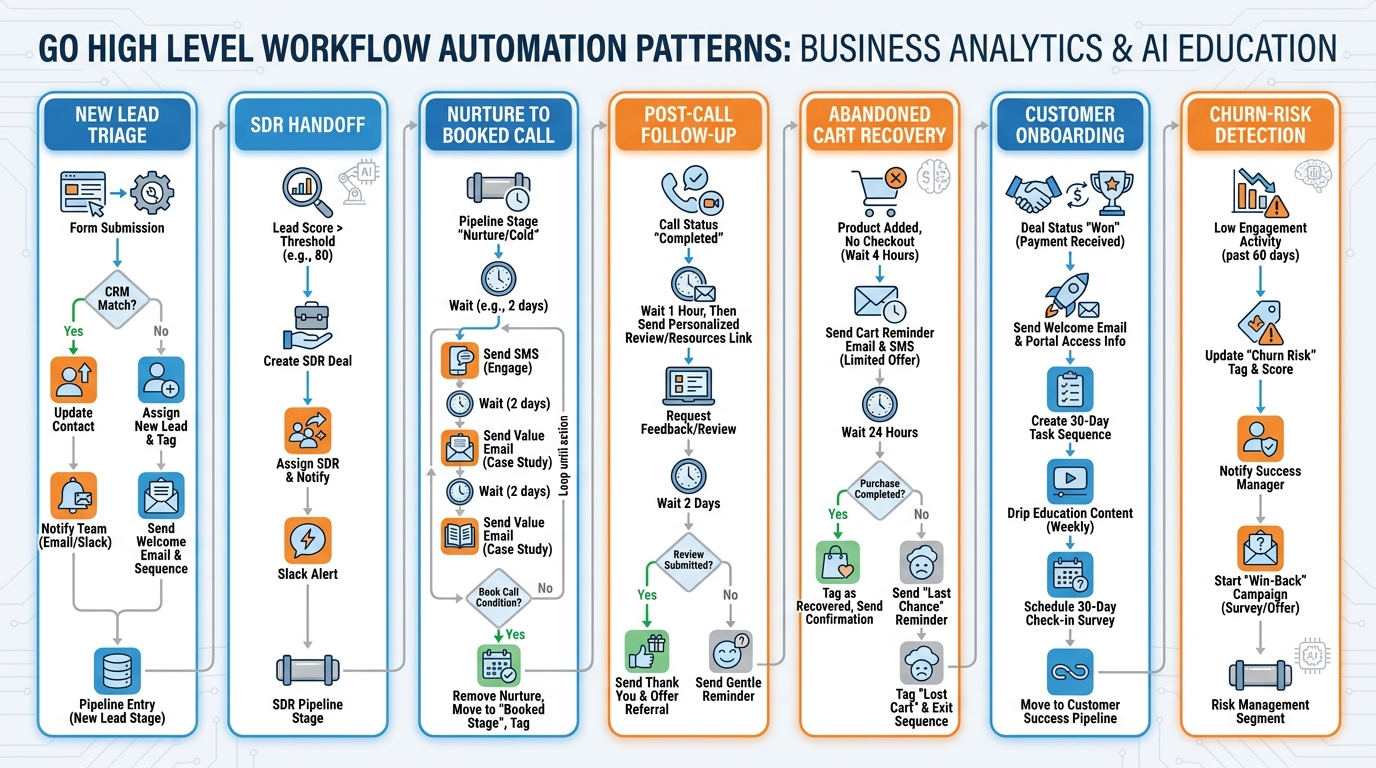
Figure 6:The seven workflow patterns every GHL implementation should include. Each pattern handles a specific conversion moment — from first contact through retention — without human intervention.
Pattern 1: New Lead Triage. Trigger: form submission. Actions: immediate SMS confirmation, internal notification to assigned rep, create opportunity at Stage 1, start nurture sequence, and if no reply in 24 hours, send follow-up SMS. No lead goes cold because a rep was busy.
Pattern 2: SDR Handoff. Trigger: tag “sales-ready” added by a qualifying workflow or the synthetic SDR from Chapter 7. Actions: move opportunity to Qualified, assign to user, create task “Call within 2 hours,” send calendar booking link. The tag bridges the automated qualification layer and the human sales layer.
Pattern 3: Nurture to Booked Call. Trigger: sequence entry. Actions: the seven-email sequence from 8.2, each separated by wait steps. Conditional branch: if the contact books a call at any point, exit the sequence and enter the post-booking flow. If they exhaust the sequence without booking, shift to monthly value cadence.
Pattern 4: Post-Call Follow-Up. Trigger: appointment status → “completed.” Actions: thank-you email with recap, proposal workflow if tag “proposal-requested” exists, follow-up SMS in 48 hours if no reply. Conditioning on call outcomes requires tagging inside or immediately after the call.
Pattern 5: Abandoned-Cart Recovery. Trigger: checkout started but not completed. Actions: immediate email with cart link, 4-hour SMS with urgency framing, 24-hour objection-handling email, 72-hour final email with bonus or discount. Among the highest-ROI automations in digital product businesses.
Pattern 6: Customer Onboarding. Trigger: payment received / opportunity Won. Actions: welcome email with access and quick-start guide, day-3 resource email, day-7 kickoff call invitation, day-14 satisfaction survey, day-30 testimonial request. Strong onboarding reduces churn and generates referrals.
Pattern 7: Churn-Risk Detection. Trigger: no opens, logins, or calendar activity for a defined window. Actions: internal alert to account manager, personal re-engagement email, check-in call offer. Intervening at disengagement is far cheaper than win-back.
68.5 Vibe Marketing
Vibe marketing is AI-assisted marketing creation — using large language models, image generation, and multimodal tools to produce campaign content at a pace and scale that was impossible for a solo founder or small team before these tools existed.
The term deliberately parallels vibe coding from Chapter 6. Just as vibe coding allows a non-engineer to build software by directing an AI, vibe marketing allows a non-designer, non-copywriter, and non-strategist to build campaigns by directing AI tools. The skill is not writing; it is directing.
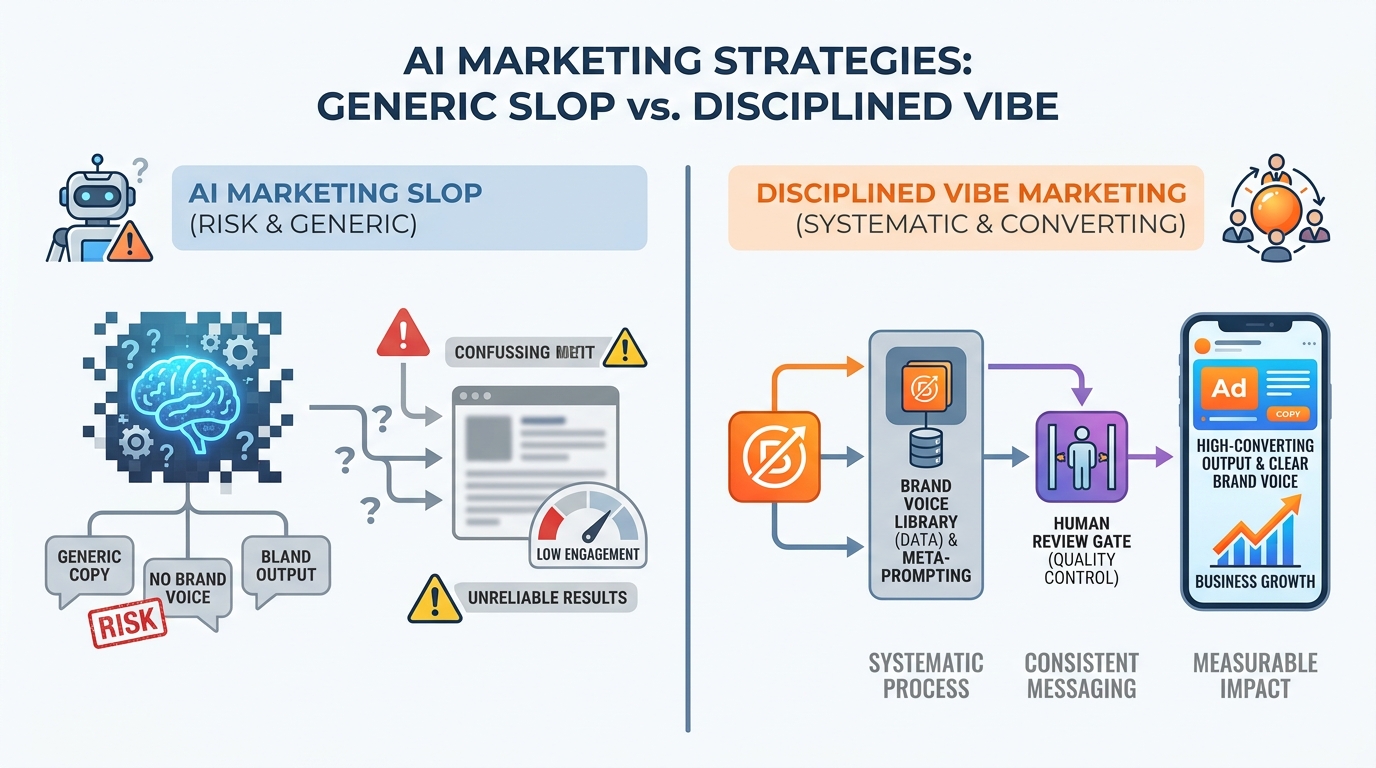
Figure 7:The slop problem vs. disciplined vibe marketing: the difference is not the model — it’s the system. Brand voice libraries, meta-prompting, and human review gates separate generic AI output from content that actually converts.
6.1AI-Assisted Ideation, Copy, and Creative
The creative workflow for a vibe marketer looks like this:
Brief — define the audience, the problem, the offer, the channel, and the desired action
Ideate — generate 20 headline variations, 10 angle concepts, 5 image concepts
Filter — apply brand voice, strategic judgment, and audience insight to select the best 3–5
Develop — expand the selected concepts into full ad creative, email copy, or landing page content
Review — human review gate: does this represent us accurately? is it true? is it on-brand?
Launch — publish to GHL social planner, email campaign, or ad platform
Measure — track open rates, CTRs, conversion rates; feed results back into the next brief
AI compresses steps 1–4 dramatically. A brief that used to require a creative agency and two weeks of iteration can now be turned into three ad variants in an afternoon. The leverage is real.
6.2The Slop Problem
The slop problem is the inevitable downside of AI at scale: when everyone uses the same tools on the same briefs, the outputs converge. Generic, fluent, inoffensive, and utterly forgettable content floods every channel. It reads right but feels hollow.
Slop is not a model problem — it is a system problem. Generic prompts produce generic output. Inputs that could have come from anyone produce content that sounds like it came from no one.
6.3Brand Voice Enforcement
The antidote to slop is a brand voice system — a documented set of constraints that shape AI output toward a specific, recognizable voice. A functional brand voice system for AI-assisted marketing includes:
Voice profile — three to five adjectives that define the tone, with positive and negative examples
Audience vocabulary — the specific words your audience uses to describe their problems and goals
Brand-specific concepts — proprietary frameworks, coined terms, recurring metaphors
Off-limits language — phrases, framings, and topics that contradict the brand or mislead the audience
Prompt library — pre-written system prompts and few-shot examples that anchor every generation task
Every AI generation task should start from the prompt library, not a blank screen.
6.4Human-in-the-Loop Review Gates
Volume and speed are the gifts of AI-assisted content production. But volume without quality control is the definition of slop at scale. Every vibe marketing workflow should include at least one human review gate — a point at which a person reads, evaluates, and approves content before it publishes.
The review gate is not a bottleneck; it is the quality signal. The human reviewer’s job is not to rewrite the AI output but to approve, flag, or discard it. A reviewer who can process 20 AI-generated pieces per hour and approve the best 30% is operating at a leverage multiple no agency can match.
6.5Attribution in an AI-Saturated Channel
When AI-assisted content floods every channel, attribution becomes harder. Multi-touch attribution models, UTM parameter discipline, and first-party data collection (pixels, server-side tracking, direct survey questions) become competitive advantages. GHL’s built-in attribution — first-touch source, last-touch source, and the full contact history — is a starting point. For businesses with significant ad spend, connecting GHL to a dedicated attribution tool becomes worthwhile.
78.6 Integrating the Stack
Chapters 5 through 7 each built a piece. This chapter connects them.
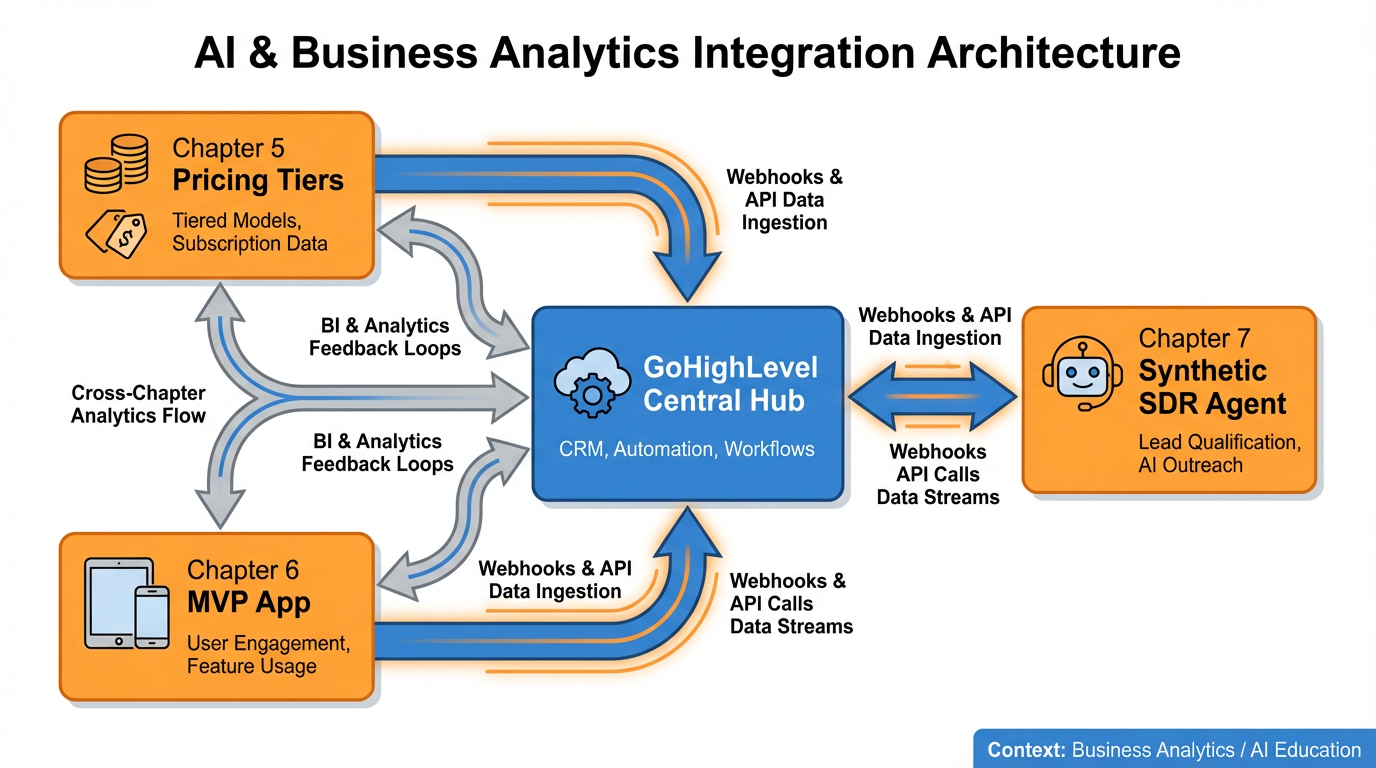
Figure 8:The full stack integration: the Chapter 6 MVP fires webhooks into GHL when users take action. The Chapter 7 synthetic SDR adds tags and moves pipeline stages. The Chapter 5 pricing tiers map to GHL products and triggers post-purchase onboarding flows.
Chapter 6 MVP → GHL Webhook. Your vibe-coded MVP can fire an HTTP POST to a GHL webhook URL whenever a user completes a meaningful action: signs up, upgrades, invites a teammate, or churns. GHL receives the webhook, identifies the contact by email, and triggers the appropriate workflow. A new signup fires the onboarding sequence. A churn event fires the win-back sequence.
Chapter 7 Synthetic SDR → GHL Pipeline. The synthetic SDR from Chapter 7 qualifies leads via conversation. At the end of a qualifying conversation, the SDR agent calls the GHL API to (1) update custom fields with qualification data, (2) add the “sales-ready” tag, and (3) move the opportunity to the appropriate pipeline stage. The human sales rep sees a pipeline populated with qualified opportunities, each with conversation context attached, without ever having touched the raw lead queue.
Chapter 5 Pricing Tiers → GHL Product Catalog. The three pricing tiers designed in Chapter 5 map directly to GHL products. Each product has a price, a payment link, and associated tags. When a contact purchases a specific tier, GHL fires the tier-appropriate onboarding sequence, grants membership area access at the corresponding level, and sets a custom field that personalizes all subsequent communication.
GHL Voice AI → Synthetic Employee Voice Layer. GHL’s Voice AI becomes one deployment surface for the Chapter 7 synthetic employee concept. The Voice AI configuration — personality, knowledge base, escalation rules — mirrors the synthetic employee playbook. An inbound caller reaches a Voice AI agent that qualifies, answers FAQs, books appointments, and escalates to a human when genuinely needed.
8Case Study: One Founder, Seven Figures, a Team of Agents
The Business: An online professional development platform selling certification programs and coaching packages to mid-career professionals. Annual revenue exceeds seven figures. Full-time human employees: one — the founder.
The Stack: GoHighLevel as the connective tissue, with the following architecture:
Traffic: Google Search Ads (primary), LinkedIn Ads (secondary), SEO-driven blog (compounding), podcast appearances (referral), alumni referral program
Capture: A free ROI calculator built in GHL forms that tells professionals how much a certification in their field increases median salary. Email address required for results.
Nurture: A seven-email sequence that educates about the certification landscape, establishes the founder’s methodology, introduces the programs, handles the top five objections, and ends with a booking link.
Offer and Close: A 45-minute video sales letter on the program landing page, followed by a calendar booking for a “Certification Strategy Session” with the founder’s synthetic SDR agent (built on the Chapter 7 stack). Qualified prospects who meet the criteria receive a proposal automatically.
Onboarding: A 30-day automated sequence using GHL workflows, delivering content via email and SMS, granting access to the membership area, and scheduling weekly check-ins.
Retention: Monthly value emails, quarterly surveys, an active alumni community in GHL’s membership area, and an automated upsell sequence that introduces the advanced certification track at the 90-day mark.
Operations: Bookkeeping agent (reads Stripe, categorizes transactions), customer success agent (monitors engagement scores in GHL, flags at-risk students), content agent (produces first drafts of blog posts and email sequences from the founder’s voice profile).
The Result: The founder spends 15–20 hours per week on the business — primarily on coaching calls, content review, and strategic decisions. Everything else is automated or agent-assisted. The business generates revenue every day including weekends, holidays, and vacations.
The lesson: The leverage is not in any individual tool. It is in the integration — the fact that every system talks to every other system through GHL, so no lead falls through a gap, no customer goes dark undetected, and no revenue opportunity goes unfollowed.
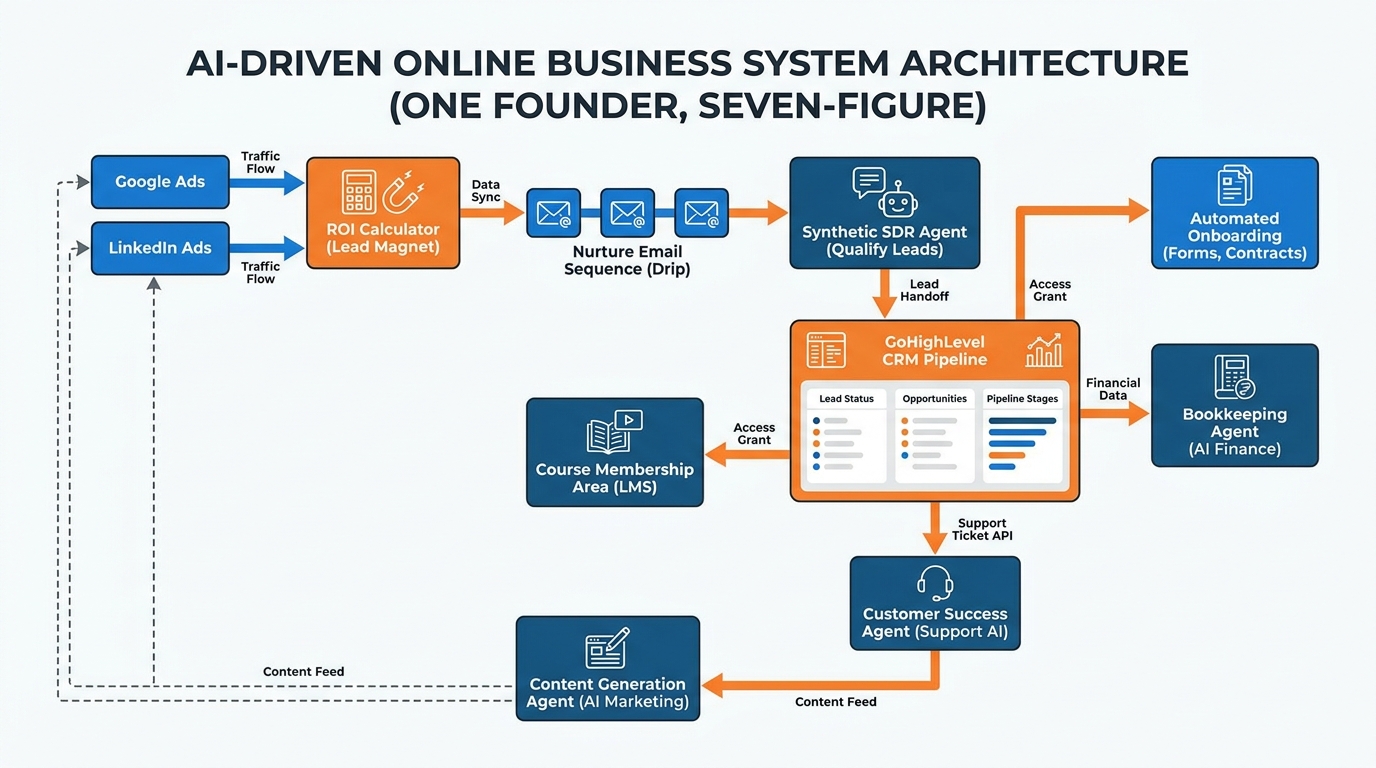
Figure 9:The full architecture of the one-founder seven-figure business. Every component feeds data into GHL, and GHL drives action across every customer-facing channel. The founder touches only the decisions that genuinely require human judgment.
9Lab 8: Sales and Marketing in a Box
This lab produces a complete, live marketing and sales system for your Chapter 6 MVP connected to your Chapter 7 agent stack.
9.1Prerequisites
Chapter 6 MVP is live (or testable via staging URL)
Chapter 7 synthetic SDR is configured
A GoHighLevel trial account or sub-account (free 14-day trial available at gohighlevel.com)
9.2Task 1: Build and Publish the Funnel
Build a two-step opt-in funnel for your MVP inside GHL. Page 1 is the lead magnet offer — a resource that solves a real problem your ICP faces, based on your Chapter 2 and Chapter 3 work. Page 2 is the thank-you / confirmation page with the next step clearly stated. Publish the funnel and confirm it is live at a GHL-hosted URL.
Meta-prompt starter: “I need to build a lead magnet landing page for [describe your MVP and ICP]. Expand this into a thorough prompt I can use to generate full landing page copy including headline, subheadline, three benefit bullets, social proof element, and CTA button text. The tone should be [describe your brand voice]. The audience’s primary pain point is [describe it].”
Deliverable: Published funnel URL (submitted to instructor for verification).
9.3Task 2: Capture Form with Automation
Add a capture form to your funnel’s opt-in page. Connect the form to a workflow that (1) sends an immediate confirmation email delivering the lead magnet, (2) sends an immediate SMS confirming receipt, and (3) creates an opportunity in your pipeline at Stage 1. Test by submitting your own email and confirming all three actions fire within 5 minutes.
Deliverable: Screenshot of workflow trigger history showing three actions fired on test submission.
9.4Task 3: Nurture Sequence — Minimum Five Touches
Build a nurture sequence of at least five emails, spaced appropriately (suggested: Day 0 delivery, Day 2 problem, Day 4 mechanism, Day 7 social proof, Day 10 offer). Each email must have a subject line, preview text, and body copy written with your brand voice prompt library. Include one conditional branch: if the contact books a call at any point, remove them from the sequence.
Deliverable: Screenshot of completed workflow showing all five emails and the conditional branch.
9.5Task 4: Pipeline with Named Stages
Create a pipeline for your MVP with a minimum of five named stages relevant to your sales process. Suggested stages: New Lead → Contacted → Qualified → Proposal Sent → Won / Lost. Move at least three test contacts through the pipeline manually to verify stage transitions and confirm that stage-triggered workflows fire.
Deliverable: Screenshot of pipeline board with at least three opportunities across multiple stages.
9.6Task 5: Integration with Chapter 7 Agent
Connect your Chapter 7 synthetic SDR to GHL. When the SDR qualifies a lead, it should call the GHL webhook to add the “sales-ready” tag and move the opportunity to the Qualified stage. Test the integration end-to-end: a form submission triggers the SDR conversation, the SDR qualifies the lead, the webhook fires, and the pipeline updates automatically.
Deliverable: Screenshot of contact record showing the “sales-ready” tag and pipeline stage updated by the agent, plus the webhook call log.
10AI Studio Build (Weekly): The Multimodal Campaign Generator
Capability Introduced: Multimodal inputs and vision-grounded generation.
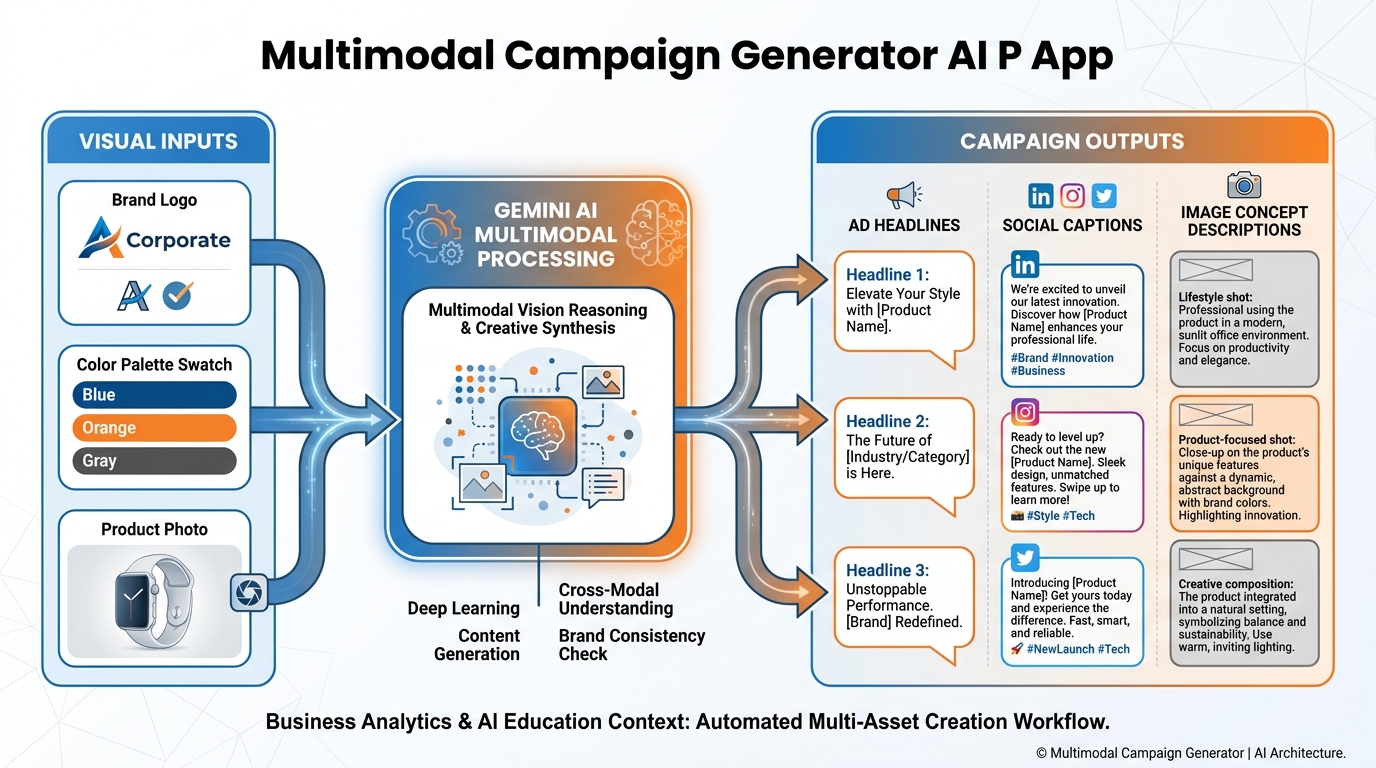
Figure 10:The Multimodal Campaign Generator: brand visual inputs (logo, color palette, product photo) plus a target audience description feed into a Gemini-powered app that generates ad headlines, social captions, and image concept descriptions grounded in the uploaded visuals.
Build a Gemini-powered application in Google AI Studio that accepts both visual and text inputs to generate a complete campaign asset set.
10.1App Requirements
Inputs (all required):
Brand logo image upload
Color palette reference image upload
Hero product or service photo upload
Target audience description (free-text field, 100+ words)
Campaign objective (awareness / lead generation / conversion)
Outputs (generated by Gemini reasoning over the visuals):
Three distinct ad headlines (each under 60 characters)
Three social media captions (platform-matched: one for LinkedIn, one for Instagram, one for Twitter/X)
Concept descriptions for three image variants (detailed enough for a visual AI tool to generate them)
Key requirement: The app must reference specific elements from the uploaded images in its output — color names, visual style descriptors, product attributes visible in the photo. An output that could have been generated without the images does not meet the requirement.
10.2Build Steps
Open Google AI Studio and create a new prompt.
Set the model to Gemini (no specific version required; use the most capable available).
In the system prompt, define the assistant’s role: a senior creative director with deep expertise in direct response marketing and visual brand identity.
Configure the prompt to accept image inputs alongside the text description.
Write a meta-prompt that instructs the model to (a) analyze the visual inputs first, (b) extract brand personality signals from the logo and color palette, (c) identify the key visual selling attributes of the product photo, and then (d) generate the output campaign assets grounded in those observations.
Test with your own brand assets from Chapter 2/3 work.
Export the share link for your configured prompt.
10.3Deliverables
AI Studio share link — the configured prompt accessible to the instructor.
Campaign assets that went live — the three headlines, three captions, and image concepts you generated and actually deployed in your GHL campaign (Task 3 nurture sequence or a paid/organic social post). Include screenshots showing the content live in GHL or your social platform of choice.
11Discussion Prompts
11.1Prompt 1: The Consolidation Bet
The consolidation thesis holds that integrated platforms will continue to gain market share from point solution stacks. But history offers counterexamples: enterprise software suites have repeatedly been disrupted by specialized upstarts that did one thing dramatically better. Critically evaluate the consolidation thesis for the SMB MarTech market over the next five years. Under what conditions does consolidation win? Under what conditions does the point solution insurgency reassert itself? Draw on at least two scholarly sources on platform economics or technology market structure to support your argument.
Response guidelines: Your initial post should be 350–450 words. It should take a clear position (consolidation wins / insurgency wins / conditional on X) and defend it with evidence. Cite at least two scholarly sources published no more than two years ago. Respond to at least two peers with substantive engagement — not agreement or disagreement alone, but an extension, challenge, or synthesis of their argument.
11.2Prompt 2: The Ethics of Automated Persuasion
A well-designed nurture sequence, executed by GHL workflows and written by AI, can guide a prospect through a belief-change journey without any human ever reading their responses or adapting to their specific situation. At what point does automated persuasion cross from helpful marketing into manipulation? What obligations does a founder have to disclose that a sequence is AI-generated and automated? Where do you draw the line in your own business? Ground your argument in at least two scholarly sources on persuasion ethics or digital marketing ethics.
Response guidelines: Your initial post should be 350–450 words and should address all three questions with intellectual honesty — including an acknowledgment of where your own line is and why. Cite at least two scholarly sources published no more than two years ago. Respond substantively to at least two peers, with particular attention to points where your ethical lines diverge from theirs.
12Readings
GoHighLevel University — official GHL training resource covering all major platform features
HubSpot Marketing Blog — current best practices on funnel design, email marketing, and lead generation
Cialdini, R. B. (1984/updated). Influence: The Psychology of Persuasion — the foundational text on ethical persuasion principles; directly relevant to nurture sequence design
ActiveCampaign Blog: Email Automation — practical deep-dives on automation architecture
MarTech Alliance — industry research and practitioner case studies on marketing technology consolidation
Close Blog: Sales Automation — inside sales automation patterns, directly applicable to GHL pipeline design
Google AI Studio Documentation — reference for the AI Studio Build task
13Glossary
Attribution — The process of assigning credit to marketing channels and touchpoints that contributed to a conversion. First-touch, last-touch, and multi-touch are the three main models.
Abandoned Cart Recovery — An automated workflow triggered when a prospect begins checkout but does not complete a purchase, typically a 2–4 message follow-up sequence.
Brand Voice System — A documented set of constraints — tone descriptors, vocabulary, off-limits language, and AI prompt libraries — that shapes generated content toward a recognizable brand identity.
Churn-Risk Detection — A workflow pattern that monitors engagement signals and fires an intervention when a contact goes dark beyond a defined threshold.
Consolidation Thesis — The argument that integrated MarTech platforms gain market share over multi-tool stacks by reducing integration debt, switching costs, and operational complexity.
Contact Record — The central data object in a CRM, holding all information and interaction history for a single person or company.
CRM (Customer Relationship Management) — Software that manages a company’s interactions with customers, organizing contacts, communications, and deal pipelines.
Custom Fields — User-defined data fields on contact records capturing business-specific information beyond standard name/email/phone.
Funnel — The full sequence of stages a prospect moves through from first awareness to becoming a loyal customer and advocate.
GoHighLevel (GHL) — An all-in-one marketing and sales platform for agencies and SMBs, combining CRM, email/SMS, funnel builder, scheduling, workflow automation, and Voice AI in one subscription.
Human-in-the-Loop (HITL) — A design pattern in which a human reviews, approves, or overrides AI outputs at defined checkpoints before publication or execution.
Lead Magnet — A free resource offered in exchange for a prospect’s contact information. Effective lead magnets solve a specific, urgent problem for a specific audience.
MarTech — Marketing Technology. The broad category of software used to plan, execute, measure, and optimize marketing activities.
Meta-Prompting — Using an AI model to expand or improve a prompt before submitting it to another generation task. Asking Claude to “expand this one-liner into a thorough creative brief” is meta-prompting.
Nurture Sequence — A planned series of automated messages designed to advance a prospect’s beliefs about their problem, available solutions, and a specific offer over time.
Opportunity — In a CRM pipeline, an individual deal record tracking a potential sale through named stages toward won or lost.
Pipeline — A visual board of deals in progress, organized by stage, used to manage the sales process and forecast revenue.
Point Solution — A software product that solves one specific problem. Calendly (scheduling), Mailchimp (email), and Stripe (payments) are examples.
Slop — Fluent but generic AI-generated content that lacks brand specificity, authentic voice, or genuine insight — the predictable output of generic prompts at scale.
Smart List — A dynamic contact segment that automatically includes or excludes contacts based on real-time field values and tags.
Sub-Account — In GHL’s agency model, an isolated environment within a master account for a separate client or business unit.
Vibe Marketing — AI-assisted marketing creation using language models, image generation, and multimodal tools to produce campaign content at a pace previously requiring agency-scale resources.
Voice AI — A system capable of conducting real-time voice conversations — qualifying leads, booking appointments, answering FAQs — without a human operator.
Webhook — An HTTP callback triggered by a system event, passing data in real time from one platform to another.
Workflow — In GHL, an automated sequence of triggers and actions that executes based on contact behavior or system events, replacing manual follow-up.