“‘Small businesses’ is not a customer. It is a census category.”
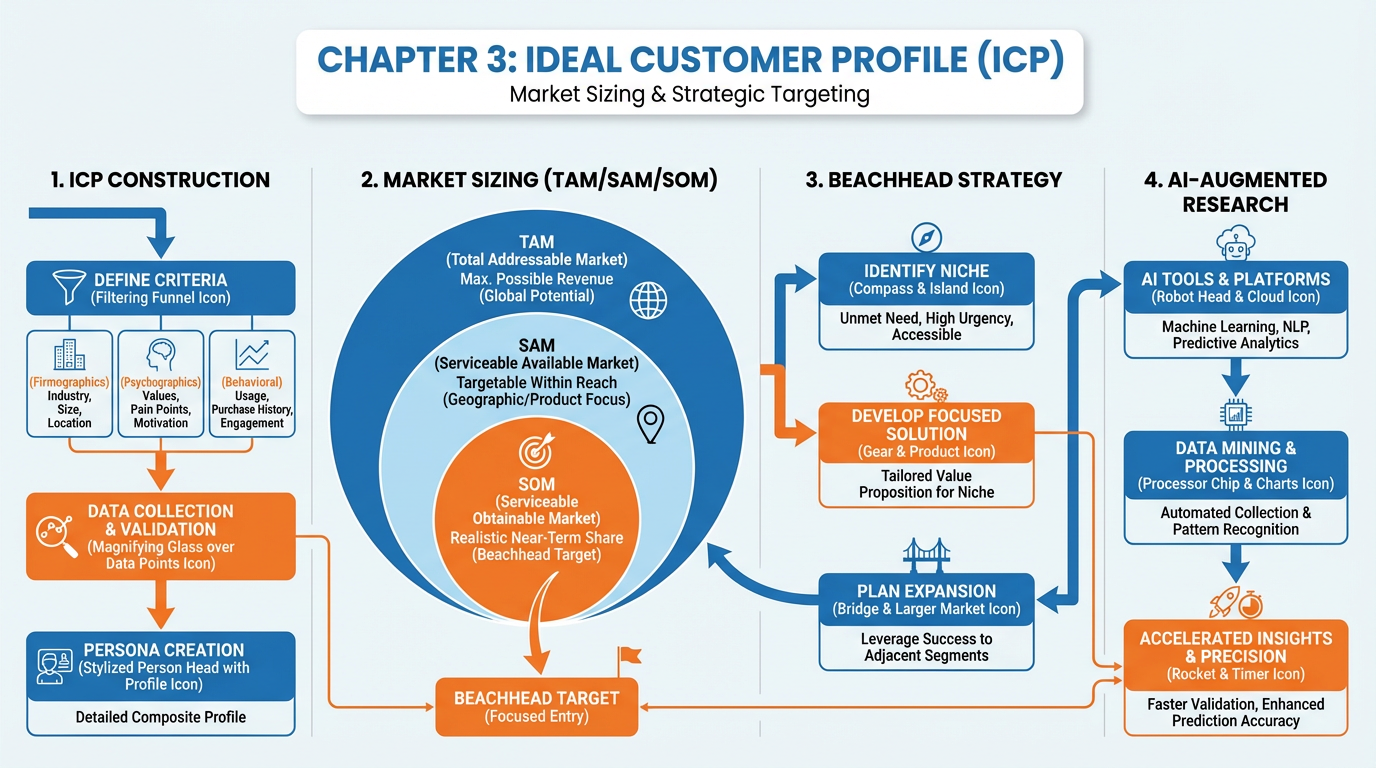
Figure 1:A comprehensive overview of Chapter 3: ICP construction dimensions, market sizing framework (TAM/SAM/SOM), beachhead strategy, and AI-augmented research tools for customer discovery.
1Learning Objectives
By the end of this chapter, you will be able to:
Distinguish between market segment, buyer persona, and Ideal Customer Profile, and explain why only one of these should drive go-to-market decisions.
Build a four-dimensional ICP using firmographic, demographic, psychographic, and behavioral attributes — and define a deliberate negative ICP.
Construct a defensible market size using unit-based bottom-up methodology, avoiding the “10% of a giant market” fallacy.
Apply the beachhead strategy to select the single most winnable segment and sequence expansion from there.
Use AI tools — NotebookLM, Deep Research, Reddit mining, and synthetic personas — to accelerate customer discovery without replacing the irreplaceable: real conversations.
Analyze the Toast case study to understand how a focused beachhead creates durable competitive advantage.
23.1 From “Customer” to “ICP”
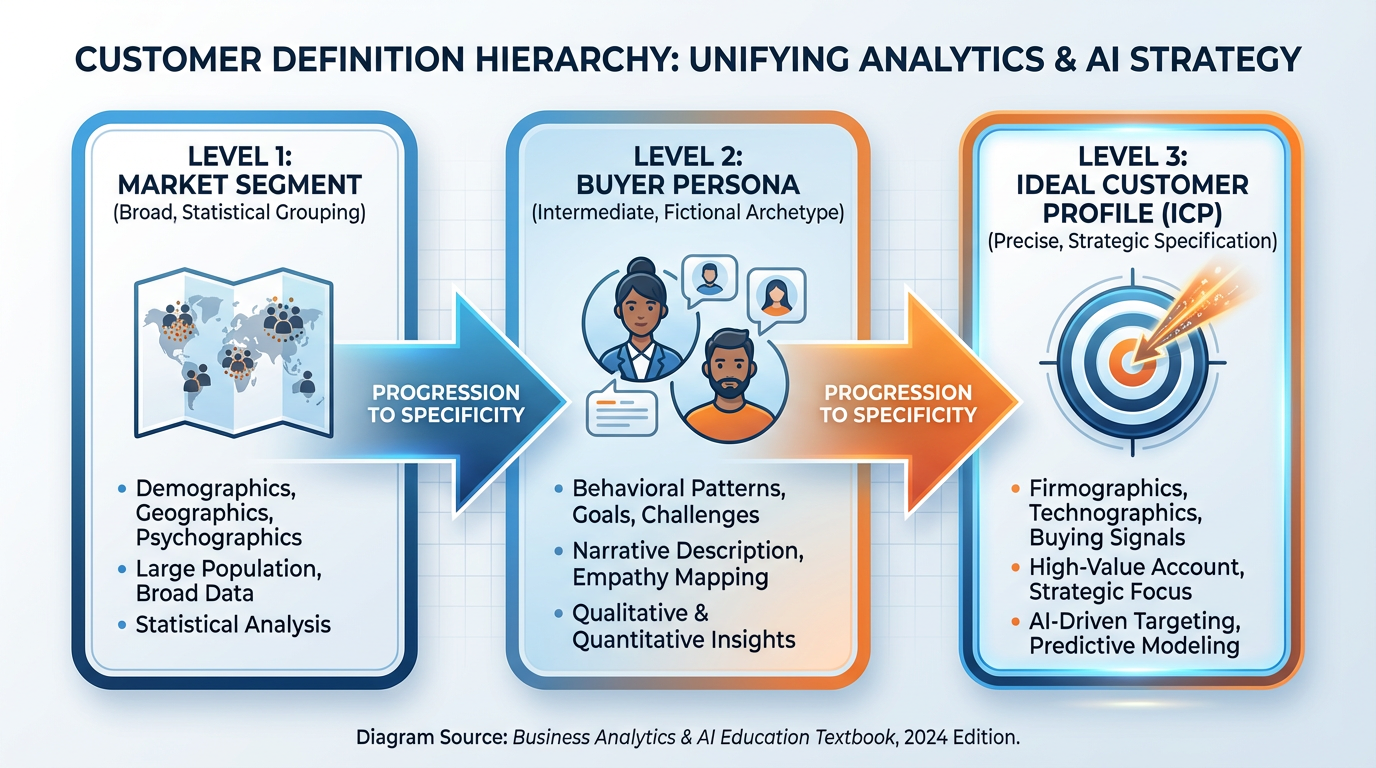
Figure 2:Three levels of customer definition: segment (a statistical grouping), persona (a fictional archetype), and ICP (a precise specification of the customer most likely to buy, retain, and refer). Only the ICP belongs on your pitch deck.
2.1The Three Definitions — and Why Two Are Insufficient
Most founding teams can produce a market segment on demand: “We serve the restaurant industry,” or “We target mid-market SaaS companies.” A segment is a statistical grouping. It is useful for sizing markets and planning advertising, but it tells you almost nothing about whom to call first or what to say when you do.
The next step up is a buyer persona — a fictional composite character representing the archetypal customer. Persona documents are a staple of marketing courses and often look impressive: “Meet Marcus, 38, VP of Operations at a regional logistics firm, worried about driver retention and loves data dashboards.” Personas are valuable for empathy-building and UX design. But personas are fictional. They are synthesized from assumptions, and they carry the dangerous illusion of specificity. Marcus does not have a LinkedIn profile. Marcus cannot sign a contract.
The Ideal Customer Profile (ICP) is something different in kind, not just degree. An ICP specifies the exact type of organization or individual — using real, verifiable attributes — for which your product delivers maximum value, which has the highest probability of purchasing, and which, once acquired, has the highest probability of retaining, expanding, and referring. An ICP is not a person you imagined. It is a description built from your best current customers, your fastest sales cycles, and your highest net revenue retention.
If you have no customers yet, your ICP is a hypothesis — clearly labeled as such — that you will test and revise through the ten real conversations required in Lab 3.
2.2The Four Dimensions of an ICP
A complete ICP is built across four intersecting dimensions. Weakness in any one dimension creates a customer definition that is too broad to be actionable.
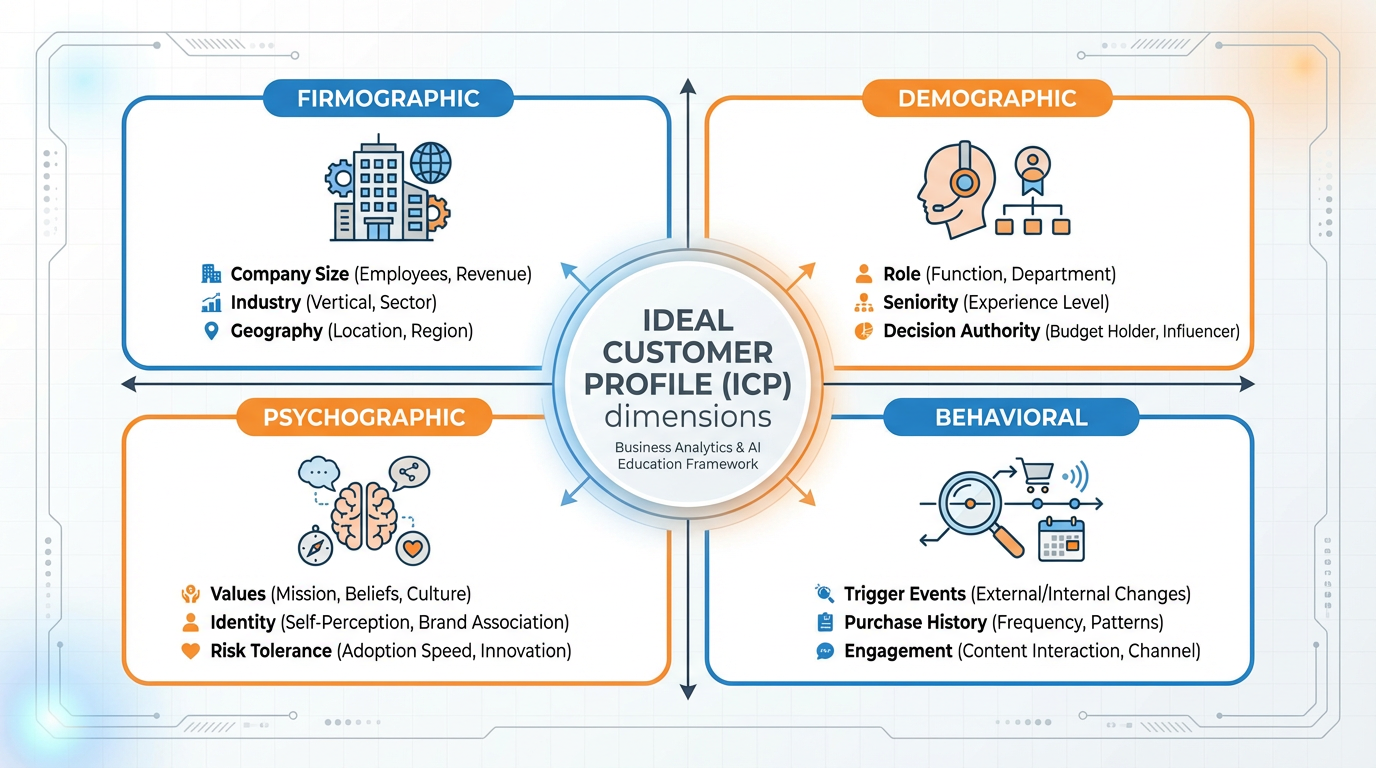
Figure 3:The four dimensions of an ICP. Firmographic and demographic attributes identify who can buy. Psychographic and behavioral attributes identify who will buy. Both layers are required.
Firmographic (for B2B): Industry vertical, company size by headcount and revenue, geographic market, funding stage, technology stack, and organizational structure. Example: “Series A–B SaaS companies with 25–150 employees, US-based, using Salesforce as their CRM.”
Demographic (for B2C or the individual buyer in B2B): Age range, role/title, seniority level, functional domain, income bracket, and — critically — decision-making authority. In B2B, the ICP often has both an organizational profile and an individual buyer profile. The company must fit firmographically; the person who signs must fit demographically.
Psychographic: Values, beliefs, risk tolerance, identity, and professional aspirations. Psychographic data does not appear on a LinkedIn profile, which is why it is the most commonly underdeveloped ICP dimension. Example: “Operators who self-identify as ‘early adopters’ of technology, whose professional identity is tied to running a tight shop, and who are embarrassed by inefficiency in front of their staff.” This describes a person who wants to be sold to. The alternative — “operators who are skeptical of software vendors and prefer to defer purchases” — is the negative ICP.
Behavioral: Purchase history, current software spend, recent trigger events (new funding, new hire, competitor acquisition, regulatory change), engagement with competitor content, and community participation. Behavioral data is the most predictive dimension because it describes what the customer is doing, not just who they are. A restaurant that just hired a new GM is behaviorally different — and far more likely to buy new technology — than an identical restaurant with a GM of ten years.
2.3The “If I Could Only Sell to One Customer” Exercise
This exercise is deceptively simple and reliably revelatory. The instinct of most founding teams is to hedge — to keep the definition broad so they don’t “leave money on the table.” This instinct is economically rational in theory and practically catastrophic in execution. A broad ICP means your sales team is qualifying indefinitely rather than closing. It means your product roadmap is shaped by a dozen contradictory customer types. It means your marketing speaks to everyone and resonates with no one.
Before writing your ICP document, answer this question in one sentence:
If I could only sign one customer — ever — which type of customer would give me the best chance of proving this business works?
The constraints force clarity. “I’d want a mid-market professional services firm” is not an answer. “I’d want a 75-person accounting firm in South Florida that recently lost a major client and is under pressure to reduce administrative overhead” is an answer. That single sentence contains: size (75 people), vertical (accounting), geography (South Florida), trigger event (client loss), pain (administrative overhead pressure), and urgency (under pressure). Every one of those attributes is a filtering criterion you can use to build a prospecting list tomorrow.
2.4Negative ICP: Deliberate Exclusion
An ICP without a negative ICP is incomplete. The negative ICP defines the customer type you will deliberately not serve, even if they want to buy from you. Common negative ICP criteria include: deal size too small to be sustainable, procurement cycle too long for your runway, customization requirements that destroy unit economics, and churn rate that predicts from the firmographic profile alone.
Refusing customers is psychologically difficult, especially early-stage. But serving the wrong customer creates a compounding problem: your team builds for their use case, your roadmap bends toward their needs, your case studies describe their context, and every future customer evaluation anchors to a reference that doesn’t match them. The wrong customer is not neutral — they actively distort your product and positioning away from the right customer.
Salesforce built a deliberate negative ICP around companies below 50 employees — not because those companies couldn’t benefit, but because the sales cost to acquire them exceeded their lifetime value. That decision preserved margin and sales capacity for mid-market accounts where the unit economics were compelling. HubSpot’s original ICP was explicit: companies with 10–200 employees using inbound marketing as their primary growth channel. Their negative ICP included enterprise companies with complex procurement, companies that relied on outbound cold calling, and companies without a dedicated marketing budget. This was not a limitation — it was a weapon. Every decision about features, pricing, and sales motion was made easier by knowing exactly who they were not building for.
33.2 Market Sizing That Survives Scrutiny
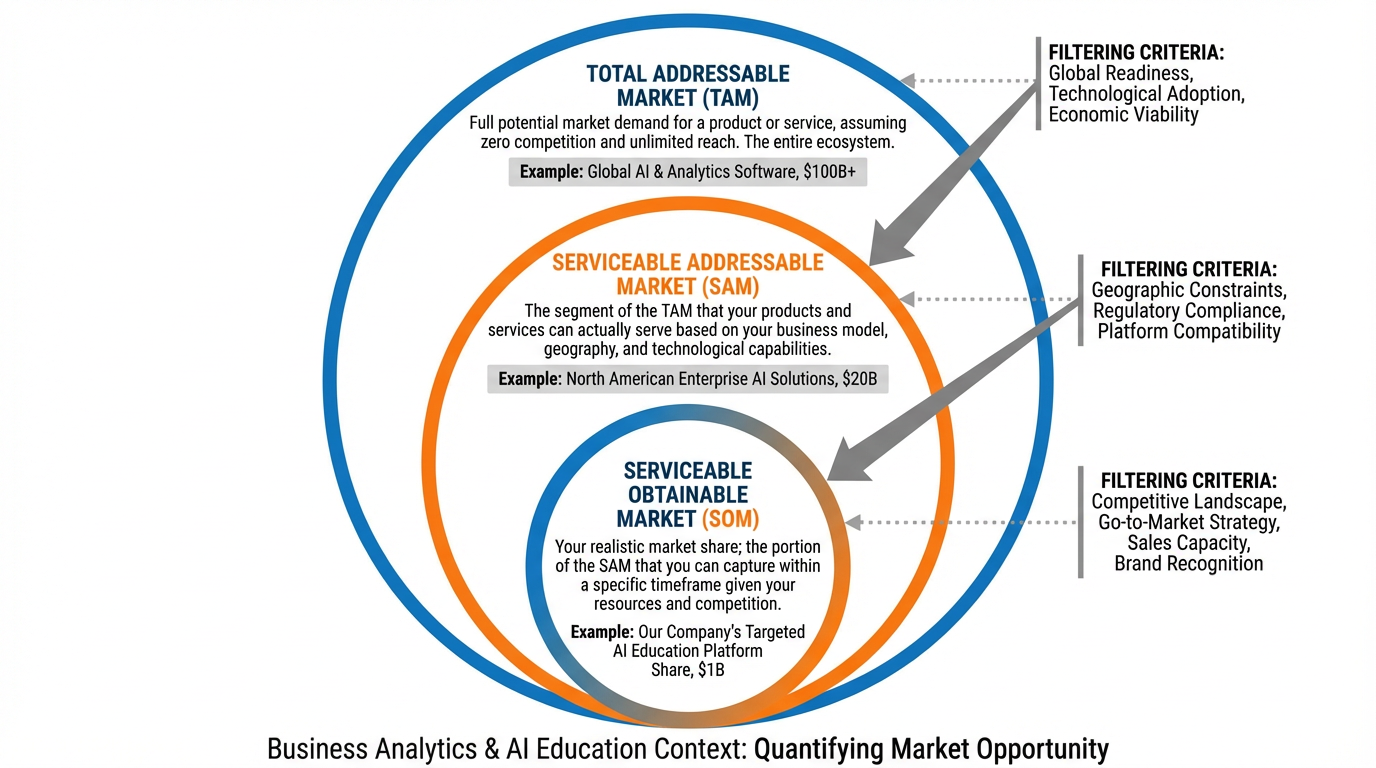
Figure 4:The TAM/SAM/SOM framework. TAM is the universe; SAM is the reachable portion; SOM is the realistic 3–5 year target. Sophisticated audiences look for honest, assumption-transparent SOM estimates, not large TAM numbers.
3.1The “10% of a $10B Market” Trap
There is a slide that appears in approximately 70% of first-time founder decks. It shows a large circle labeled “TAM: 100M in revenue.” This slide does not impress sophisticated investors. It signals that the founder has not done the work.
The “10% of a $10B market” framing (in all its variants) fails for three reasons. First, it provides no information about how you will acquire customers — the slide is a math exercise disguised as a strategy. Second, TAM figures are frequently sourced from market research reports that aggregate industries at a level of abstraction that renders them meaningless for a specific go-to-market. “The global restaurant software market” is not useful when you are deciding whether to hire a second salesperson in Miami. Third, percentage-of-market framing inverts the causal logic of business: you do not capture a percentage of a market; you win specific customers, one at a time, each for specific reasons.
3.2Top-Down vs. Bottom-Up: Understanding Both
Start from the macro; work to your share.
Process: Begin with an industry-level market size (from IBISWorld, Statista, industry associations, or public company 10-Ks). Then apply successive filters to estimate the portion relevant to your offering.
Example: The US restaurant POS market is approximately 1.4B. Restaurants with 50+ seats and annual revenue above 560M SAM.
When it works: Useful for communicating industry context to investors and for sanity-checking bottom-up figures.
Risk: Every filter is an assumption, and filters compound. Four assumptions each with 80% confidence compound to 41% confidence. Top-down sizing must be explicitly labeled as an order-of-magnitude estimate, not a precise figure.
Start from the unit; multiply up.
Process: Identify the number of addressable customers, multiply by your expected Average Contract Value (ACV), then apply a realistic capture rate based on comparable company benchmarks.
Formula: SOM = Addressable Units × ACV × Realistic Capture Rate
Example: There are approximately 180,000 full-service restaurants in the US with 50+ seats. At an ACV of 1.08B SAM. A realistic three-year capture rate for a well-funded startup in this segment is 1–3%, yielding a SOM of 32.4M.
When it works: Always. Bottom-up sizing is the only methodology that connects market size to sales motion. It tells you not just how big the market is but how many deals you need to close and at what price.
Risk: Requires honest assumptions about ACV and capture rate — the two variables founders most frequently inflate.
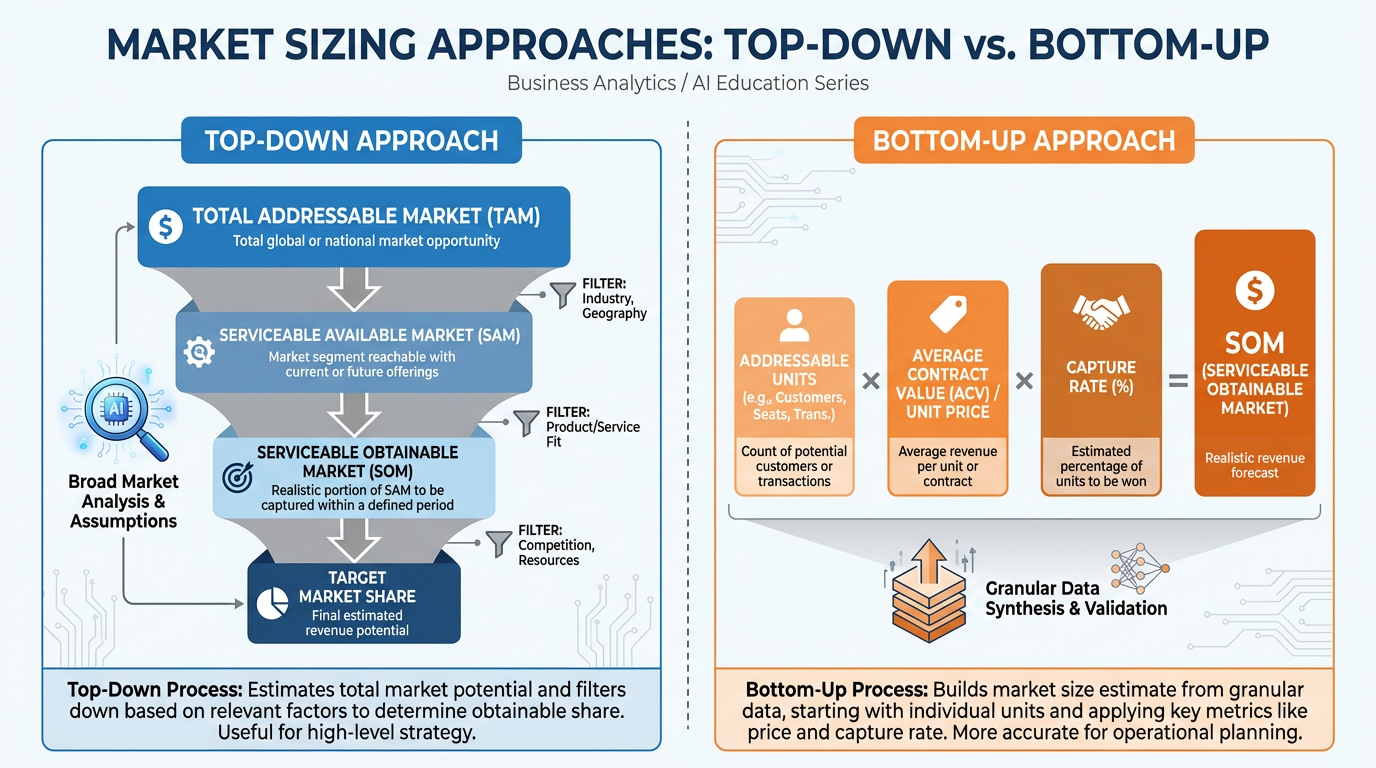
Figure 5:Top-down sizing communicates context; bottom-up sizing drives decisions. Use both, but build your operating model on the bottom-up figure.
3.3Communicating Market Size to Sophisticated Audiences
When presenting market size to investors, advisors, or accelerator program managers, the single biggest credibility signal is your willingness to be specific and honest about your assumptions. Savvy audiences have seen hundreds of 4,800 ACV and a 5% three-year capture rate, our SOM is $768K. We have the sales capacity to close 8 deals per month, which means we can reach that number in approximately 18 months with one AE." That is a claim they can evaluate, challenge, and believe.
The goal is not to present a big number. The goal is to present a credible path — one that connects the size of the opportunity to the specific actions your team will take to capture it.
3.4Unit-Based Sizing in Practice
The unit-based framework forces you to answer three questions that immediately expose the weaknesses in most market size claims:
How many addressable customers exist? (Not “how big is the industry” — how many specific entities match your ICP criteria?)
What is a realistic ACV? (Not your aspirational price — the price comparable products command in comparable segments today.)
What is a realistic capture rate? (Not “1% of the market” as an abstract figure — what percentage of wins per year can your current team sustain, given your sales cycle length and close rate?)
If your ICP is “50-seat full-service restaurants in South Florida,” the addressable market is approximately 3,200 restaurants — a number you can verify on Yelp, Google Maps, or the Florida Division of Hotels and Restaurants database. At 768,000 — a real operating target, not a PowerPoint fantasy.
That number is not impressive on a slide. But it is honest, and it connects directly to a hiring and sales plan. More importantly, once you own South Florida full-service restaurants, you have a replicable playbook and a reference customer base to expand to the next geography. That expansion story — geographic replication of a proven model — is far more compelling to investors than a percentage of an abstract national market.
43.3 The Beachhead Strategy
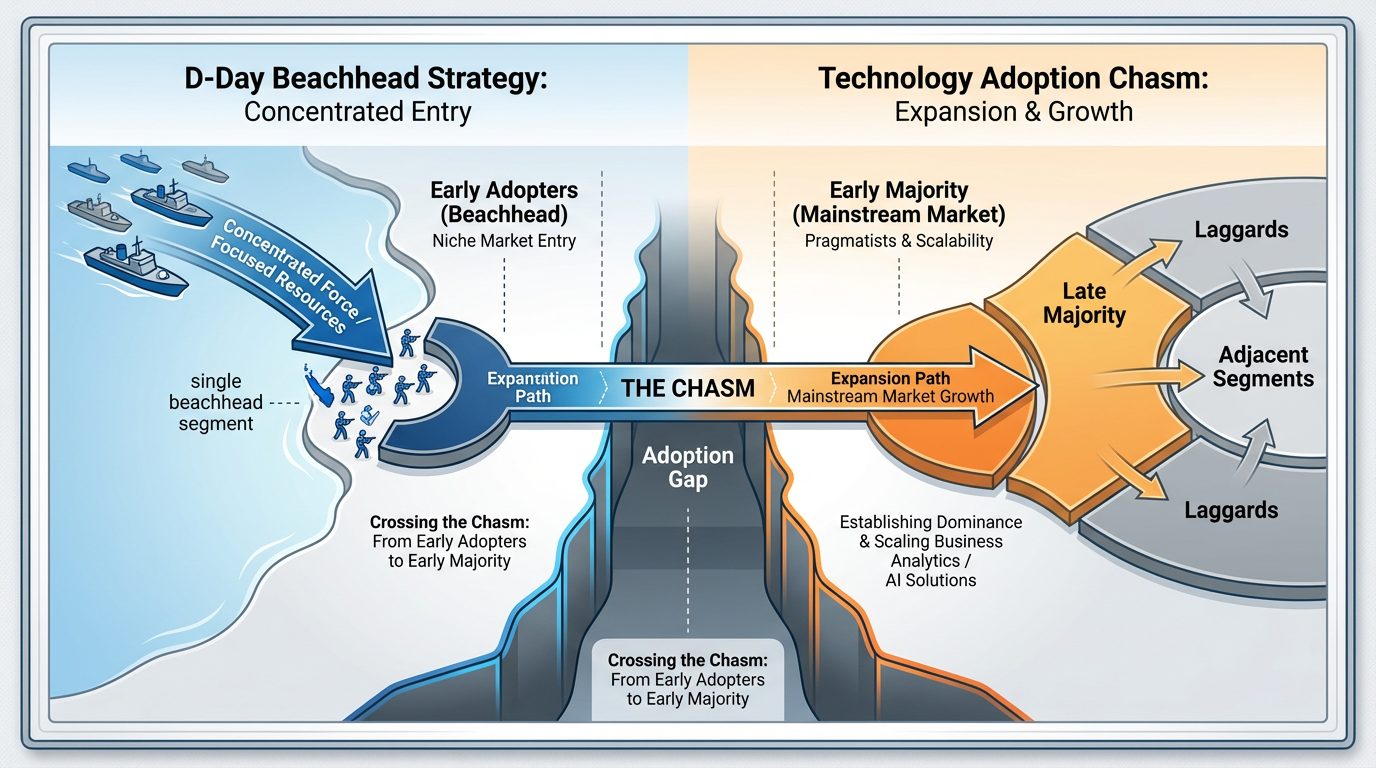
Figure 6:The beachhead strategy: concentrate force on the most winnable segment, establish dominance, then expand. Geoffrey Moore’s Crossing the Chasm describes this as the difference between companies that cross the chasm and those that fall into it.
4.1Geoffrey Moore’s Chasm, Revisited
Geoffrey Moore’s Crossing the Chasm (first published in 1991, with editions updated through the 2010s) remains the most useful framework for understanding why technology products that succeed with early adopters frequently fail to reach the mainstream market. The “chasm” is the gap between the early adopter cohort — a small group of enthusiasts willing to accept incomplete, buggy products in exchange for competitive advantage — and the early majority, a far larger group that requires proof, references, and industry-specific validation before purchasing.
Moore’s central prescription is the beachhead strategy: instead of attempting to serve multiple segments simultaneously, concentrate your entire go-to-market effort on a single segment, achieve undeniable dominance there, and use that dominance — in the form of reference customers, case studies, and product maturity — as the launching point for the next segment.
The D-Day analogy is Moore’s own. On June 6, 1944, the Allied forces did not attempt to land simultaneously across the entire French coastline. They concentrated on five beaches in Normandy, achieved a foothold against formidable resistance, and then expanded from that established position. The same logic applies to markets. Attempting to land everywhere simultaneously means you are never dominant anywhere — which means every sale is a greenfield, every objection is new, and you never accumulate the reference-base momentum that makes selling progressively easier.
4.2One Segment Deep vs. Many Segments Shallow
The intuition that serves founders poorly is the instinct toward breadth. A product that could serve restaurants, hotels, and retail feels more valuable — and more investable — than a product that only serves restaurants. This is the wrong frame. A product that dominates restaurants has a defensible position, a word-of-mouth network, and a product shaped by the most exacting users in its target vertical. A product that dabbles in restaurants, hotels, and retail has none of those things.
The diagnostic question is: In which segment, if you won it completely, would you have the strongest possible position for expanding to the second segment?
Deep Dive: How to Score Your Beachhead Candidates
Beachhead scoring criteria:
Score each candidate segment on a 1–5 scale across five dimensions:
Urgency — How acutely does this segment feel the pain today? (5 = operational crisis; 1 = nice-to-have)
Accessibility — Can you reach this segment through a channel you already own or can quickly acquire? (5 = existing warm network; 1 = requires new category education)
Reference density — If you win three customers in this segment, will word travel fast enough to accelerate subsequent sales? (5 = tight community with high information sharing; 1 = fragmented, low-communication market)
Expansion vector — Does winning this segment position you directly to enter an adjacent, larger segment? (5 = clear, credible path to segment 2; 1 = dead-end vertical)
Defensibility — Once you establish dominance, how hard is it for a competitor to displace you? (5 = high switching costs, deep integration, strong community; 1 = purely price-competitive)
Score interpretation: 20–25: Primary beachhead. 15–19: Secondary candidate. Below 15: Not a beachhead — may be a future expansion market.
4.3Case: Stripe’s YC Beachhead
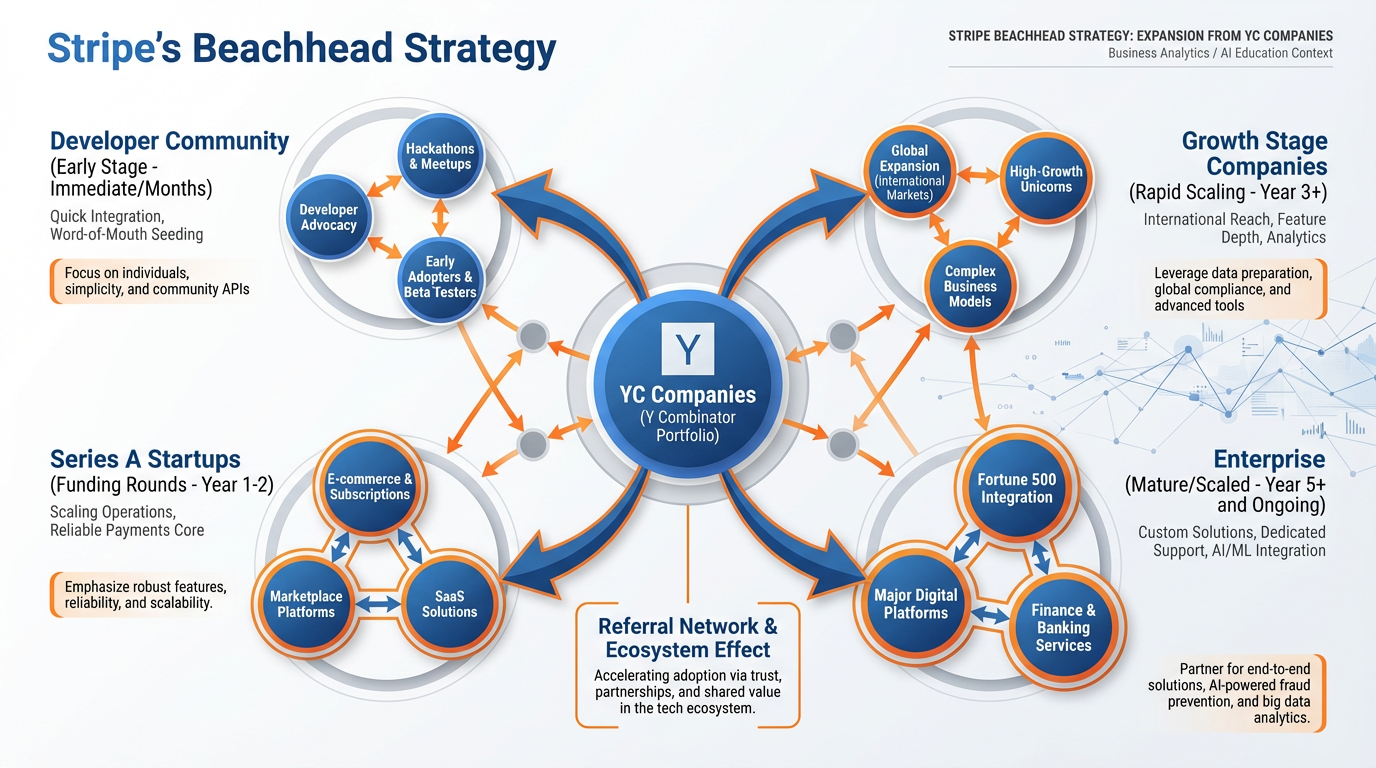
Figure 7:Stripe’s beachhead: Y Combinator portfolio companies were the ideal initial segment — technically sophisticated, urgently underserved by legacy payment processors, and embedded in a high-density referral network. The YC community amplified every successful integration into multiple new leads.
When Patrick and John Collison launched Stripe in 2010, the payments infrastructure problem was not new. PayPal existed. Braintree existed. Legacy merchant processors served millions of businesses. What was missing was a payment API that a developer could integrate in seven lines of code rather than six weeks of paperwork with a regional bank.
The Collisons did not attempt to serve all businesses simultaneously. Their initial focus was Y Combinator portfolio companies — a segment that was simultaneously: technically sophisticated enough to evaluate an API, urgently frustrated by the legacy integration process, operating under runway pressure that made faster implementation valuable, and — critically — embedded in a dense referral network where every YC batch founder talked to every other YC batch founder about their infrastructure stack.
The YC beachhead gave Stripe something money could not buy: a self-reinforcing reference network in a community with outsized downstream influence. YC companies, even at the seed stage, grow into major enterprises. The technical decisions made in the first ninety days of a startup’s life often persist for years. And YC alumni — who went on to found, join, and advise thousands of subsequent startups — carried their Stripe preference with them.
The lesson is not “target YC companies.” The lesson is: the ideal beachhead is a segment where your initial customers are connected to your future customers, where the reference value compounds rather than merely accumulates.
53.4 AI-Augmented Customer Research
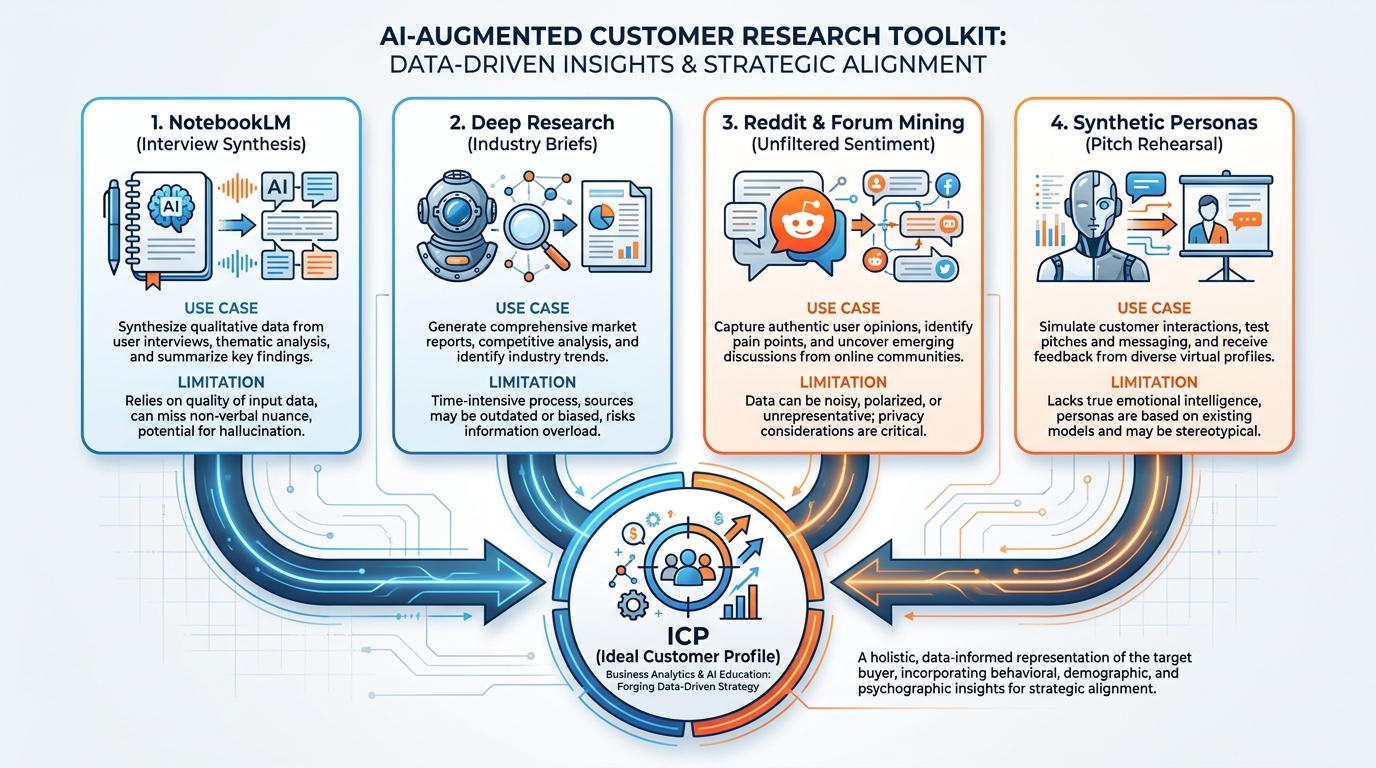
Figure 8:The AI-augmented customer research stack. Each tool has a specific job. None of them replaces the irreplaceable: a live conversation with a potential customer who has no obligation to be kind to you.
5.1NotebookLM for Interview Synthesis
Google’s NotebookLM is designed for exactly the problem every founder faces after conducting a batch of customer interviews: you have recordings, transcripts, and notes across multiple documents, and you need to synthesize them into coherent insights without losing the nuance of individual responses.
The workflow: upload all interview transcripts as sources, then use the chat interface to query across them. “What objections appeared in more than two interviews?” “Which pain points were mentioned with the highest emotional intensity?” “Were there any contradictions between what early-stage founders said and what growth-stage operators said?” NotebookLM cites sources for every response, so you can trace any synthesized claim back to the specific transcript that generated it.
5.2Deep Research for Industry Briefs
The major AI labs now offer “Deep Research” modes — available through the latest Claude, Gemini, and ChatGPT — that conduct multi-step web research autonomously, synthesizing dozens of sources into a structured report. For ICP development, the most valuable use cases are: competitive landscape mapping (who else serves this segment and on what dimensions?), industry pain point documentation (what problems do trade publications, earnings calls, and analyst reports consistently identify?), and regulatory/technology trigger identification (what is changing in this industry that creates urgency?).
A Deep Research brief on “full-service restaurant technology adoption barriers” will surface trade press, operator surveys, vendor case studies, and regulatory analysis that would take a human researcher two days to compile. The limitation — and it is important — is that Deep Research synthesizes published information. It cannot tell you what your specific target customers believe, feel, or are willing to pay. It is background intelligence, not primary data.
5.3Using Deep Research Effectively: A Protocol
To get maximum value from Deep Research tools, structure your request around three specific output types: (1) a competitive landscape matrix showing which vendors serve which sub-segments and on what dimensions, (2) a pain point frequency analysis drawn from trade press, operator forums, and analyst reports published in the past two years, and (3) a trigger event calendar identifying regulatory, seasonal, or macroeconomic forces that increase purchase urgency in your target vertical. A well-structured Deep Research brief on your beachhead segment will take 10–20 minutes to generate and will compress what would otherwise be a week of desk research — leaving more of your limited time for the primary research that cannot be automated.
5.4Reddit and Forum Mining with AI
For consumer-facing businesses and for B2B products targeting communities with strong online presence, Reddit and industry forums are repositories of unfiltered customer sentiment. The signal-to-noise ratio is higher than typical customer surveys because the people posting are not responding to your questions — they are expressing genuine frustration or enthusiasm in a context where they have no reason to manage your feelings.
The research process: identify the subreddits, forums, and review platforms where your ICP spends time (for restaurant operators: r/KitchenConfidential, r/restaurantowners, Yelp owner forums, Toast’s community platform). Export or scrape recent threads. Feed the content to an AI with a structured prompt: “Analyze these forum posts and identify: (1) the five most frequently mentioned operational pain points, (2) the language operators use to describe these problems in their own words, and (3) any mentions of existing solutions — including why those solutions failed.” The output gives you both insight and language — the exact vocabulary your customers use, which is invaluable for copywriting, sales scripts, and positioning.
5.5Synthetic Personas: Useful and Irreplaceable — In Their Own Way
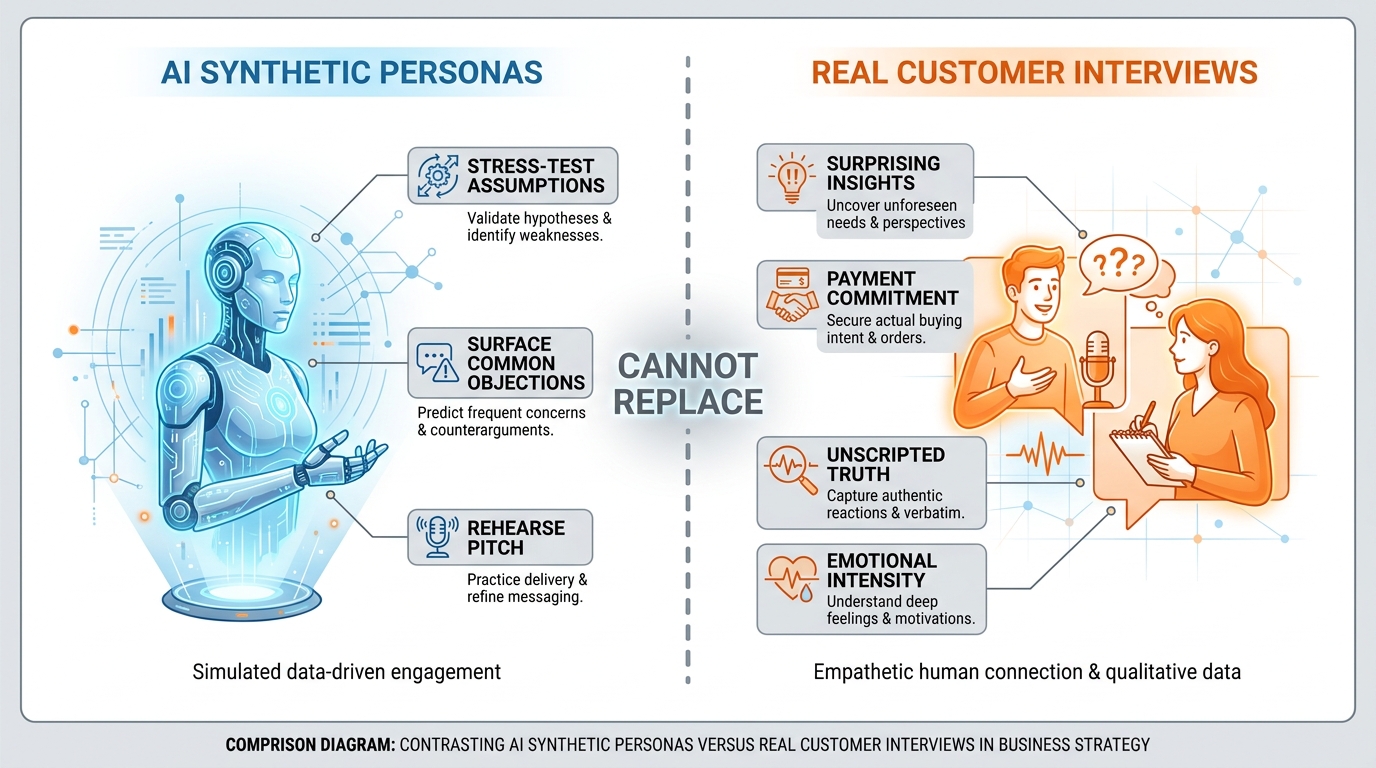
Figure 9:Synthetic personas can stress-test your assumptions, surface overlooked objections, and help you prepare for real interviews. They cannot replace real conversations because they tell you what a statistically average customer might say — not what your specific, actual customer will pay.
Current AI models can generate surprisingly plausible customer personas with articulated needs, objections, and decision criteria. Ask the latest Claude or Gemini to “play the role of a General Manager at a 75-seat restaurant in Miami who is evaluating new POS software,” and it will engage in a realistic-seeming product conversation complete with objections, budget constraints, and questions about vendor support.
This is useful for preparation — rehearsing your pitch, stress-testing your value prop, and surfacing objections you haven’t considered. It is not a substitute for real conversations for three reasons:
Synthetic personas cannot surprise you. They respond to what you already believe to be true about your ICP. Real customers tell you things you didn’t know to ask.
Synthetic personas cannot commit. The only signal that actually matters is whether a real human is willing to pay real money (or sign a letter of intent, or give you a reference call). An AI will never give you that signal.
Synthetic personas sample from training data. They represent the average published wisdom about your customer type, not the specific, contextual reality of the customer in your beachhead.
The non-negotiable rule, which applies regardless of how good AI research tools become: conduct at least ten real customer conversations before finalizing your ICP. Not surveys. Conversations — with discovery questions, follow-up probes, and the unscripted detours that produce genuine insight. Rob Fitzpatrick’s The Mom Test offers the definitive guide to structuring these conversations so that polite or optimistic respondents cannot mislead you: ask about past behavior rather than future intent, ask about specific incidents rather than general preferences, and never pitch before you have fully understood the problem. An ICP built on ten honest conversations is worth more than one built on ten thousand survey responses.
6Case Study: Toast’s Beachhead Decision
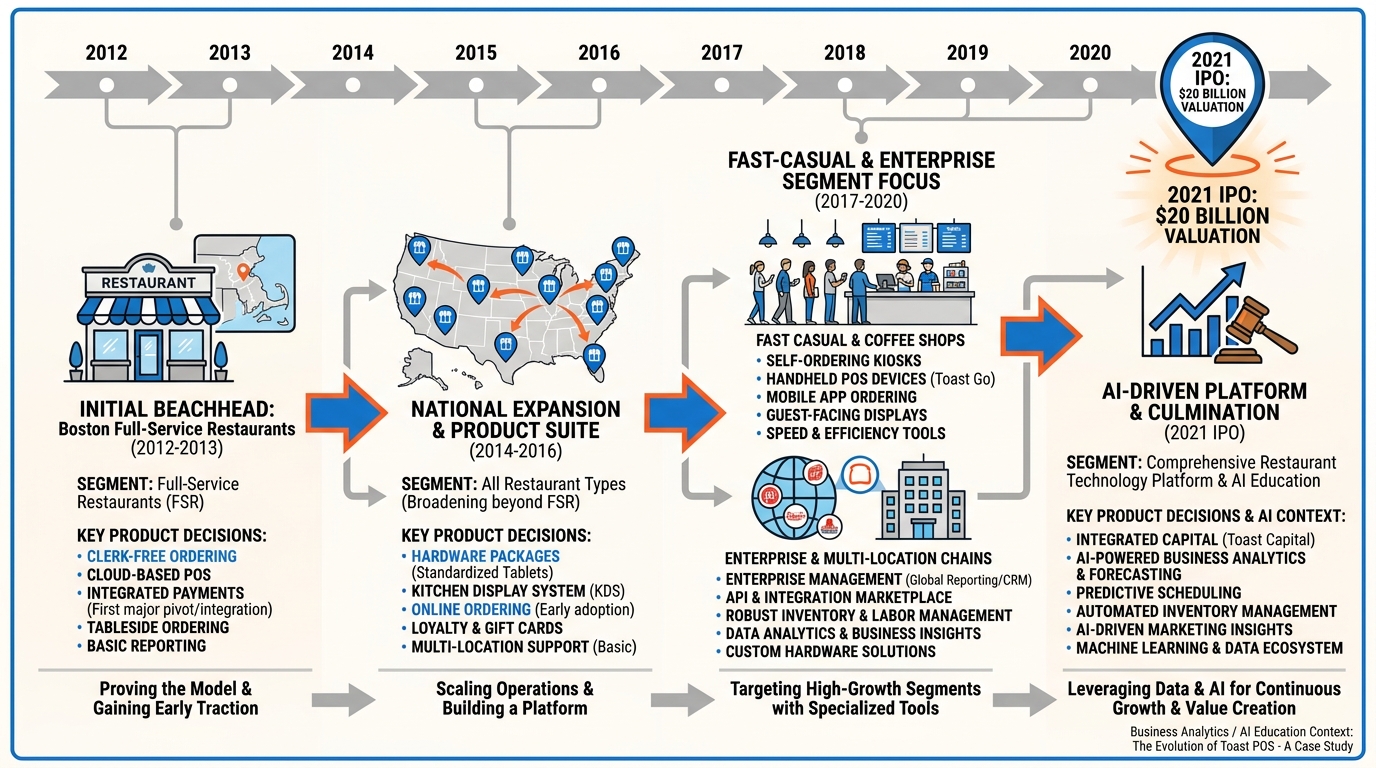
Figure 10:Toast’s beachhead decision: serve only full-service restaurants, deeply, before expanding. This choice shaped product design, sales motion, support staffing, and ultimately the IPO story.
Toast launched in 2012 into one of the most fragmented, conservative, and technically underserved markets in the US economy: food service technology. Restaurant operators were not early adopters. They were running on hardware-based POS systems from NCR and Aloha — systems that were notoriously difficult to configure, required on-site technicians for updates, and charged high per-transaction fees that many operators found opaque.
Toast’s founding team made a choice that, in retrospect, looks obvious but was genuinely difficult at the time: they would serve only full-service restaurants — sit-down establishments with tableside ordering, full menus, and servers. They would not pursue fast food, fast casual, cafeterias, food trucks, or retail. Not because those segments were unattractive, but because they were not the same problem.
Full-service restaurants had a specific, acute pain: their entire operation — ordering, payments, kitchen display, tip management, shift scheduling, and reporting — was managed across multiple disconnected systems or paper-based processes. The manager who ran the lunch shift had no visibility into what happened during dinner service without walking to a back-office terminal. Tipping was a reconciliation nightmare. Menu changes required a call to a vendor. Every one of these problems was specific to full-service operations and required product decisions (tableside ordering, tip pooling, course-paced kitchen display) that would have been irrelevant or counterproductive for a quick-serve environment.
The counterfactual: What if Toast had launched as a general restaurant POS platform — “the modern operating system for any food service business”?
The answer is straightforward and supported by dozens of enterprise software failures: they would have built a product optimized for no one. A general platform must make neutral choices where a vertical product makes specific, opinionated choices. For full-service restaurants, “neutral” on tableside ordering means no tableside ordering — because the engineering cost is prohibitive without a concentrated customer base to justify it. Neutral on tip management means a generic tipping module that satisfies no one’s compliance requirements. The attempt to serve everyone would have produced a product that served no one better than the incumbent.
Instead, Toast spent three years going deep: building the most technically complete solution for full-service restaurants in the US, earning references in Boston’s restaurant community (their home market), and then using those references to expand market-by-market. By the time they raised their Series D and began their national expansion, they had solved problems the incumbents had not attempted — including offline functionality when internet goes down, a problem that NCR’s cloud-based competitors had ignored because it was hard, but that full-service restaurant operators flagged as a deal-breaker in the first sixty days of Toast’s customer discovery.
Toast went public in 2021 at a valuation exceeding $20B. Their product now serves fast casual, enterprise, and international markets. But the full-service beachhead gave them something no amount of marketing could buy: the reputation as the system built for restaurants by people who understood restaurant operations.
7Lab 3: The ICP Dossier
Deliverable: A 5-page ICP Dossier for your venture. This is a professional document — formatted, sourced, and specific. Vague language (“mid-size companies who care about efficiency”) will result in required revision.
Part 1: Firmographic Profile (1 page)
Define your ICP across all four dimensions: firmographic, demographic, psychographic, and behavioral. For each dimension, provide: (a) the attribute, (b) the specific value or range, and (c) a one-sentence justification for why this attribute is defining. Include your negative ICP — at least three explicit exclusions with rationale.
Starter prompt: “Help me define the firmographic and psychographic dimensions of my ICP for [venture description].”
Part 2: Named Beachhead (0.5 page)
Name your beachhead segment with geographic, vertical, and size precision. Run the five-dimension beachhead scoring exercise from Section 3.3. Show your scores and explain the single most important reason this segment earns your first go-to-market investment.
Starter prompt: “Evaluate these three beachhead candidates for my venture using urgency, accessibility, reference density, expansion vector, and defensibility.”
Part 3: TAM/SAM/SOM with Assumptions (1 page)
Build a unit-based market size using the formula: Addressable Units × ACV × Realistic Capture Rate. For each variable, state the source of your estimate and the range of uncertainty. Show both an optimistic and a conservative SOM scenario. Identify any top-down market figure that corroborates (or contradicts) your bottom-up estimate.
Starter prompt: “Help me build a bottom-up market sizing model for [beachhead segment] with assumptions I can defend in a pitch.”
Part 4: Buyer Journey (1 page)
Map the five stages of your ICP’s buyer journey: (1) trigger event that creates urgency, (2) awareness (how they discover solutions), (3) evaluation (what criteria they use and who is involved in the decision), (4) purchase (who signs, procurement requirements, typical timeline), and (5) adoption (what success looks like in the first 90 days). For each stage, identify one specific AI or technology tool you will use to reach or serve the buyer.
Starter prompt: “Map the buyer journey for [ICP description] including trigger events, evaluation criteria, and the key objections at each stage.”
Part 5: Three Customer Conversation Transcripts (1.5 pages)
Conduct three real conversations with people who match your ICP hypothesis (or who know your ICP intimately — operators, consultants, investors in the space). These are not surveys. They are open-ended discovery conversations of 20–45 minutes each. Submit lightly edited transcripts (with permission), a one-paragraph synthesis per conversation, and a one-page cross-conversation analysis identifying: points of consensus, contradictions, and the single most surprising thing you learned.
Starter prompt: “Help me design a customer discovery interview guide for [ICP description] that surfaces pain intensity, current workarounds, and budget authority without leading the witness.”
8AI Studio Build (Weekly): The Synthetic Customer
Capability introduced: Conversational system design and persona grounding.
The Synthetic Customer — Build a multi-turn conversational agent in Google AI Studio that plays your target ICP. The system prompt must encode the ICP’s fears, objections, jargon, and buying triggers. The agent must refuse to break character, push back on weak value propositions, and ask the questions a real buyer would ask. Students conduct a 20-turn mock sales call and submit the transcript plus a self-critique identifying where their pitch was weak.
System prompt construction guide:
Your system prompt should include five elements:
Identity: Name, title, company type, and firmographic context (e.g., “You are Dana, General Manager of a 90-seat Italian restaurant in Coral Gables. You have been in this role for four years.”)
Active pain: The specific operational problem this character is experiencing today, in their own language (e.g., “Your end-of-shift reconciliation takes ninety minutes and you still have a $50–200 variance most nights. Your owner is asking questions.”)
Objections: The three most common objections your ICP raises, with the emotional logic behind each (e.g., “You are skeptical of software vendors after a bad implementation two years ago that took your POS offline during a Saturday dinner rush.”)
Buying triggers: The conditions under which this character would buy (e.g., “You would move quickly if you saw the system working at a comparable restaurant you respect, and if the vendor would do a live demonstration at your location.”)
Character rules: Explicit instructions to maintain persona, challenge weak claims, ask follow-up questions, and never break character regardless of how the student frames their prompt.
Submission requirements:
Full 20-turn transcript
Self-critique (minimum 300 words) identifying: (a) the turn where your pitch was weakest and why, (b) one objection you failed to anticipate, (c) one thing the synthetic customer revealed that changed your ICP or value prop
9Discussion Prompts
Prompt 1: The Negative ICP as Competitive Strategy
Elizabeth Ries’s The Lean Startup argues for customer discovery as an ongoing, iterative process — yet many founders treat the ICP as a document written once and never revisited. Using Ries (2011) and Eisenmann, Osterwalder, and Pigneur (2013) as your theoretical foundation, argue for or against the following position: A well-defined negative ICP is more valuable than a well-defined positive ICP, because knowing who you will not serve protects you from the organizational drift that destroys focus.
Your response should: (a) engage directly with both scholarly sources, (b) ground your argument in at least one specific company example (not Toast — select your own), and (c) stake a clear position with supporting evidence. After posting, respond substantively to at least two peers whose position differs from yours.
Prompt 2: The Ethics of Synthetic Personas in Customer Research
AI-generated synthetic personas are increasingly used in product development, marketing research, and customer discovery. Scholars including Kozinets (2023) and Belz and Baumbach (2010) have examined the ethical dimensions of digital consumer research methodologies. Drawing on at least two scholarly sources (no more than two years old), analyze the following: Under what conditions is it ethically appropriate to use AI-generated synthetic personas as a substitute for — rather than a supplement to — real customer research? What obligations do founders have to the customers whose experiences these personas are meant to represent?
Your response should take a clear position, not merely describe both sides. After posting, respond substantively to at least two peers, engaging with the specific evidence they cite.
10Readings
Required:
Moore, G.A. Crossing the Chasm: Marketing and Selling Disruptive Products to Mainstream Customers (3rd ed.). HarperBusiness. Chapters 3–4 (Beachhead and Target Customer Characterization).
Wickman, G. & Winters, M. Rocket Fuel: The One Essential Combination That Will Get You More of What You Want from Your Business. BenBella Books. Chapter 5 (Ideal Customer).
Christensen, C.M., Hall, T., Dillon, K., & Duncan, D.S. “Know Your Customers’ Jobs to Be Done.” Harvard Business Review. hbr
.org /2016 /09 /know -your -customers -jobs -to -be -done
Recommended:
Fitzpatrick, R. The Mom Test: How to Talk to Customers and Learn If Your Business Is a Good Idea When Everyone Is Lying to You. Independently published.
Weinberg, G. & Mares, J. Traction: How Any Startup Can Achieve Explosive Customer Growth. Portfolio/Penguin. Chapter on Targeting Blogs and Community.
Toast Inc. S-1 Filing (2021). SEC EDGAR. sec.gov. Review the “Business” and “Market Opportunity” sections for real-world TAM/SAM framing.
11Glossary
Ideal Customer Profile (ICP) A precise specification of the organization or individual type that delivers maximum mutual value — highest probability of purchase, retention, and referral. Built from verified attributes, not fictional composites.
Market Segment A statistical grouping of potential customers sharing one or more demographic, firmographic, or behavioral characteristics. Segments are useful for sizing and advertising but insufficient for go-to-market execution.
Buyer Persona A fictional, named archetype representing a typical customer, constructed from synthesized research. Useful for empathy-building and UX design; not a substitute for ICP precision.
Negative ICP An explicit definition of the customer types a company will deliberately not serve, used to protect product focus and unit economics.
Firmographic Attributes describing an organization: industry, size, revenue, geography, funding stage, and technology stack. The organizational equivalent of demographic data.
Psychographic Attributes describing values, beliefs, professional identity, risk tolerance, and aspiration. The most predictive ICP dimension for willingness to buy, and the most commonly underdeveloped.
Behavioral Trigger A recent, verifiable event — new hire, funding round, competitor acquisition, regulatory change — that elevates a prospect’s probability of purchasing. Behavioral triggers are the highest-signal prospecting data available.
TAM (Total Addressable Market) The maximum revenue a business could generate if it captured 100% of the relevant market with no competitive losses. A theoretical ceiling, not an operating target.
SAM (Serviceable Addressable Market) The portion of TAM that can be reached with your current go-to-market strategy, product capabilities, and geographic reach.
SOM (Serviceable Obtainable Market) The realistic revenue target over a defined period (typically 3–5 years), based on your sales capacity, competitive dynamics, and market adoption pace. The only market size figure that belongs in your operating plan.
Average Contract Value (ACV) The annualized revenue per customer account, used as the unit price in bottom-up market sizing.
Beachhead Strategy The go-to-market approach of concentrating all resources on the most winnable segment, achieving dominance, and then expanding from that established position. Named for the military concept of securing a landing zone before advancing.
Crossing the Chasm Geoffrey Moore’s framework describing the gap between early adopters (who accept incomplete products) and the early majority (who require proof, references, and risk mitigation). Crossing the chasm requires a focused beachhead.
Customer Discovery The structured process of testing business model hypotheses through direct conversations with potential customers, as defined by Steve Blank in The Four Steps to the Epiphany.
Synthetic Persona An AI-generated character simulating a customer type, used for pitch rehearsal and assumption stress-testing. Useful as preparation; not a substitute for real customer conversations.
Reference Customer A paying customer willing to speak publicly or privately on behalf of a vendor to other potential buyers. The single most powerful sales asset in B2B go-to-market; the primary output of a successful beachhead strategy.
NotebookLM Google’s AI-powered research tool that allows users to upload documents, interview transcripts, and reports as sources and then query across them with cited responses. Useful for synthesizing customer discovery interviews at scale.