Chapter 1: Introduction to AI in Business
Understanding the Foundations of Artificial Intelligence and Its Business Applications
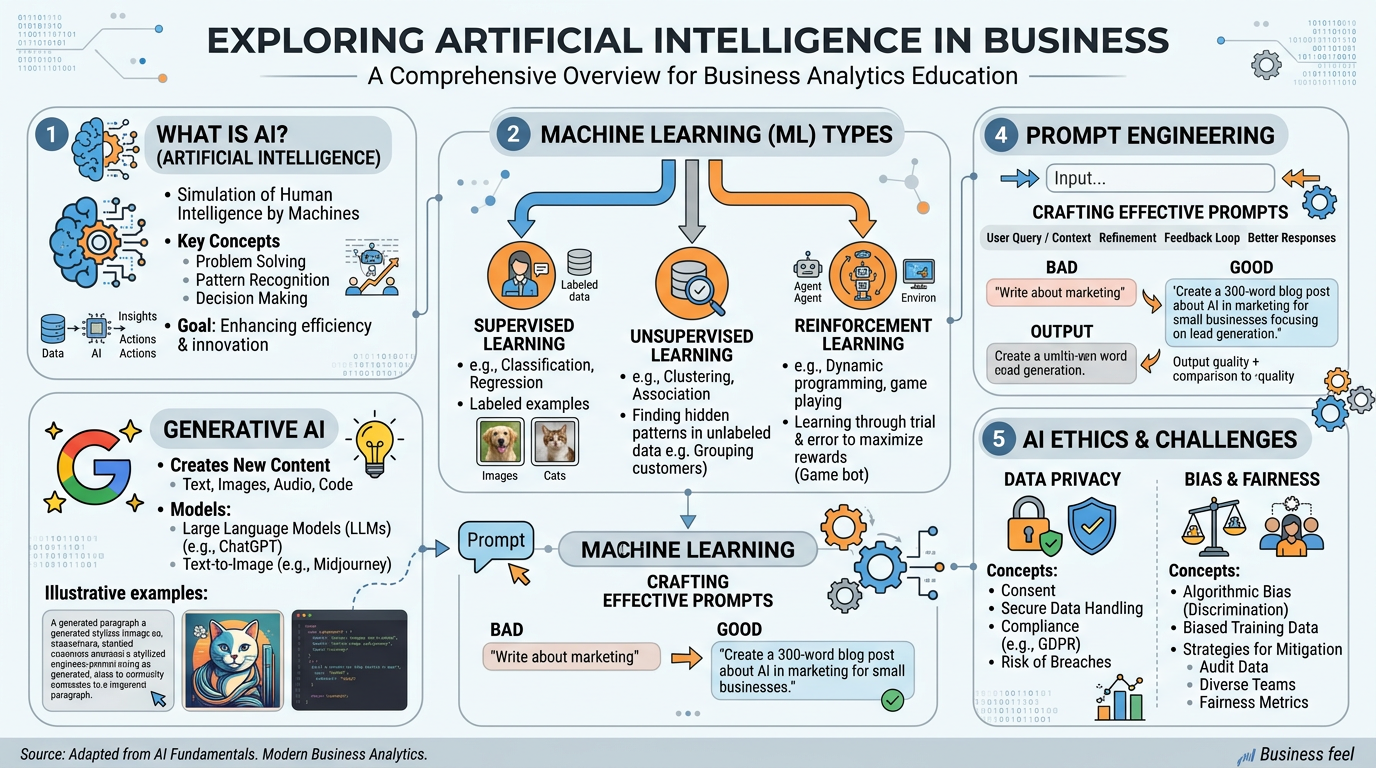
Figure 1:An illustrated overview of the foundational AI concepts covered in this chapter — from defining artificial intelligence to understanding its role in modern business.
“The fear of the LORD is the beginning of wisdom, and knowledge of the Holy One is understanding.”
Proverbs 9:10 (NIV)
Artificial intelligence is no longer a futuristic concept confined to science fiction novels and research laboratories. It is here — embedded in the tools we use daily, transforming the industries we work in, and reshaping the very nature of business itself. From the algorithms that recommend products on Amazon to the chatbots that handle customer service inquiries, AI has become an invisible but powerful force in the modern economy.
For students preparing to enter the business world, understanding AI is not optional — it is essential. But understanding AI as a business professional is fundamentally different from understanding it as a computer scientist. You do not need to write neural network code from scratch. What you need is the ability to recognize where AI creates value, evaluate AI-powered tools critically, communicate effectively with technical teams, and make ethical decisions about how AI is deployed in your organization.
This chapter lays the foundation for your journey into AI for business. We will define artificial intelligence and its major categories, explore how businesses are already using AI to automate processes and gain competitive advantages, introduce the art and science of prompt engineering, and begin an important conversation about privacy and bias — two issues that every business leader must understand in the age of AI.
As students at Palm Beach Atlantic University, you bring a unique perspective to this conversation. Your education is grounded in Christian values — values that emphasize truth, stewardship, human dignity, and ethical responsibility. These values are not obstacles to innovation; they are exactly what the world of AI needs. As we explore these powerful technologies together, we will continually ask: How do we use these tools in ways that honor God, serve others, and promote human flourishing?
1What Is Artificial Intelligence?
1.1Defining AI: More Than Just “Smart Machines”
The term “artificial intelligence” was coined in 1956 by John McCarthy at the Dartmouth Conference, a landmark workshop that brought together researchers who believed that “every aspect of learning or any other feature of intelligence can in principle be so precisely described that a machine can be made to simulate it.” Nearly seven decades later, that vision has been realized in ways McCarthy could scarcely have imagined.
But defining AI precisely is more challenging than it appears. The field encompasses a vast range of technologies, from simple rule-based systems that follow pre-programmed instructions to sophisticated deep learning models that can generate human-like text, create photorealistic images, and even write computer code. To make sense of this landscape, we need to understand several key distinctions.
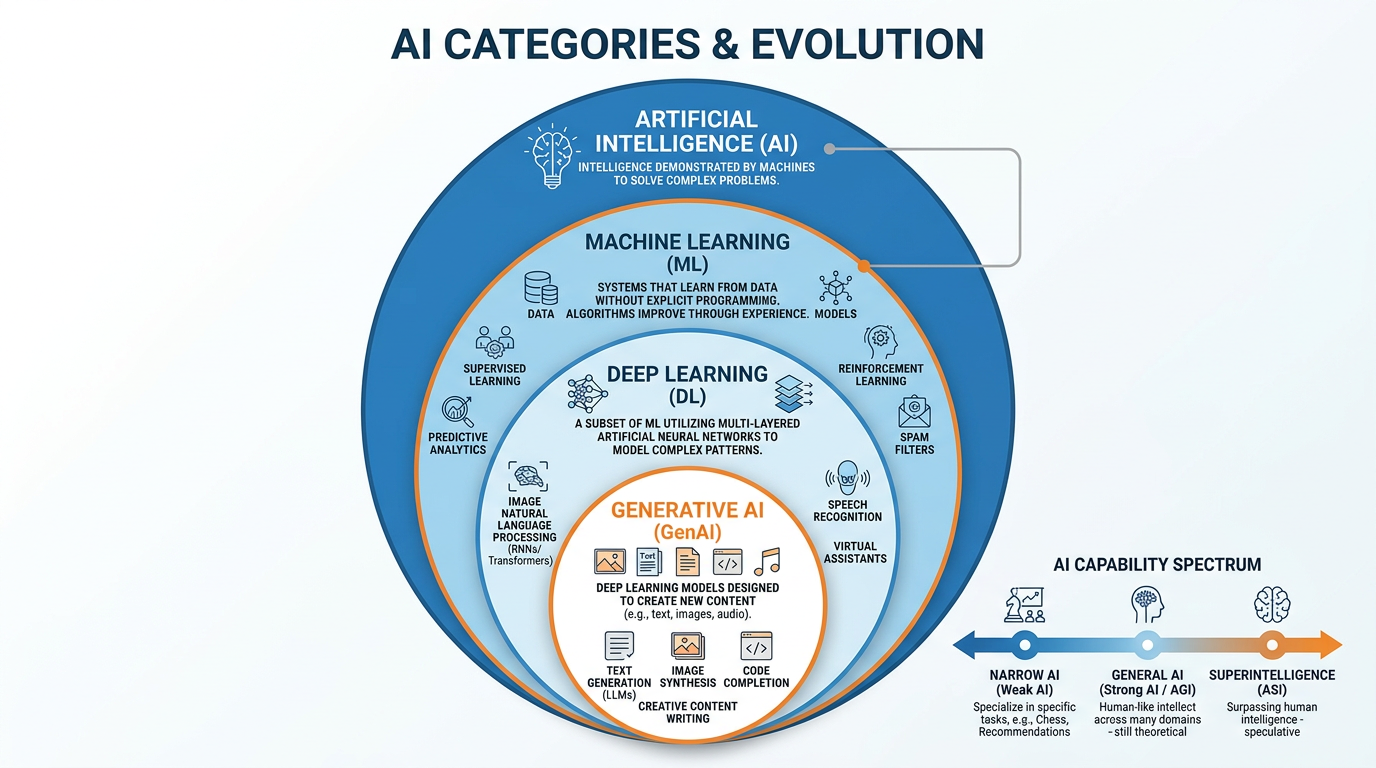
Figure 2:The hierarchy of AI categories — from the broadest concept of Artificial Intelligence down to specific subfields like Machine Learning, Deep Learning, and Generative AI. Understanding this hierarchy is essential for evaluating AI tools and solutions.
1.2Narrow AI vs. General AI
Narrow AI (also called Artificial Narrow Intelligence or “weak AI”) refers to AI systems designed to perform a specific task or a narrow set of related tasks. Every AI system in commercial use today is narrow AI.
Examples:
Siri and Alexa (voice assistants)
Netflix recommendation algorithms
Spam email filters
Self-driving car navigation systems
ChatGPT (language generation)
Medical imaging diagnostic tools
Narrow AI can be extraordinarily powerful within its domain — a chess AI can defeat any human grandmaster — but it cannot transfer that expertise to an unrelated task like writing poetry or diagnosing diseases.
Artificial General Intelligence (AGI), sometimes called “strong AI,” refers to a hypothetical AI system that possesses the full range of human cognitive abilities. An AGI could learn any intellectual task that a human can, transfer knowledge between domains, reason abstractly, and adapt to entirely new situations without specific training.
AGI does not yet exist. Despite dramatic advances in AI capabilities, no system today demonstrates true general intelligence. Estimates for when AGI might be achieved vary wildly — from a few years to several decades to “possibly never.”
The pursuit of AGI raises profound philosophical and theological questions about the nature of intelligence, consciousness, and what it means to be human — questions we will return to throughout this course.
Artificial Superintelligence (ASI) is a theoretical concept referring to AI that surpasses human intelligence in virtually every domain — scientific creativity, social skills, general wisdom, and more.
ASI remains firmly in the realm of speculation, but it has been the subject of serious discussion among AI researchers, philosophers, and ethicists. Thinkers like Nick Bostrom (author of Superintelligence) have argued that the development of ASI could pose existential risks to humanity if not carefully managed.
For our purposes in this course, we will focus on narrow AI — the technology that is transforming business today — while keeping an eye on the trajectory toward more capable systems.
1.3The AI Spectrum: From Rules to Learning
Not all AI works the same way. It is helpful to think of AI technologies as existing on a spectrum, from simple rule-based systems to sophisticated learning algorithms.
Table 1:The AI Technology Spectrum
Technology | How It Works | Business Example | Era |
|---|---|---|---|
Rule-Based Systems | Follows pre-programmed if-then rules | Tax preparation software | 1960s–present |
Expert Systems | Encodes domain expert knowledge into decision rules | Medical diagnosis assistants | 1970s–1990s |
Machine Learning | Learns patterns from data without explicit programming | Fraud detection, product recommendations | 2000s–present |
Deep Learning | Uses multi-layered neural networks for complex pattern recognition | Voice recognition, image classification | 2010s–present |
Generative AI | Creates new content (text, images, code, audio) based on training data | ChatGPT, DALL-E, Midjourney | 2020s–present |
2Categories of AI: Machine Learning and Generative AI
2.1Machine Learning: Learning from Data
Machine learning is the engine that powers most modern AI applications. Rather than telling a computer exactly what to do in every situation, ML allows the computer to learn from examples. Feed it thousands of emails labeled “spam” or “not spam,” and it learns to identify spam on its own. Show it millions of product purchases and customer profiles, and it learns to recommend products that customers are likely to buy.
The Three Types of Machine Learning
Learning from labeled examples
The algorithm is trained on a dataset where the correct answer is provided for each example. It learns to map inputs to outputs.
Business applications:
Email spam classification
Credit scoring and loan approvals
Sales forecasting
Customer churn prediction
Medical diagnosis from imaging
Analogy: Like a student learning from a textbook with an answer key — they study the questions and correct answers, then apply what they learned to new questions.
Discovering hidden patterns
The algorithm explores data without labeled answers, seeking to find natural groupings, patterns, or structures.
Business applications:
Customer segmentation
Market basket analysis
Anomaly detection (fraud)
Topic modeling for documents
Social network analysis
Analogy: Like sorting a pile of photographs into groups without being told what the categories should be — you naturally group by subject, color, or location.
Learning through trial and error
The algorithm learns by interacting with an environment, receiving rewards for good actions and penalties for bad ones.
Business applications:
Dynamic pricing optimization
Inventory management
Robotic warehouse automation
Ad placement optimization
Game-playing AI (AlphaGo)
Analogy: Like training a dog — you reward desired behaviors and correct undesired ones, and the dog gradually learns what to do.
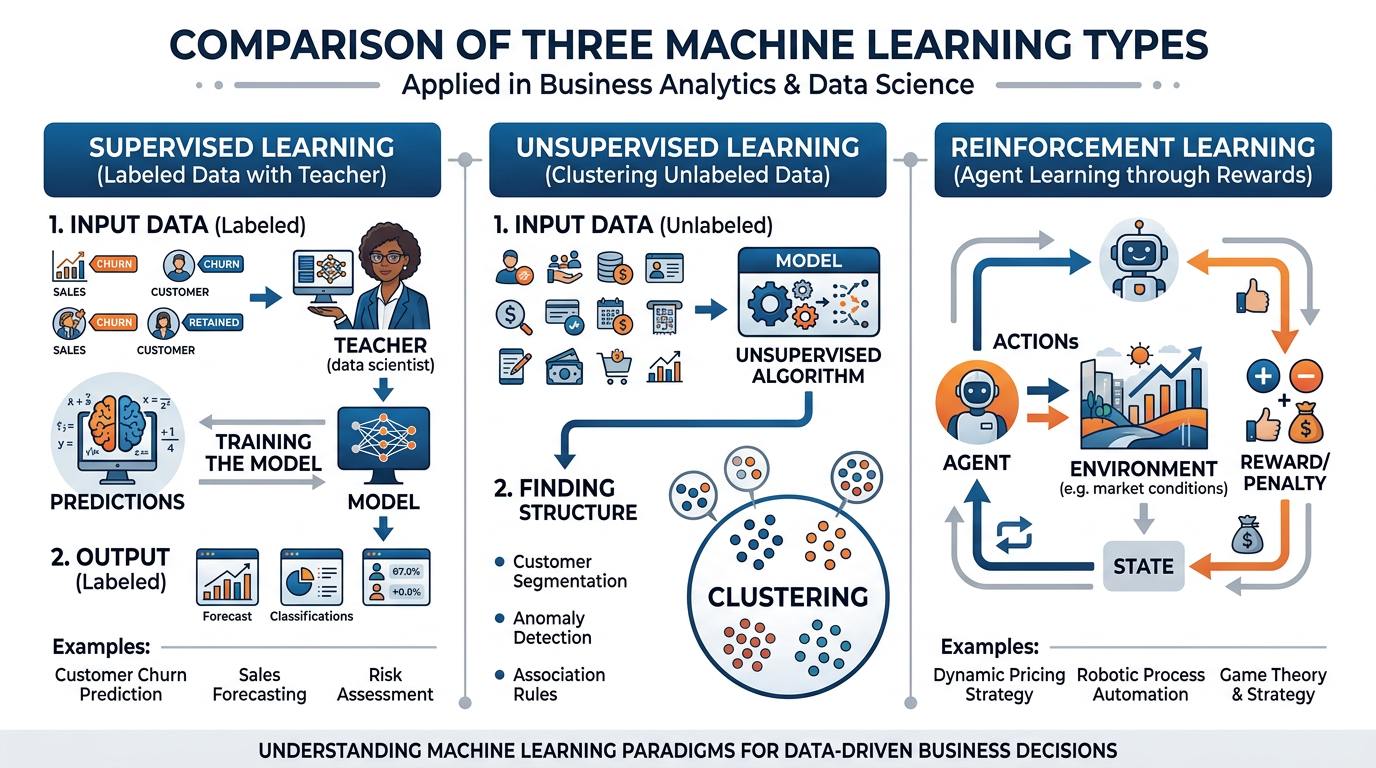
Figure 3:The three major categories of machine learning, each suited to different business problems. Understanding which type to apply is a key competency for business leaders working with AI.
How Machine Learning Works: A Business Perspective
You do not need to understand the mathematics behind gradient descent or backpropagation to be an effective business leader in the AI era. What you do need to understand is the general process by which ML systems are developed and deployed:
Define the Business Problem. What decision are you trying to improve? What outcome do you want to predict? The most common reason ML projects fail is not technical — it is a poorly defined business problem.
Collect and Prepare Data. ML systems learn from data, and the quality of that data determines the quality of the results. This step typically consumes 60-80% of the total project effort. Data must be collected, cleaned, labeled (for supervised learning), and formatted.
Choose and Train the Model. Data scientists select an appropriate algorithm and train it on the prepared data. Training involves feeding the data through the model and adjusting its parameters to minimize errors.
Evaluate Performance. The model is tested on data it has never seen before to assess how well it generalizes. Key metrics include accuracy, precision, recall, and F1 score.
Deploy to Production. The trained model is integrated into business systems where it can make predictions on new data in real time.
Monitor and Maintain. ML models can degrade over time as the data they encounter changes (a phenomenon called “model drift”). Ongoing monitoring and periodic retraining are essential.
2.2Generative AI: Creating New Content
Generative AI has captured the world’s attention since the release of ChatGPT in November 2022. In just two months, ChatGPT reached 100 million users — the fastest-growing consumer application in history. But ChatGPT is just one manifestation of a broader technological revolution.
The Generative AI Landscape
Table 2:Major Generative AI Categories and Tools
Category | What It Generates | Key Tools | Business Applications |
|---|---|---|---|
Text Generation | Written content, code, analysis | ChatGPT, Claude, Gemini, Perplexity | Content marketing, customer service, coding assistance, research |
Image Generation | Photorealistic images, illustrations, designs | DALL-E, Midjourney, Adobe Firefly, Stable Diffusion | Marketing materials, product mockups, advertising creative |
Audio Generation | Speech, music, sound effects | ElevenLabs, Suno, Udio | Voiceovers, podcasts, accessibility, customer service |
Video Generation | Video clips, animations | Sora (OpenAI), Runway, Synthesia | Marketing videos, training content, product demos |
Code Generation | Software code, applications | GitHub Copilot, Cursor, Replit AI | Software development, automation, rapid prototyping |
How Generative AI Works: The Transformer Architecture
The breakthrough behind modern generative AI is the transformer architecture, introduced in the landmark 2017 paper “Attention Is All You Need” by researchers at Google. Transformers process text (or other data) by paying “attention” to the relationships between all parts of the input simultaneously, rather than processing it sequentially.
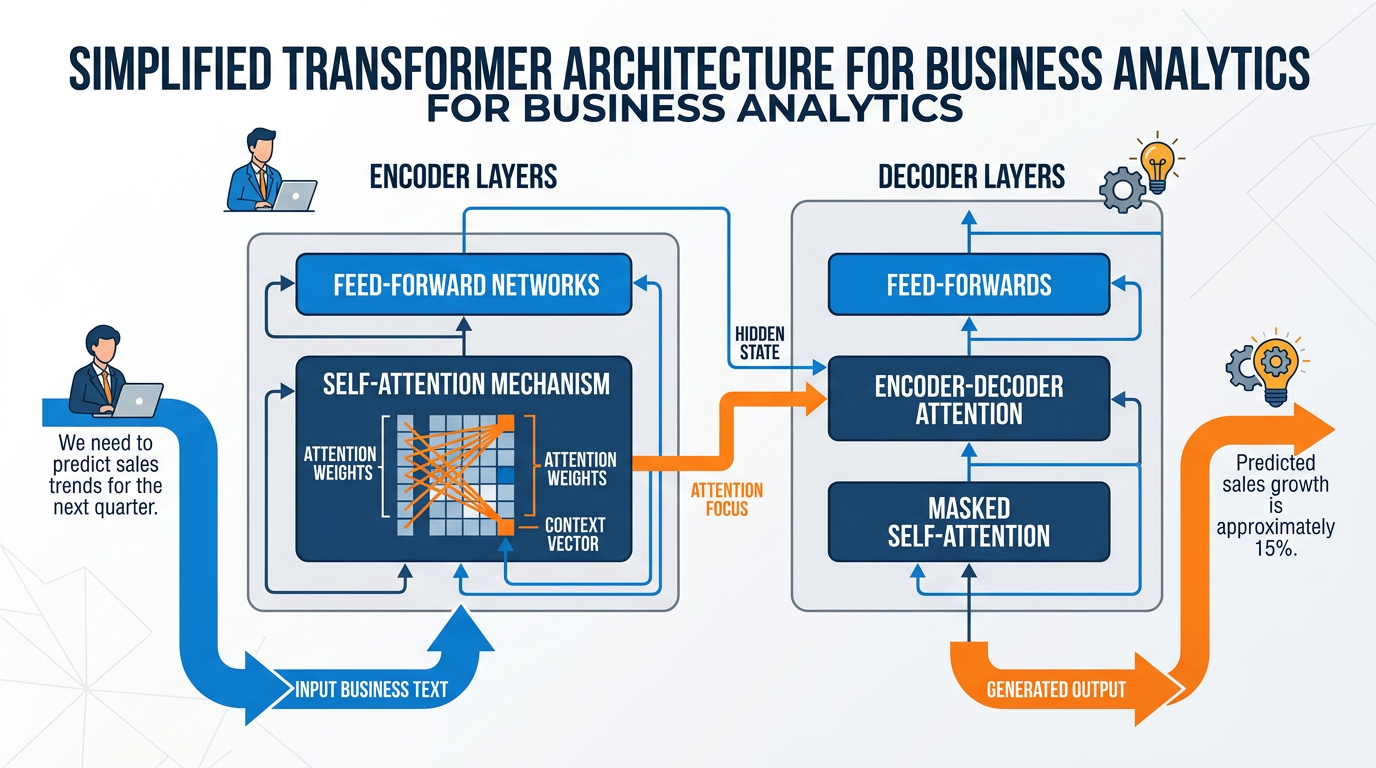
Figure 4:A simplified view of the transformer architecture that powers large language models. The “attention mechanism” allows the model to consider the relationships between all words in a sentence simultaneously.
Large language models (LLMs) like ChatGPT are built on the transformer architecture and trained on vast corpora of text data. During training, the model learns statistical patterns about how words, sentences, and ideas relate to each other. When you provide a prompt, the model generates a response by predicting the most likely sequence of words based on those learned patterns.
3AI in Business: Automation and Transformation
3.1The Business Case for AI
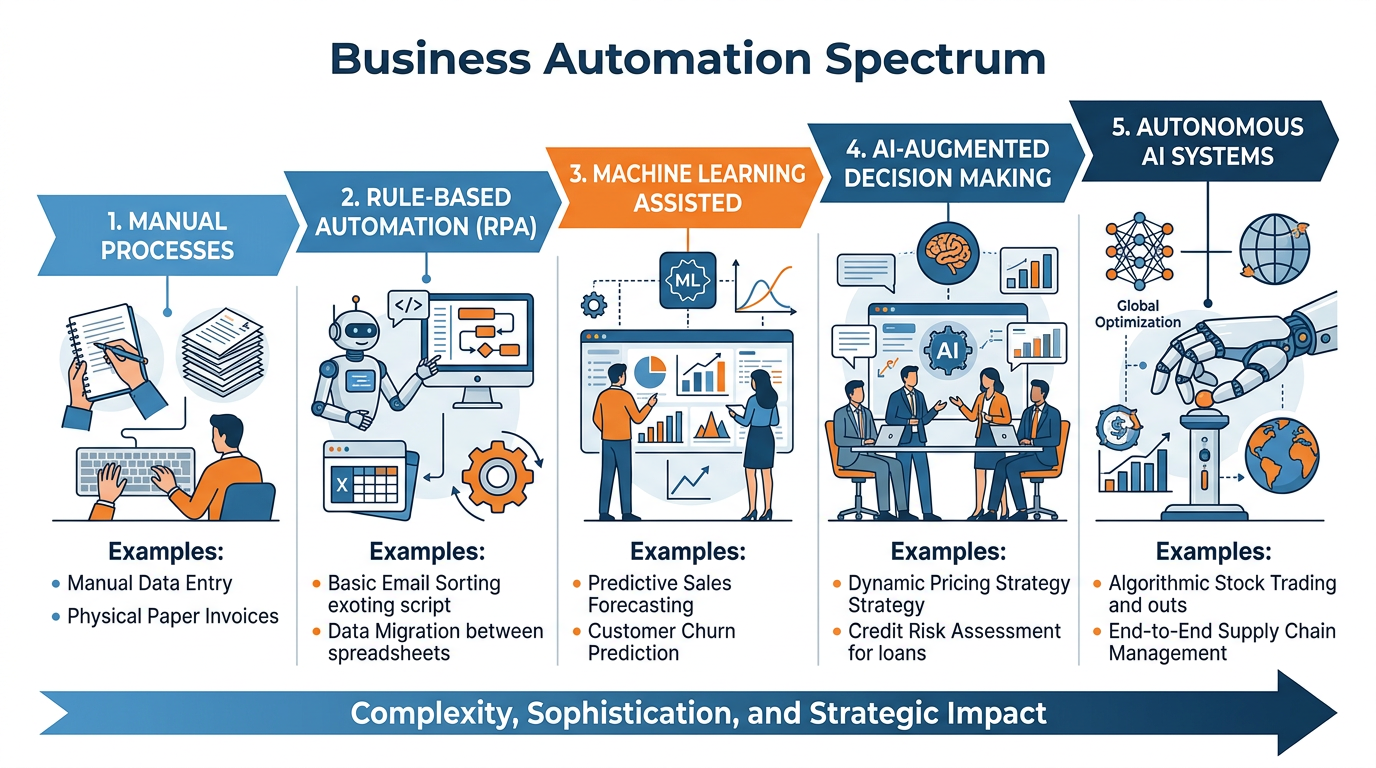
Figure 5:The business automation spectrum — from fully manual processes to autonomous AI systems. Most organizations today are somewhere in the middle, using AI to augment rather than replace human decision-making.
Why are businesses investing billions of dollars in AI? The answer lies in AI’s ability to enhance efficiency, improve decision-making, personalize customer experiences, and create entirely new products and services.
Table 3:AI Business Impact by Function
Business Function | AI Application | Impact | Example Company |
|---|---|---|---|
Marketing | Personalized content, customer segmentation, predictive analytics | 20-30% increase in campaign effectiveness | Netflix, Spotify |
Sales | Lead scoring, demand forecasting, conversational AI | 50% increase in qualified leads | Salesforce Einstein |
Operations | Supply chain optimization, predictive maintenance, quality control | 15-25% reduction in operational costs | Amazon, Siemens |
Finance | Fraud detection, algorithmic trading, risk assessment | 60-70% reduction in fraud losses | JPMorgan Chase, PayPal |
Human Resources | Resume screening, employee engagement analysis, skills assessment | 75% reduction in time-to-hire | LinkedIn, HireVue |
Customer Service | Chatbots, sentiment analysis, automated ticket routing | 40% reduction in support costs | Zendesk, Intercom |
3.2Case Study: How Starbucks Uses AI
Starbucks provides an excellent example of how a large company integrates AI across its operations. Their AI platform, “Deep Brew,” powers multiple aspects of the business:
Deep Brew in Action
Personalized Recommendations. The Starbucks mobile app uses machine learning to analyze each customer’s purchase history, time of day, weather conditions, and local store inventory to make personalized drink recommendations. This personalization engine drives a significant portion of mobile orders.
Predictive Inventory Management. AI models predict demand for each product at each store, accounting for variables like weather, local events, day of the week, and seasonal trends. This reduces waste and ensures popular items are always in stock.
Labor Optimization. Deep Brew helps managers schedule staff by predicting busy periods based on historical data and external factors. This ensures adequate coverage during peak times while controlling labor costs.
Equipment Maintenance. IoT sensors on espresso machines and other equipment feed data to AI systems that predict when maintenance is needed before a breakdown occurs, reducing downtime and repair costs.
The result? Starbucks has reported that AI-driven personalization has increased customer spending by 3x in some channels and reduced waste by over 30% in pilot stores.
3.3Case Study: AI at JPMorgan Chase — COiN
JPMorgan Chase’s Contract Intelligence (COiN) platform demonstrates AI’s transformative potential in finance. The system uses natural language processing and machine learning to review commercial loan agreements — a task that previously required approximately 360,000 hours of lawyer time annually.
COiN can review documents in seconds, extracting key data points with greater accuracy than human reviewers. The system processes 12,000 annual commercial credit agreements, identifying over 150 relevant attributes per document. What once took lawyers months of tedious work is now accomplished in hours, freeing legal professionals to focus on higher-value advisory work.
3.4Case Study: Zara’s AI-Powered Fast Fashion
Zara, the Spanish fashion retailer, uses AI throughout its supply chain to maintain its competitive advantage of bringing new designs from concept to store shelf in just two weeks — compared to six months for traditional retailers.
Trend Prediction. Zara’s AI systems analyze social media posts, fashion blogs, runway shows, and sales data to identify emerging trends before they go mainstream. Natural language processing parses millions of social media conversations to detect rising interest in specific styles, colors, or materials.
Design Assistance. AI tools help designers create new garments by suggesting fabric combinations, color palettes, and style elements based on trend analysis. Human designers retain creative control, but AI dramatically accelerates the ideation process.
Demand Forecasting. Machine learning models predict demand for each SKU at each store location, enabling Zara to produce smaller initial batches and restock quickly based on actual sales data, rather than overproducing based on forecasts.
Dynamic Pricing. AI algorithms optimize markdown timing and pricing to maximize revenue while clearing inventory efficiently.
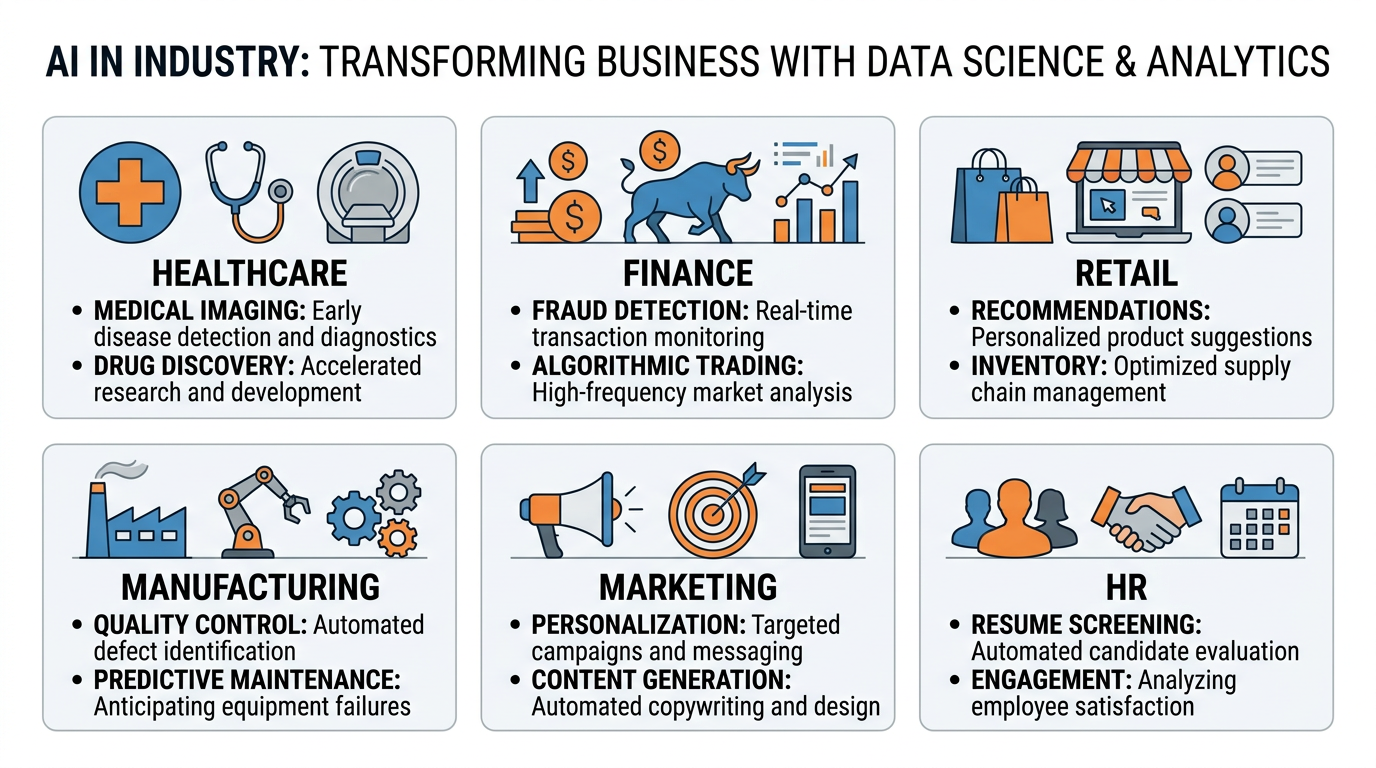
Figure 6:AI applications across major industry sectors. Every business function is being transformed by AI, creating opportunities for competitive advantage and operational efficiency.
3.5Small Business AI Applications
AI is not exclusively for large corporations. Small and medium-sized businesses are increasingly adopting AI tools that were once available only to enterprises with massive technology budgets:
Jasper AI / Copy.ai: Generate marketing copy, social media posts, email campaigns
Canva AI: Design marketing materials with AI-assisted tools
HubSpot AI: Automated email marketing and lead nurturing
Buffer AI Assistant: Social media content scheduling and optimization
QuickBooks AI: Automated bookkeeping and financial forecasting
Grammarly Business: AI-powered writing assistance for teams
Notion AI: Automated note-taking, summarization, project management
Zapier AI: Automated workflow connections between apps
Tidio / Intercom: AI chatbots for customer support
Freshdesk AI: Automated ticket routing and response suggestions
CallRail: AI-powered call tracking and conversation analysis
Gorgias: E-commerce customer support automation
Crystal Knows: AI-powered personality insights for sales
Gong.io: AI analysis of sales calls for coaching
Google Analytics 4: AI-powered website analytics and predictions
Tableau AI: Automated data visualization and insights
4Prompt Engineering: The New Business Literacy
4.1What Is Prompt Engineering?
In the age of generative AI, prompt engineering has emerged as a critical skill for business professionals. The quality of output you get from an AI system depends enormously on the quality of the instructions you provide. A vague, poorly structured prompt will produce vague, poorly structured results. A clear, detailed, well-structured prompt will produce clear, detailed, useful results.
Think of prompt engineering as the new “search literacy.” Just as the rise of Google required people to develop skills in formulating effective search queries, the rise of generative AI requires people to develop skills in formulating effective prompts.
4.2The Anatomy of an Effective Prompt
Effective prompts typically include several key components:
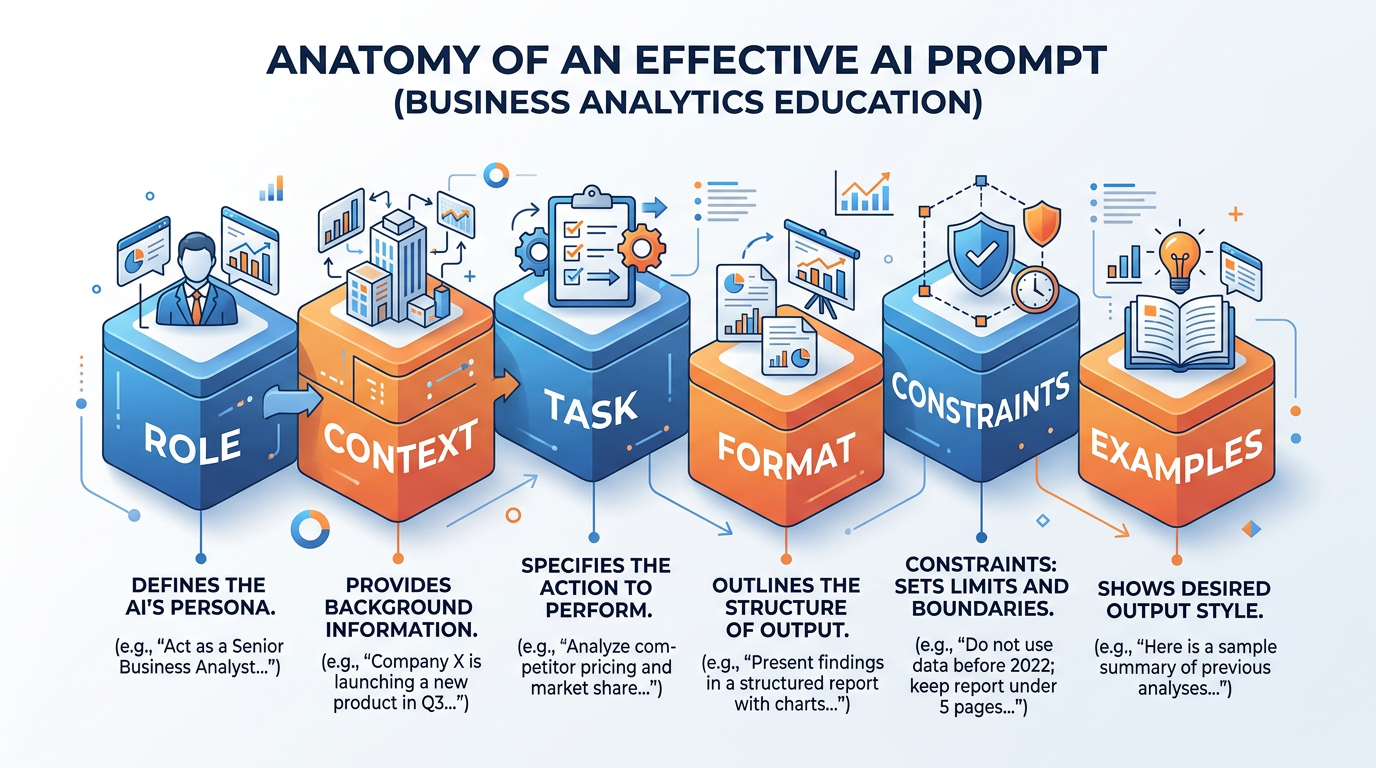
Figure 7:The anatomy of an effective AI prompt. Each component contributes to generating a more accurate and useful response.
Table 4:Components of an Effective Prompt
Component | Purpose | Example |
|---|---|---|
Role | Establish the AI’s persona and expertise level | “You are a senior financial analyst specializing in retail industry trends.” |
Context | Provide background information the AI needs | “Our company is a mid-size retailer with $50M annual revenue considering expanding into e-commerce.” |
Task | Clearly state what you want the AI to produce | “Create a competitive analysis comparing our top three e-commerce platform options.” |
Format | Specify the desired output structure | “Present as a comparison table with rows for each platform and columns for cost, features, scalability, and ease of integration.” |
Constraints | Set boundaries and requirements | “Keep the analysis focused on platforms supporting fewer than 10,000 SKUs. Budget limit: $500/month.” |
Examples | Show the AI what good output looks like | “Here is an example of the format I want: [example]” |
4.3Prompting Techniques for Business
Zero-Shot Prompting
The simplest approach — provide a task with no examples.
Summarize the key risks of implementing an AI chatbot for customer
service in a healthcare organization. Focus on regulatory compliance,
patient privacy, and liability concerns.
Few-Shot Prompting
Provide examples of desired input-output pairs before your actual task.
Classify the following customer reviews as Positive, Negative, or Neutral:

Review: "The product exceeded my expectations! Fast shipping too."
Classification: Positive

Review: "It works, but nothing special for the price."
Classification: Neutral

Review: "Terrible quality. Broke after one week. Want a refund."
Classification: Negative

Review: "I've been using this software for three months and it has
completely transformed our inventory management process."
Classification:
Chain-of-Thought Prompting
Ask the AI to reason step by step before providing a final answer.
A small retail business has monthly revenue of $120,000 and is
considering implementing an AI-powered inventory management system
that costs $2,000/month. Historical data shows similar businesses
have reduced inventory costs by 15-20% with such systems. Their
current monthly inventory cost is $40,000.

Think through this step by step:
1. Calculate the potential savings range
2. Determine the net benefit after the system cost
3. Calculate the ROI
4. Recommend whether to proceed and explain your reasoning
Role-Based Prompting
Assign the AI a specific professional role to shape its perspective and language.
You are a Christian business ethics professor at a university. A
student asks you: "Is it ethical for a company to use AI to make
hiring decisions without telling candidates?"

Provide a thoughtful response that considers:
- Biblical principles of honesty and transparency
- Legal requirements (EEOC guidelines)
- Practical business considerations
- The dignity of job applicants as people made in God's image4.4Common Prompting Mistakes
4.5Practical Exercise: Prompt Comparison
Consider these two prompts asking for the same information:
Write something about using AI in marketing.Problems:
No role assignment
No specific focus
No format specification
No audience definition
No length guidance
No constraints
You are a digital marketing strategist with 10 years of experience
in retail. Create a concise action plan (500-700 words) for a small
clothing boutique owner who wants to start using AI tools in their
marketing. The owner has no technical background and a monthly
marketing budget of $500.

Include:
1. Three specific AI tools they should try first (with pricing)
2. A realistic 30-day implementation timeline
3. Expected results they can measure
4. One potential risk to watch for

Write in a practical, jargon-free style. Use bullet points for
the action items.
Why this works:
Clear role and expertise level
Specific audience with constraints
Defined format and length
Actionable deliverables
Measurable outcomes requested
5Privacy and Bias: An Introduction
5.1Why Privacy Matters in the AI Era
“The prudent see danger and take refuge, but the simple keep going and pay the penalty.”
Proverbs 27:12 (NIV)
AI systems are fundamentally data-driven. They learn from data, they process data, and they make decisions based on data. This creates inherent privacy concerns that every business professional must understand.
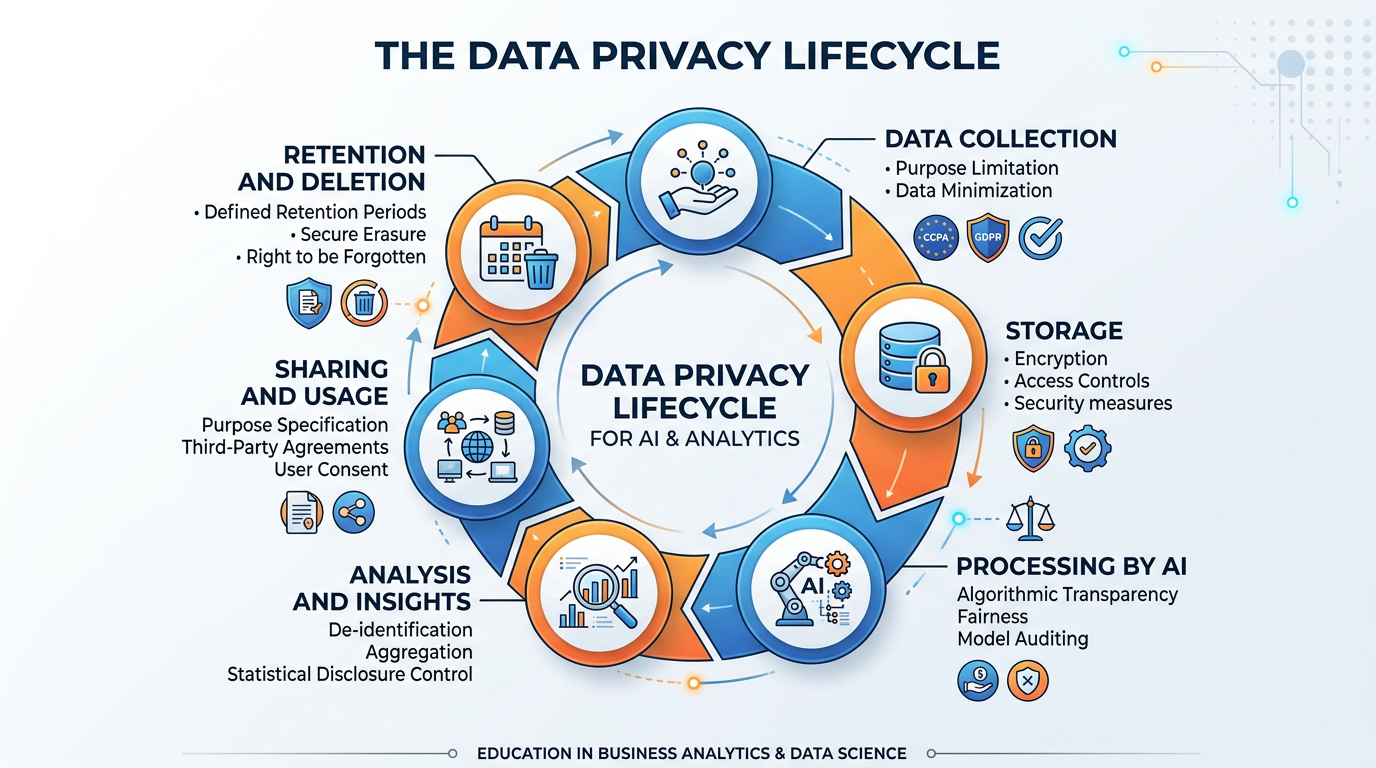
Figure 8:The data privacy lifecycle in AI-driven organizations. Each stage presents unique privacy considerations and regulatory requirements that business leaders must understand and manage.
Data Collection and Consent
Modern AI systems often require vast amounts of data to function effectively. This data frequently includes personal information — customer purchase histories, browsing behavior, demographic information, health records, financial data, and more. The ethical and legal questions surrounding this data are profound:
Informed consent. Do customers understand what data is being collected and how AI systems will use it?
Purpose limitation. Is data collected for one purpose being used for another without consent?
Data minimization. Is the organization collecting only the data it truly needs, or is it hoarding data “just in case”?
Right to be forgotten. Can individuals request deletion of their data from AI training sets?
Key Privacy Regulations
Table 5:Major Data Privacy Regulations
Regulation | Jurisdiction | Key Provisions | AI Relevance |
|---|---|---|---|
GDPR | European Union | Right to access, deletion, portability; consent requirements; data breach notification | Right to explanation of automated decisions; restrictions on AI profiling |
CCPA/CPRA | California, USA | Right to know what data is collected; right to opt-out of data sales; right to deletion | Applies to AI-driven personalization and profiling |
HIPAA | USA (Healthcare) | Protection of health information; security requirements; breach notification | Strict limits on using health data for AI training |
FERPA | USA (Education) | Student record privacy; parental consent requirements | Limits use of student data in educational AI tools |
EU AI Act | European Union | Risk-based classification of AI systems; transparency requirements; prohibited practices | First comprehensive AI-specific regulation globally |
Case Study: Cambridge Analytica
The Cambridge Analytica scandal (2018) remains one of the most important cautionary tales about AI and privacy. The political consulting firm harvested personal data from approximately 87 million Facebook users through a personality quiz app. The data — collected without users’ meaningful consent — was used to build AI-driven psychographic profiles for targeted political advertising during the 2016 U.S. presidential election and the Brexit referendum.
The fallout was severe: Facebook (now Meta) paid a $5 billion FTC fine — the largest privacy penalty in U.S. history. Cambridge Analytica went bankrupt. Public trust in social media data practices plummeted. And the scandal accelerated the passage of privacy legislation worldwide.
5.2Understanding AI Bias
AI bias is one of the most critical challenges facing businesses deploying AI systems. Because AI learns from historical data — and historical data reflects historical inequities — AI systems can perpetuate, amplify, and even automate discrimination.
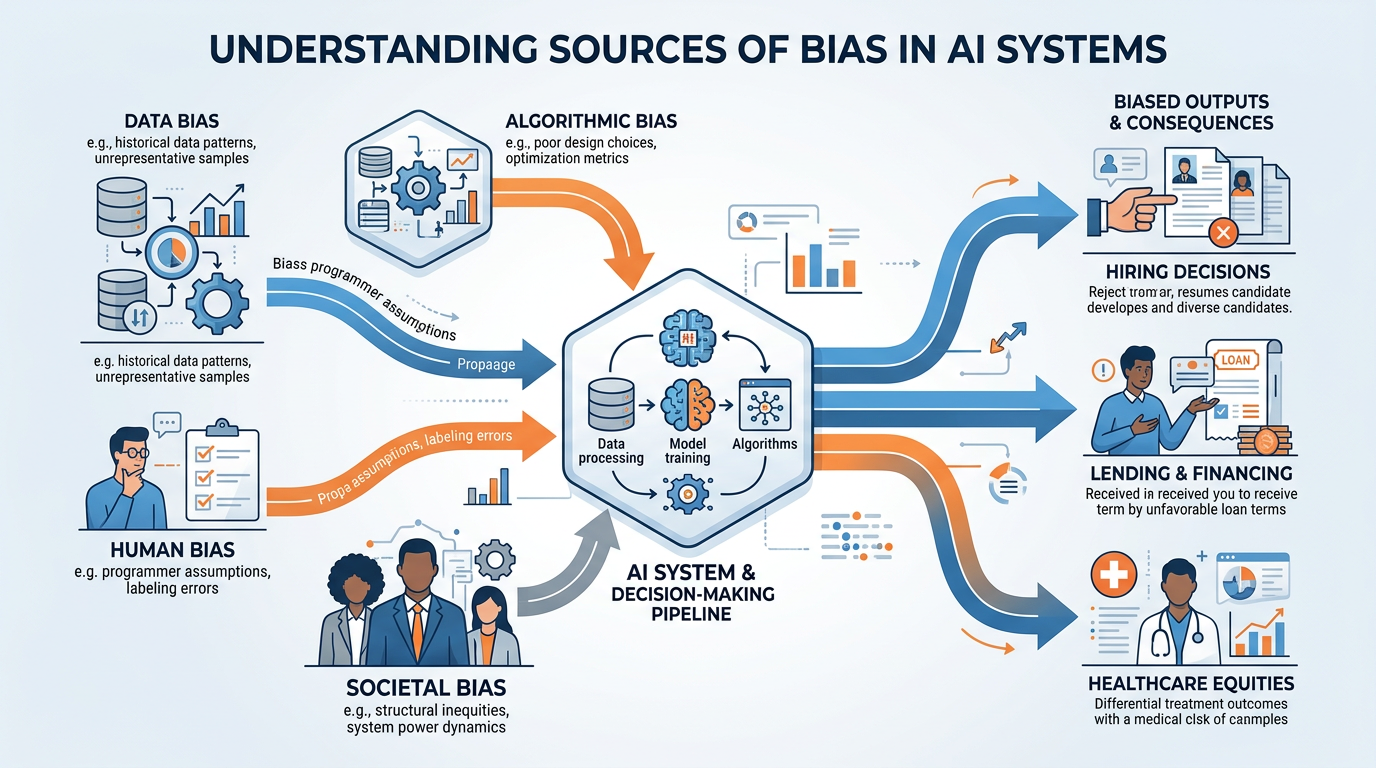
Figure 9:The four primary sources of AI bias and how they propagate through the AI pipeline. Understanding these sources is the first step toward building fairer AI systems.
Sources of AI Bias
Case Study: Amazon’s AI Recruiting Tool
In 2018, Reuters reported that Amazon had scrapped an AI recruiting tool that showed significant bias against women. The system was trained on resumes submitted to the company over a ten-year period — a period during which the technology industry was overwhelmingly male. The AI learned to associate “male” characteristics with success:
It penalized resumes that included the word “women’s” (as in “women’s chess club captain”)
It downgraded graduates of all-women’s colleges
It favored language patterns more common in male-written resumes
Amazon’s engineers attempted to correct the bias, but ultimately concluded that they could not guarantee the system would not find other ways to discriminate. The project was abandoned.
Case Study: Healthcare Algorithm Bias
A 2019 study published in Science revealed that a widely used healthcare algorithm — used by hospitals across the United States to predict which patients need extra medical care — exhibited significant racial bias. The algorithm used healthcare spending as a proxy for healthcare needs. But because Black patients in America historically have had less access to healthcare (and therefore lower healthcare spending), the algorithm systematically underestimated the healthcare needs of Black patients.
The result: Black patients who were equally as sick as white patients were assigned lower risk scores and received less additional care. The study estimated that eliminating this bias would increase the percentage of Black patients receiving extra care from 17.7% to 46.5%.
5.3A Christian Perspective on Privacy and Bias
As Christians entering the business world, we have a unique and important perspective on these issues:
6The AI-Ready Business Professional
6.1Skills for the AI Era
What does it mean to be “AI-ready” as a business professional? It does not mean becoming a data scientist or software engineer. It means developing a specific set of competencies that enable you to work effectively alongside AI:
Understand AI categories and capabilities
Evaluate AI tools for specific business needs
Write effective prompts for generative AI
Interpret AI-generated insights and recommendations
Recognize limitations and failure modes
Identify business problems that AI can solve
Assess build-vs-buy-vs-partner decisions
Calculate ROI for AI investments
Understand competitive implications of AI adoption
Plan AI implementation roadmaps
Evaluate AI systems for bias and fairness
Ensure compliance with privacy regulations
Advocate for transparent AI practices
Balance innovation with responsibility
Apply Christian values to technology decisions
Explain AI capabilities to non-technical stakeholders
Collaborate effectively with data science teams
Present AI-driven insights to decision-makers
Manage change when AI transforms workflows
Build trust in AI-augmented processes
6.2The Human-AI Collaboration Framework
The most successful organizations don’t replace humans with AI — they design workflows that leverage the unique strengths of both:
Table 6:Human vs. AI Strengths
Capability | Human Advantage | AI Advantage |
|---|---|---|
Pattern Recognition | Recognizes novel, unprecedented patterns | Finds patterns in massive datasets at scale |
Creativity | Generates truly novel ideas, empathy-driven design | Generates variations and combinations rapidly |
Decision Making | Considers ethics, context, relationships | Processes data objectively, consistently |
Communication | Understands nuance, emotion, culture | Processes language at massive scale, 24/7 |
Learning | Transfers knowledge across wildly different domains | Learns from millions of examples rapidly |
Judgment | Moral reasoning, wisdom, accountability | Optimizes for defined objectives consistently |
7Chapter Summary
This chapter has introduced the foundational concepts you need to begin your journey into AI for business:
Artificial intelligence encompasses a range of technologies, from simple rule-based systems to sophisticated generative AI, all designed to perform tasks typically requiring human intelligence.
Machine learning — the engine behind most modern AI — enables systems to learn from data rather than being explicitly programmed, with supervised, unsupervised, and reinforcement learning as the three major categories.
Generative AI represents the latest frontier, with systems like ChatGPT, DALL-E, and Gemini capable of creating new text, images, audio, and code.
AI is transforming every business function — from marketing and sales to operations and finance — creating both opportunities and challenges.
Prompt engineering is emerging as a critical business literacy skill, enabling professionals to interact effectively with AI systems.
Privacy and bias are fundamental challenges that demand attention from every business leader deploying AI systems.
As Christians, we bring essential perspectives to these challenges — rooted in human dignity, truth, stewardship, and justice.
Artificial Intelligence (AI) Computer systems capable of performing tasks that typically require human intelligence, including learning, reasoning, problem-solving, perception, and language understanding.
Machine Learning (ML) A subset of AI in which systems learn to perform tasks by identifying patterns in data, improving with experience rather than through explicit programming.
Generative AI AI systems that create new content (text, images, audio, video, code) based on patterns learned from training data.
Large Language Model (LLM) A type of generative AI trained on vast amounts of text data, capable of understanding and generating human-like text. Examples include GPT-4, Claude, and Gemini.
Prompt Engineering The practice of designing and refining inputs to AI systems to elicit high-quality, relevant outputs.
Transformer Architecture The neural network architecture underlying most modern LLMs, introduced in the 2017 paper “Attention Is All You Need,” notable for its attention mechanism.
Supervised Learning ML approach where the algorithm learns from labeled data — examples with known correct answers.
Unsupervised Learning ML approach where the algorithm discovers patterns in unlabeled data without predefined categories.
Reinforcement Learning ML approach where the algorithm learns through trial and error, receiving rewards or penalties for actions.
AI Bias Systematic errors in AI outputs that produce unfair results for certain groups, often originating from biased training data or flawed design.
Hallucination When an AI system generates confident-sounding but factually incorrect information.
Model Drift The degradation of an AI model’s performance over time as the data it encounters diverges from its training data.
GDPR The General Data Protection Regulation — the European Union’s comprehensive data privacy law.
EU AI Act The world’s first comprehensive AI-specific regulation, classifying AI systems by risk level and imposing corresponding requirements.
Narrow AI AI designed for a specific task or narrow set of tasks — all commercially available AI today.
Artificial General Intelligence (AGI) Hypothetical AI possessing the full range of human cognitive abilities.
8Module 1 Activities
8.1Discussion: The Role of AI in Modern Business
8.2Written Analysis: AI Impact Assessment
8.3Reflection: Faith and Technology
8.4Hands-On Activity 1: AI Tool Exploration
8.5Hands-On Activity 2: AI Ethics Case Analysis
Chapter 1 has established the foundation for understanding AI in business. In Chapter 2, we will trace the fascinating history of artificial intelligence — from Alan Turing’s revolutionary ideas in the 1950s to the deep learning revolution that powers today’s most capable AI systems.