The Shifting Landscape of IT Innovation in Higher Education
From Legacy Systems to Intelligent Campuses
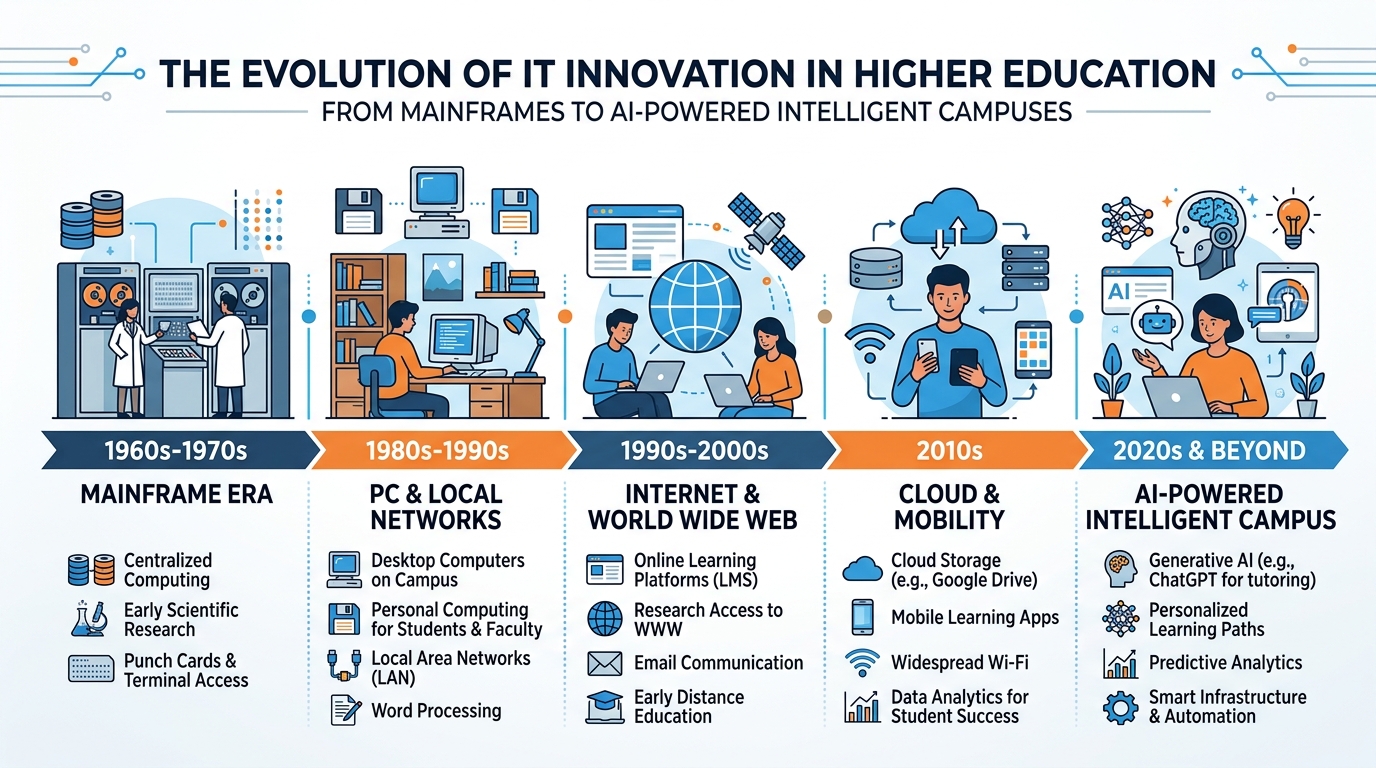
Figure 1:Chapter 1 Overview: The evolution of IT in higher education — from isolated mainframes in the 1960s to today’s AI-powered intelligent campus ecosystems. Each era introduced new capabilities, new expectations, and new institutional challenges.
Higher education stands at a remarkable inflection point. For decades, colleges and universities managed information technology as a back-office function — important for payroll, registration, and research computing, but rarely seen as a strategic differentiator. That era is over. Today, information technology is the connective tissue of the academic enterprise, enabling everything from hybrid instruction to precision advising to real-time research collaboration across continents.
The catalyst for this acceleration is, of course, generative artificial intelligence. But understanding how generative AI is reshaping higher education requires a clear-eyed look at the terrain it has entered: decades of technology investment, institutional culture, procurement constraints, and uneven adoption that together form the complex IT landscape of today’s academy. This chapter traces that landscape — where it came from, where it stands now, and what the arrival of AI-native tools means for institutions of every size, type, and mission.
11.1 A Brief History of IT in Higher Education
Universities were among the first non-governmental organizations to acquire digital computers. The story of IT in higher education is, in many ways, the story of computing itself.
1.11.1.1 The Mainframe Era (1960s–1970s)
The first institutional computers arrived in major research universities in the late 1950s and early 1960s — massive, room-filling machines shared by the entire institution through a batch-processing model. IBM’s System/360, introduced in 1964, became the workhorse of university computing centers. Access was highly centralized: researchers and administrators submitted card-decks or paper-tape jobs to a computing center, waited hours or days for results, and retrieved printed output.
Despite its cumbersomeness, this era established a critical precedent: universities were willing to make large capital investments in computing infrastructure when the research payoff was clear. Federal funding through the National Science Foundation and DARPA subsidized much of this early adoption, creating a symbiotic relationship between government research priorities and institutional computing capability that persists to this day.
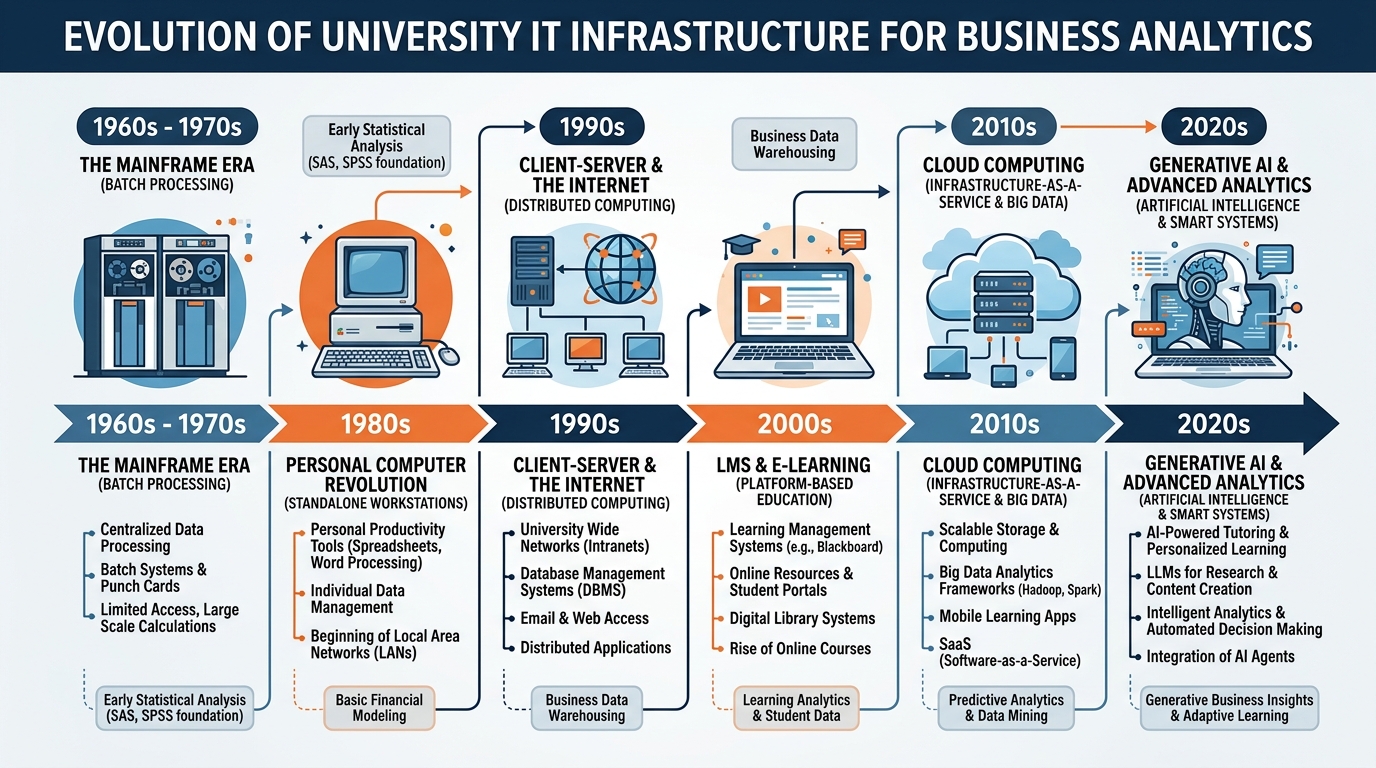
Figure 2:Figure 1.2: The infrastructure evolution arc of university IT — from centralized batch-processing mainframes to globally distributed, cloud-native, AI-augmented environments. Each transition required not just new technology but new organizational models.
1.21.1.2 The Personal Computer Revolution (1980s)
The arrival of the Apple II (1977) and IBM PC (1981) democratized computing in ways the mainframe never could. By the mid-1980s, universities were deploying computer labs — rows of personal computers that any student could use without scheduling time at a central facility. Word processing, spreadsheets, and early statistical software became standard academic tools.
This era also saw the first wave of specialized academic software: grade book applications, early library catalog systems, and departmental financial tracking. IT departments, formerly staffed largely by research computing specialists, began hiring administrators familiar with end-user support. The organizational structure of university IT began to resemble what we see today — a central office managing infrastructure, software licensing, and support, with departmental computing staff handling local needs.
1.31.1.3 The Internet and Client-Server Era (1990s)
No technology transformation in higher education has been more consequential than the commercialization of the Internet. Universities, which had used ARPANET’s successor networks for research since the 1980s, were perfectly positioned to embrace the World Wide Web when it emerged from CERN in 1991. By 1995, virtually every American research university had a web presence. By 2000, most had course websites, faculty pages, and early e-commerce capabilities for online registration and tuition payment.
The 1990s also brought client-server computing — a model in which application logic was split between desktop clients and shared servers. This architecture enabled the first generation of enterprise resource planning (ERP) systems: SAP, PeopleSoft, and Banner became the administrative backbone of university operations, managing student records, human resources, finance, and facilities. These systems remain deeply embedded in most institutions today, often representing the single largest IT investment a university has ever made.
1.41.1.4 The LMS and E-Learning Wave (2000s)
The Learning Management System (LMS) transformed the pedagogical relationship between technology and instruction. Blackboard, WebCT (later acquired by Blackboard), Moodle, and eventually Canvas created digital extensions of the physical classroom — spaces where faculty could post syllabi and readings, administer quizzes, host discussions, and record grades.
The 2008 financial crisis accelerated LMS adoption by creating pressure to expand online enrollment as a revenue strategy. Community colleges and regional universities invested heavily in online program development, and the LMS became critical infrastructure. By 2015, LMS adoption in U.S. higher education was nearly universal.
Yet the LMS also revealed a persistent pattern in higher education IT: technology adoption that is institution-wide but pedagogically shallow. Studies consistently found that most faculty used LMSs primarily for grade posting and document distribution — a tiny fraction of their potential functionality. The gap between technological capability and pedagogical practice became a defining challenge for educational technologists.
21.2 The Current IT Landscape: Complexity, Legacy, and Transformation
Today’s university IT environment is not a coherent system — it is an archaeology of decisions made over five decades, layered atop each other and integrated with varying degrees of success.
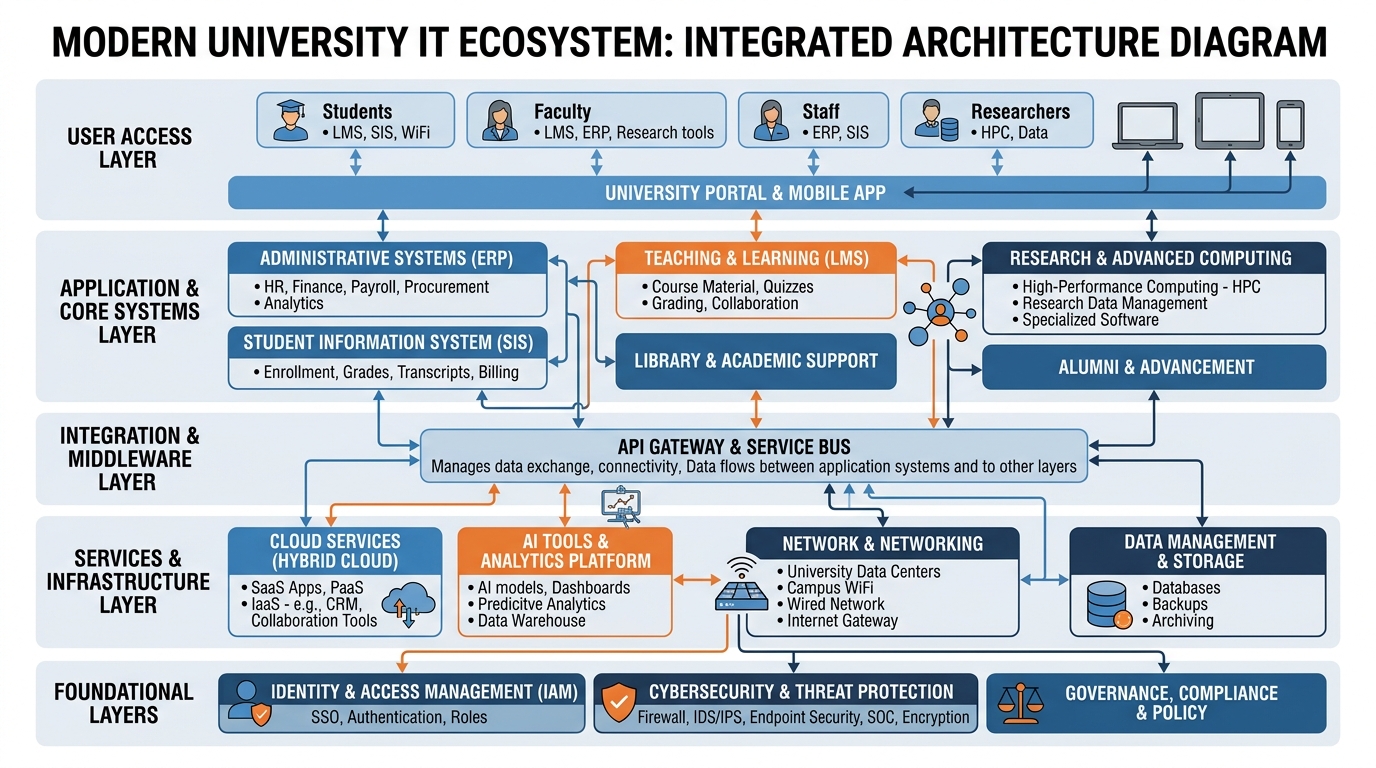
Figure 3:Figure 1.3: The modern university IT ecosystem — a multi-layered, hybrid environment spanning on-premises legacy systems, cloud platforms, SaaS applications, research computing clusters, and an increasingly AI-augmented services layer.
2.11.2.1 The Hybrid Infrastructure Reality
Walk into any mid-sized university’s IT data center today and you will find a striking mixture of the old and the new. Legacy ERP servers run on-premises, often in aging facilities with cooling systems that predate modern efficiency standards. Alongside them, virtual machine clusters run departmental workloads. Kubernetes orchestration manages containerized microservices. And increasingly, cloud gateways pipe workloads to AWS, Azure, and Google Cloud.
This hybrid reality is not a transitional state — it is the stable, long-term condition of most universities. Unlike corporations that can mandate rapid cloud migration, universities must navigate:
Shared governance structures in which faculty senates have input on technology decisions
Research computing requirements that may include specialized hardware (GPU clusters, high-memory nodes) not well-suited to standard cloud economics
Data sovereignty concerns related to FERPA, HIPAA (for health sciences programs), export control regulations, and state privacy laws
Procurement constraints that make rapid vendor transitions difficult
Thin IT staffing relative to the complexity of the environment
2.21.2.2 The Student Information System Challenge
The Student Information System (SIS) — the database that tracks enrollment, grades, transcripts, degree audits, financial aid, and student demographics — is the most critical and most difficult-to-change component of university IT. Major SIS platforms including Banner (Ellucian), PeopleSoft Campus Solutions (Oracle), and Workday Student are built on data models that predate modern computing paradigms.
Replacing an SIS is an undertaking comparable in scale to a hospital replacing its electronic medical records system. The University of California system’s migration to Oracle PeopleSoft across its ten campuses took nearly a decade and cost hundreds of millions of dollars. Other institutions have experienced failed SIS implementations that consumed years of institutional energy and significant financial resources.
The SIS challenge matters profoundly for AI adoption. Most of the data that AI systems need to personalize student experiences, predict academic risk, and optimize institutional operations lives in SIS systems that were never designed for API-based real-time access. Building AI capabilities on top of legacy SIS data requires significant data engineering investment.
2.31.2.3 Cybersecurity: The Existential Challenge
Higher education has become a prime target for ransomware attacks, data breaches, and nation-state espionage. Between 2019 and 2024, dozens of major universities experienced significant cybersecurity incidents:
The University of California San Francisco paid a $1.14 million ransom after a ransomware attack encrypted research data
Lincoln College (Illinois) cited a cybersecurity attack as a contributing factor in its 2022 closure
The 2023 MOVEit vulnerability affected scores of institutions through a single third-party file transfer tool
The attack surface of a university is uniquely difficult to defend. Unlike corporations with controlled networks and managed devices, universities operate open networks serving students, faculty, staff, and visitors on hundreds of thousands of personally owned devices. Academic freedom norms create cultural resistance to restrictive security controls. And the research university model — with collaborators spanning dozens of countries and data sets containing everything from clinical trial results to defense research — creates a target-rich environment for sophisticated adversaries.
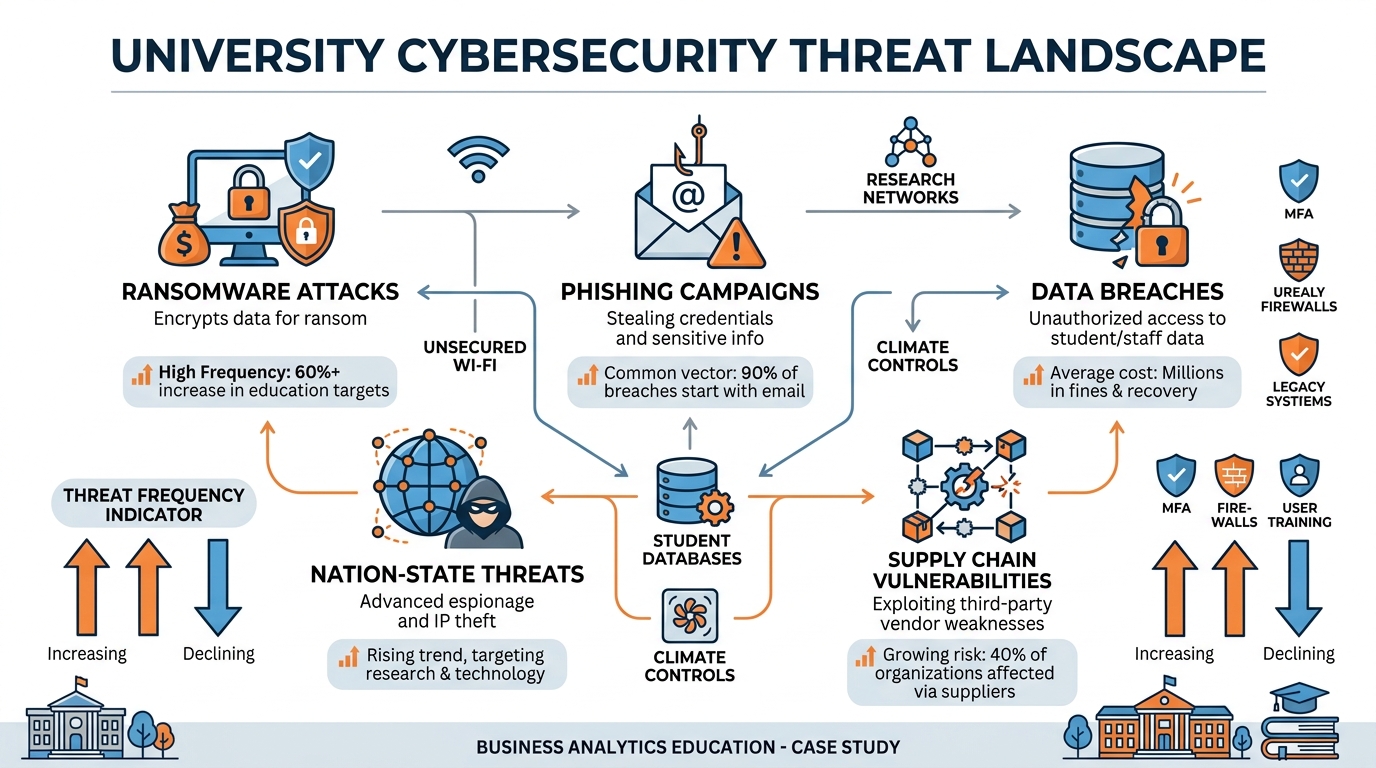
Figure 4:Figure 1.4: The cybersecurity threat landscape facing higher education institutions. Ransomware, phishing campaigns, and third-party software vulnerabilities represent the most frequent vectors, while nation-state threats target research data with increasing sophistication.
2.41.2.4 Data Analytics and the Rise of Institutional Intelligence
One of the most significant IT developments in higher education over the past decade has been the maturation of data analytics as an institutional capability. What began as basic enrollment reporting has evolved into sophisticated predictive modeling used for:
Student success prediction: Identifying students at academic risk before they reach crisis, enabling proactive advising intervention
Enrollment management: Modeling the financial aid and tuition discount strategies that maximize net revenue while meeting enrollment targets
Facilities optimization: Using occupancy sensors and scheduling data to reduce space underutilization
Research portfolio analysis: Understanding the institution’s research strengths, funding trends, and collaboration networks
Platforms like Civitas Learning, EAB Navigate, and Anthology (formerly Campus Management) have built entire product lines around higher education analytics. Salesforce for Higher Education has enabled sophisticated CRM-based student lifecycle management. And nearly every major LMS now includes learning analytics dashboards that give faculty and advisors visibility into student engagement patterns.
Yet the data analytics capability of most universities remains fragmented. Data sits in dozens of disconnected systems — SIS, LMS, advising systems, financial aid platforms, residential life software, library systems, campus health records — and integration is incomplete. The “single view of the student” that analytics professionals discuss as the ideal remains elusive at most institutions.
31.3 Forces Driving the Current Wave of Innovation
The convergence of several forces has made the current moment of IT innovation in higher education different in kind, not just degree, from previous technology waves.
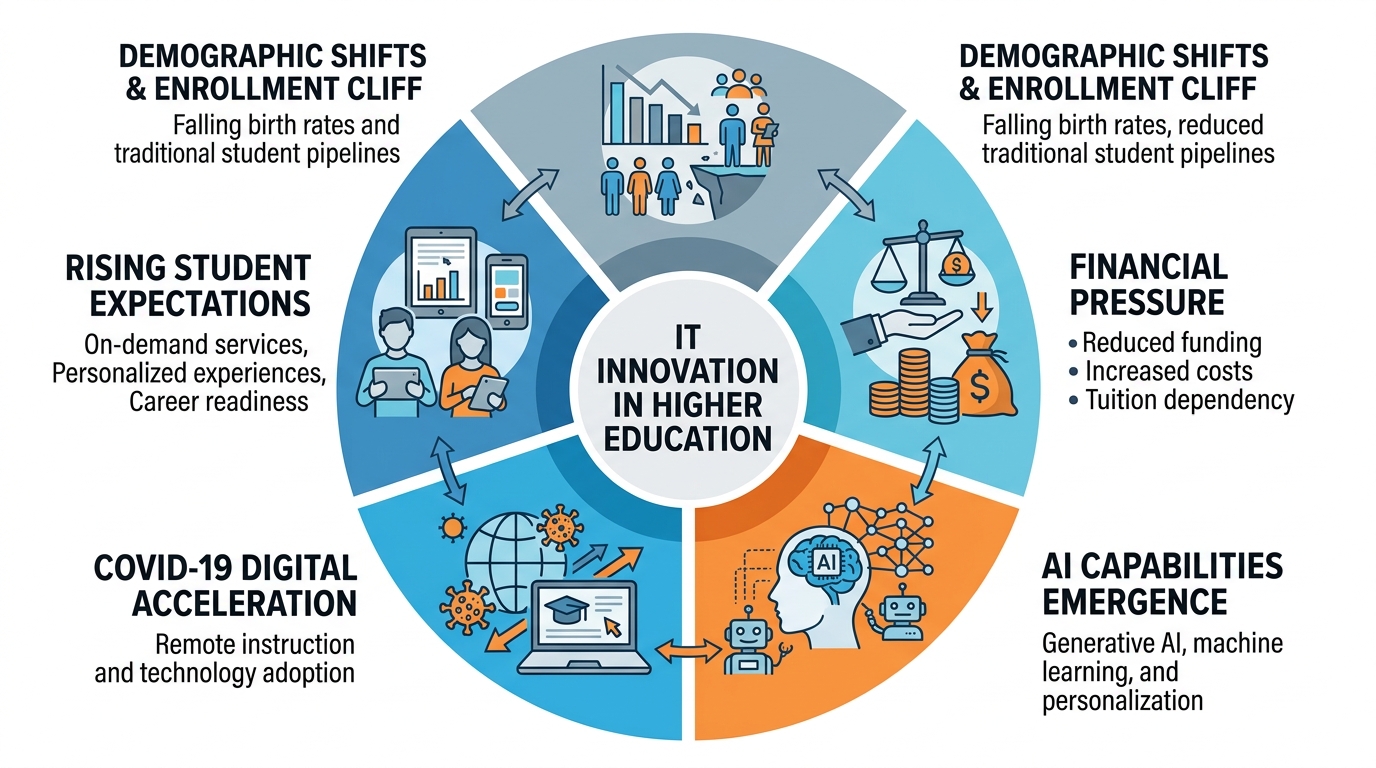
Figure 5:Figure 1.5: Five converging forces driving unprecedented IT innovation urgency in higher education. Unlike previous technology waves, these forces are mutually reinforcing — demographic pressure intensifies financial pressure, which intensifies the search for AI-enabled efficiency, which raises student expectations.
3.11.3.1 Demographic Headwinds and the Enrollment Cliff
American higher education faces a structural enrollment challenge that demographers have been warning about for years: the cohort of students born after the 2008 financial crisis, who will be college-age beginning in 2026, is significantly smaller than previous cohorts. This “enrollment cliff” threatens the revenue model of hundreds of institutions, particularly regional comprehensive universities that depend heavily on tuition from traditional-age students.
The enrollment cliff is not simply a marketing problem — it is an IT strategy problem. Institutions that can use data analytics and AI to identify, engage, and retain students more effectively will have a competitive advantage. Institutions whose technology cannot provide the seamless digital experience that prospective students expect will struggle to compete. According to a 2025 EDUCAUSE survey, 67% of CIOs at institutions with fewer than 5,000 students rated enrollment-related IT capabilities as a “critical strategic priority.”
3.21.3.2 Financial Pressure and the Search for Efficiency
Higher education has faced sustained financial pressure since the 2008 recession, as states reduced per-student appropriations and institutions raised tuition to compensate. By 2024, many public universities received less than 20% of their operating budgets from state appropriations — compared to 45-50% in the 1990s. The COVID-19 pandemic temporarily masked these pressures through federal relief funding (HEERF grants totaling over $76 billion), but as that funding ran out, many institutions faced structural budget gaps.
The financial pressure creates powerful incentives to seek technology-enabled efficiency. Administrative consolidation, automated service delivery, AI-assisted advising, and intelligent facilities management all promise to reduce operational costs. For the first time in many institutions’ histories, IT is being evaluated not just as a cost center but as a potential source of operational savings.
3.31.3.3 Student Expectations and the Digital Experience Gap
Students arriving at college in 2026 have never known a world without smartphones. They navigate complex digital environments with ease, expect immediate responses to service requests, and judge institutions partly by the quality of their digital experience. A clunky registration system, a poorly designed mobile app, or an LMS that does not work on their phone creates friction that affects student satisfaction and, ultimately, retention.
Surveys of college students consistently find that “quality of digital services” ranks among the top factors influencing their perception of institutional quality. EDUCAUSE’s 2025 Student Technology Report found that 58% of students reported that technology problems had negatively affected their academic performance at least once in the previous year — a statistic that represents both a problem and an opportunity for institutions with better technology strategies.
3.41.3.4 The COVID-19 Acceleration
The COVID-19 pandemic compressed a decade of digital transformation into eighteen months. The forced move to remote instruction in March 2020 required institutions to deploy or scale technologies at unprecedented speed: video conferencing platforms (Zoom adoption increased by 300% across higher education in the first month of the pandemic), cloud document collaboration tools, digital proctoring systems, virtual laboratory simulations, and asynchronous video content creation tools.
Many of these technologies, deployed hastily in 2020, proved unexpectedly valuable and were retained when campuses returned to in-person instruction. More importantly, the pandemic demonstrated that institutions could change their technology practices far more rapidly than many had believed possible when necessity demanded it. This realization has shifted conversations about technology adoption from “can we?” to “how quickly should we?”
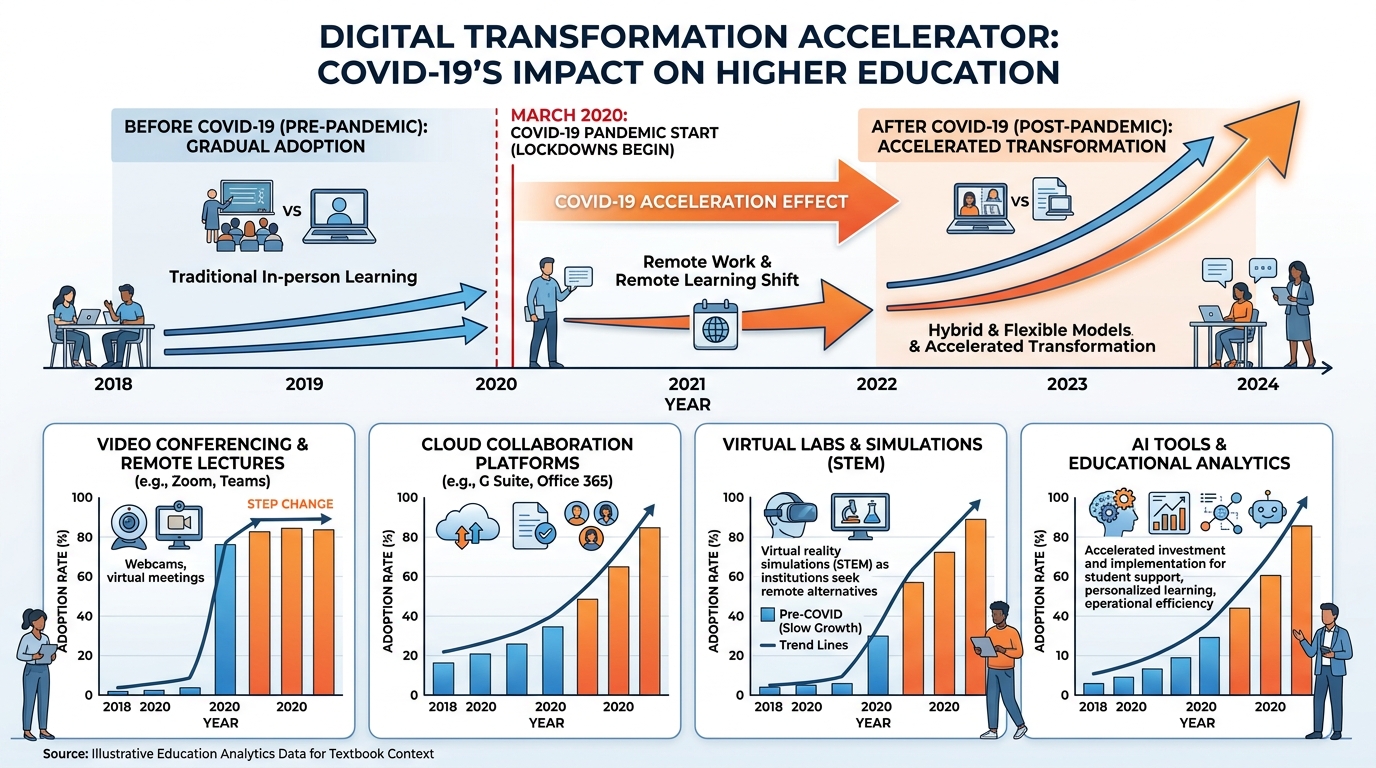
Figure 6:Figure 1.6: COVID-19 as a digital accelerant in higher education. Technology adoption curves that would normally take 5-7 years compressed into 12-18 months. Many institutions that deployed these tools out of necessity discovered unexpected pedagogical value and retained them.
3.51.3.5 The Generative AI Discontinuity
The release of ChatGPT in November 2022 represented something qualitatively different from previous technology introductions in higher education. Unlike cloud computing or even the LMS — technologies that required institutional procurement decisions and professional deployment — generative AI arrived as freely available consumer tools accessible to every student, faculty member, and administrator with an internet connection.
Within weeks of ChatGPT’s public release, higher education was consumed by debate about academic integrity, AI-generated assignments, and the future of the essay. Within months, more constructive conversations emerged about how generative AI could support writing instruction, research, accessibility, advising, and administrative efficiency. And by 2024-2025, major technology vendors had integrated generative AI into every significant higher education platform — LMSs, SIS portals, library databases, research tools, advising systems, and more.
The generative AI discontinuity is the subject of this book’s subsequent chapters. But to understand it properly, one must understand the terrain into which it arrived: a sector characterized by legacy infrastructure, financial pressure, uneven technology adoption, and an institutional culture that is simultaneously among the most intellectually sophisticated and most organizationally resistant to change of any major social institution.
41.4 Mapping the Innovation Ecosystem: Key Players and Technologies
The higher education IT innovation ecosystem involves a complex array of stakeholders whose interests do not always align.
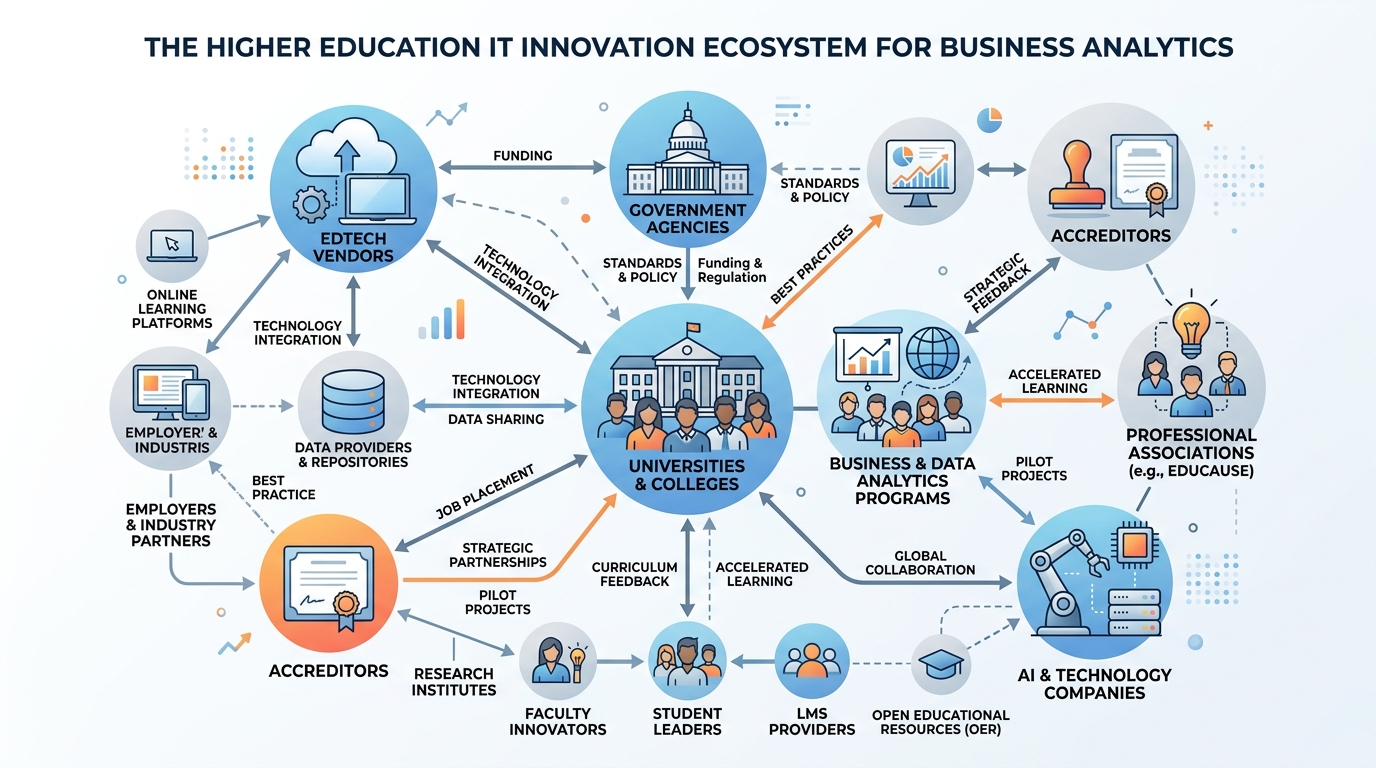
Figure 7:Figure 1.7: The higher education IT innovation ecosystem — a complex network of institutions, vendors, professional associations, government agencies, and emerging AI companies whose interests, timelines, and incentives often diverge significantly.
4.11.4.1 The Major EdTech Vendors
The higher education technology market is large — estimated at over $100 billion globally in 2025 — and characterized by a small number of dominant platform vendors alongside hundreds of specialized point solutions.
Ellucian dominates the North American market for Student Information Systems (Banner) and ERP platforms, serving over 2,500 institutions. Their 2024 introduction of Ellucian Intelligent Experiences, an AI layer built on their existing platforms, represented the mainstreaming of generative AI in university administrative systems.
Instructure (Canvas) leads the LMS market with approximately 40% market share in North America. Their 2023 acquisition by private equity and subsequent public offering in 2024 was accompanied by significant AI feature investment, including Canvas AI, which provides generative assistance to faculty for rubric creation, quiz generation, and student feedback.
Salesforce for Higher Education has grown from a supplemental CRM tool into a comprehensive student lifecycle platform used by hundreds of institutions for recruitment, advising, alumni relations, and student success management. Their Einstein AI capabilities are deeply integrated.
Microsoft and Google compete fiercely for the university productivity suite market (Microsoft 365 vs. Google Workspace for Education) and have both moved aggressively to embed generative AI capabilities — Microsoft Copilot and Google Gemini — into their education offerings.
Workday, known primarily for HR and finance ERP, has expanded significantly into higher education with Workday Student, positioning AI-powered insights as a core differentiator.
4.21.4.2 Professional Associations and Standards Bodies
EDUCAUSE is the primary professional association for higher education technology leaders. Its annual surveys, research reports, and conference (the EDUCAUSE Annual Conference, drawing 10,000+ attendees) set the agenda for the field. EDUCAUSE’s AI in Higher Education initiative has produced frameworks, toolkits, and policy resources that institutions use to structure their AI strategies.
Internet2 provides advanced networking, cloud, and security services to over 300 research universities, facilitating the high-bandwidth connectivity that research computing and video-intensive instruction require. Internet2’s Trusted Access Platform addresses identity and access management — critical infrastructure for AI tool authentication.
IMS Global (now 1EdTech) develops interoperability standards including Learning Tools Interoperability (LTI), which enables third-party tools to integrate with LMSs, and Caliper Analytics, a data standard for learning events. These standards are critical for the AI tool ecosystem — without them, new AI applications cannot reliably integrate with existing institutional platforms.
4.31.4.3 Federal and State Policy Environment
The federal government shapes higher education IT through multiple channels:
Department of Education regulations including FERPA (student privacy) and Title IV eligibility requirements for financial aid create the compliance environment within which university IT must operate.
NIST Cybersecurity Framework and executive orders on AI safety shape institutional security and AI governance practices.
NSF and NIH funding for research computing infrastructure continues to drive adoption of high-performance computing and, increasingly, AI computing capabilities.
State legislatures have increasingly introduced legislation addressing AI use in education, with varying approaches — some banning certain AI uses, others mandating AI literacy curriculum.
51.5 Institutional Archetypes: One Size Does Not Fit All
A critical insight for understanding IT innovation in higher education is that “higher education” encompasses extraordinarily diverse institutions, and technology strategies that work at one institutional type may be entirely inappropriate at another.
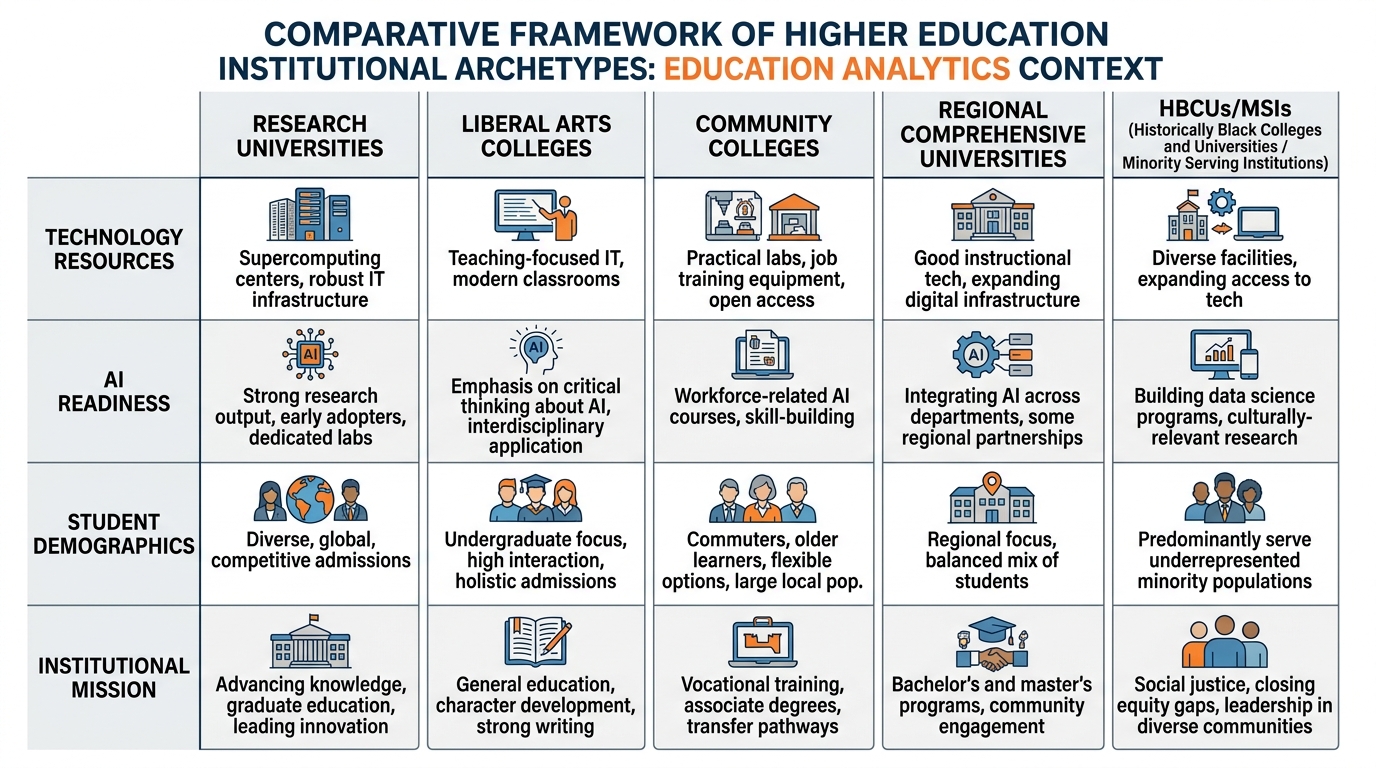
Figure 8:Figure 1.8: Higher education institutional archetypes and their technology profiles. IT innovation strategy must be calibrated to institutional mission, resource base, student population, and existing technology maturity — what works at a well-resourced research university may be inappropriate or unaffordable at a community college.
5.11.5.1 Research Universities (R1 and R2)
The approximately 200 doctoral universities classified by Carnegie as R1 (very high research activity) or R2 (high research activity) are the most technologically sophisticated institutions in higher education. They maintain large central IT departments (often 300-1,000 staff), operate research computing facilities with thousands of CPU and GPU cores, and have dedicated staff for cybersecurity, enterprise applications, and instructional technology.
R1 universities are typically early adopters of new technologies, often through research-driven use cases before administrative or instructional applications. Many have established dedicated AI centers or institutes that serve both as research units and as institutional think tanks for AI governance and strategy.
AI Readiness Score (2025 average): High — most have dedicated AI strategy teams, institutional AI policies, and active pilots in multiple domains.
5.21.5.2 Liberal Arts Colleges
The approximately 200 residential liberal arts colleges — Amherst, Williams, Middlebury, Swarthmore, and hundreds of smaller similar institutions — operate with very different technology profiles. Their IT departments are typically small (20-60 staff), their research computing needs are modest, and their student populations are small but often more affluent and technologically expectant.
Liberal arts colleges face a particular tension around generative AI: their pedagogical model is built on intensive writing, close reading, seminar discussion, and the development of critical thinking through challenging intellectual labor. Generative AI threatens each of these practices in ways that must be thoughtfully navigated. Many have taken more cautious approaches to AI adoption while investing heavily in AI literacy education.
5.31.5.3 Community Colleges
Community colleges — over 900 institutions serving approximately 10 million students — represent both the largest opportunity and the largest technology equity challenge in higher education. Their students are disproportionately first-generation, low-income, working adults, and students of color. Many lack reliable broadband at home, own only smartphones (not laptops), and have limited time for technology learning curves.
Community college IT departments are typically small and under-resourced relative to the complexity of their environments. Their students benefit enormously from AI tools that can provide tutoring, writing feedback, and advising support at scale — but the institutions themselves may lack the staff and infrastructure to implement such tools responsibly.
5.41.5.4 HBCUs and Minority-Serving Institutions (MSIs)
Historically Black Colleges and Universities (HBCUs), Hispanic-Serving Institutions (HSIs), tribal colleges, and other minority-serving institutions face distinctive technology challenges. Many HBCUs, which were historically underfunded relative to their predominantly white counterparts, have made significant recent investments in technology infrastructure — partly through HBCU-focused federal funding and corporate philanthropy (Google, Microsoft, and Apple have all made substantial HBCU technology investments) and partly through their own strategic initiatives.
The AI equity dimension is particularly salient at MSIs: AI tools trained on data that underrepresents minority communities may perform less accurately for MSI students. Assessment AI tools have demonstrated bias in evaluating non-standard English. And the cultural context of historically Black institutions — their emphasis on community, collective success, and institutional mission — may not map well onto AI tools designed for predominantly white institutions.
61.6 The Digital Equity Imperative
Any honest examination of IT innovation in higher education must grapple with the persistent reality of digital inequity — within institutions, between institutions, and in the broader society that students come from.
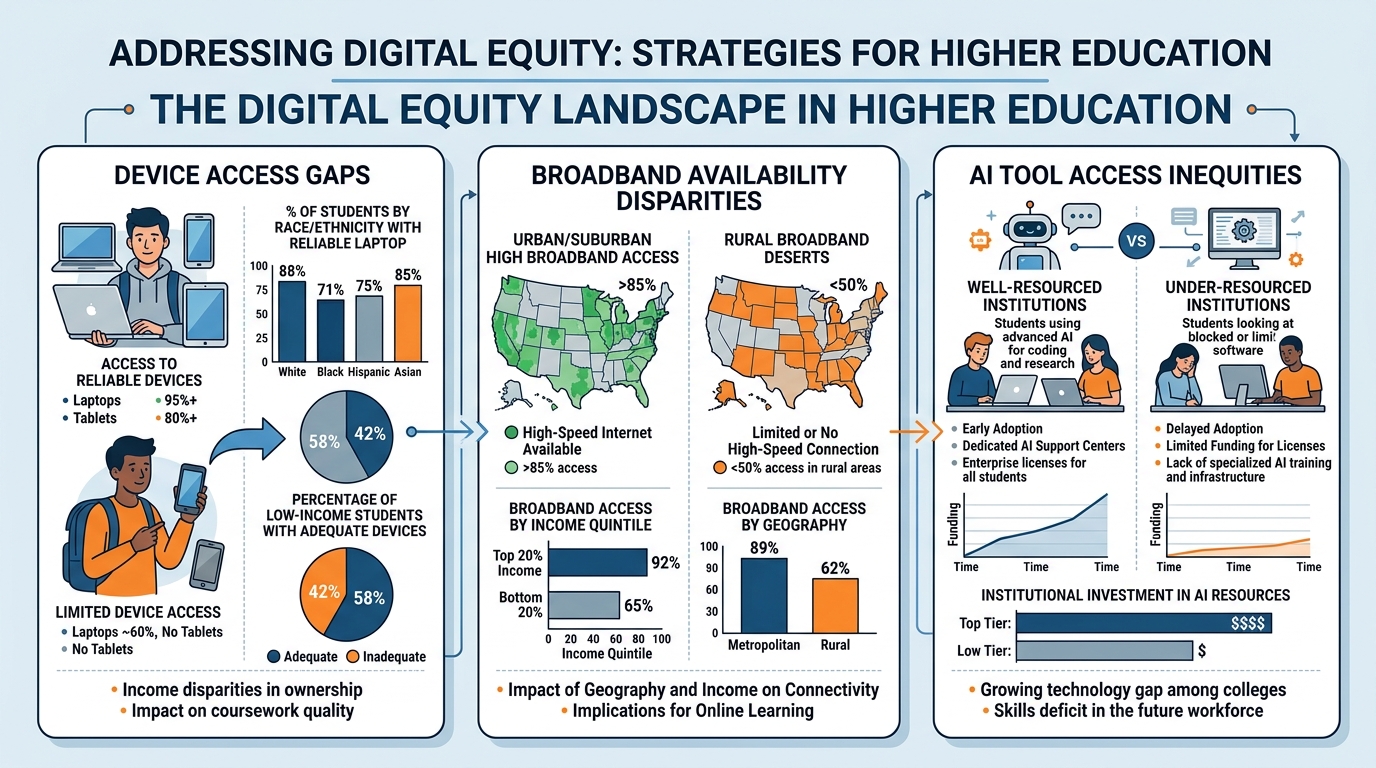
Figure 9:Figure 1.9: The digital equity landscape in higher education. Access disparities exist at every level — between students within institutions, between institutions, and between geographic regions. AI tools that presuppose reliable broadband and personal devices will exacerbate these gaps if equity is not designed in from the start.
6.11.6.1 The Device and Connectivity Gap
Despite years of “device for every student” initiatives, device and connectivity gaps persist. A 2024 EDUCAUSE survey found:
14% of college students lacked reliable broadband access at their primary residence
22% of community college students relied primarily on smartphones for coursework (inadequate for many learning applications)
Rural students and low-income students reported connectivity problems at significantly higher rates
These gaps matter enormously for AI adoption. Most generative AI tools are web-based, computationally intensive, and require reliable broadband. Students without adequate connectivity cannot access AI-assisted tutoring, feedback tools, or accessibility features. If institutions deploy AI tools without addressing underlying connectivity inequities, they risk deepening rather than closing the achievement gap.
6.21.6.2 The Algorithmic Equity Problem
AI systems can perpetuate or amplify existing inequities in ways that are often invisible to users and administrators. In higher education contexts:
Predictive risk models trained on historical student data reflect historical inequities, potentially flagging students of color or first-generation students as “high risk” in ways that lead to differential — and potentially stigmatizing — treatment
AI writing feedback tools may evaluate writing style in ways that penalize African American Vernacular English or other non-dominant language patterns
Facial recognition technologies used in proctoring systems have documented accuracy disparities across racial groups
Recommendation algorithms that suggest academic programs may encode historical enrollment patterns that steered certain groups away from high-earning fields
71.7 The CIO as Strategic Leader
The role of the Chief Information Officer (CIO) in higher education has undergone a fundamental transformation over the past decade. The position that was once primarily focused on infrastructure operations has become one of the most strategically consequential leadership roles in the institution.
7.11.7.1 From Infrastructure Manager to Innovation Partner
The modern higher education CIO must simultaneously:
Manage complex infrastructure across hybrid on-premises and cloud environments
Lead institutional AI strategy — developing governance frameworks, evaluating vendor claims, advising academic leadership on AI policy
Navigate cybersecurity threats that have become existential risks to institutional operations
Champion digital equity and ensure that technology investments serve all students
Partner with academic affairs on instructional technology in ways that respect faculty governance and academic freedom
Drive administrative efficiency through technology-enabled process improvement
Communicate with boards about technology risk, investment, and strategic opportunity in terms that non-technical trustees can understand
This is an extraordinary breadth of responsibility, and it has made the CIO one of the most sought-after — and in many cases, most under-resourced — positions in higher education administration.
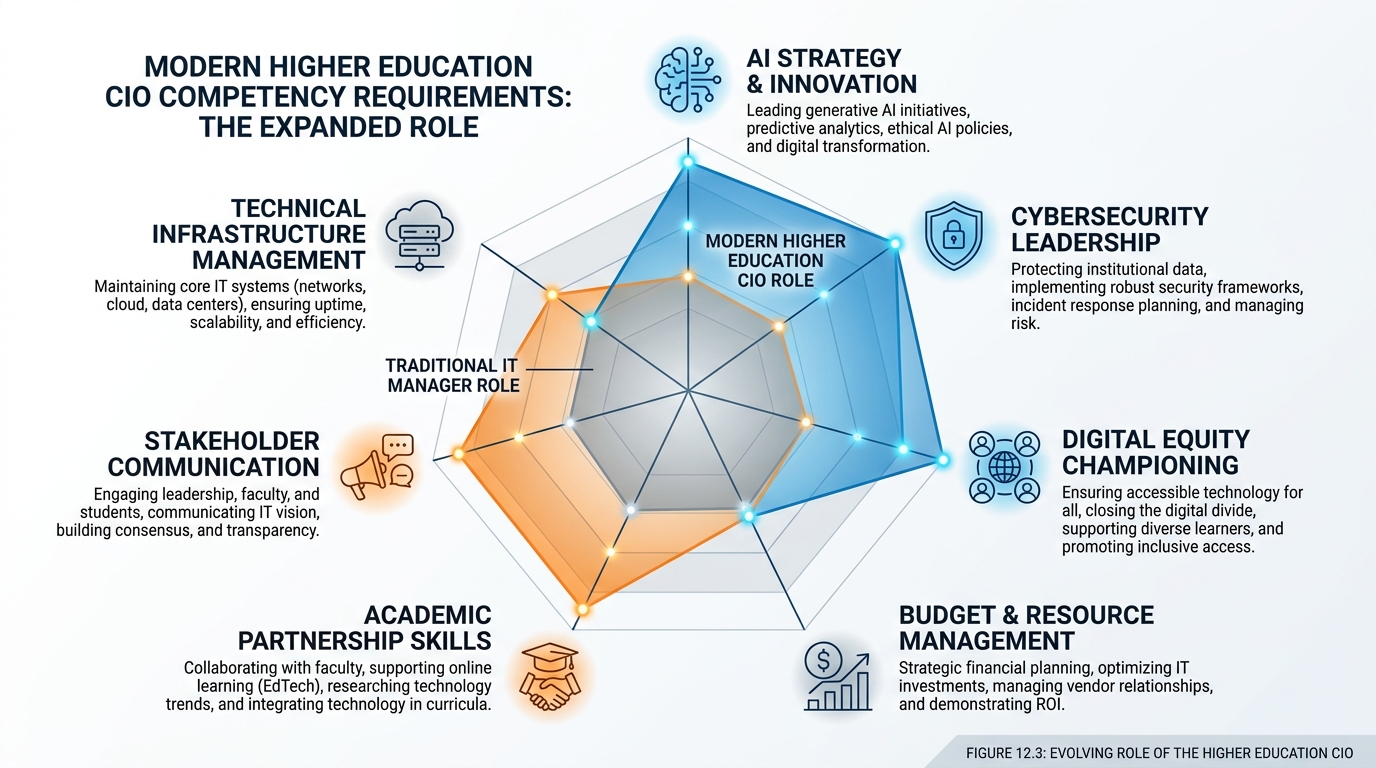
Figure 10:Figure 1.10: The modern higher education CIO competency profile. The role has expanded dramatically from its origins in infrastructure management. Today’s CIOs must be simultaneously credible technical leaders, strategic advisors, equity champions, and communicators who can translate technology implications for non-technical board members and academic leaders.
7.21.7.2 Governance Structures for the AI Era
How institutions govern technology decision-making significantly affects their capacity for strategic AI adoption. Effective governance structures typically include:
A Technology Strategy Committee composed of faculty, students, administrators, and IT leadership that provides broad institutional input on technology priorities, AI policy, and investment decisions.
An AI Steering Group — often a subcommittee or working group — that focuses specifically on AI governance: reviewing new AI tools before institutional deployment, developing acceptable use policies, monitoring for bias and accuracy issues, and advising on academic integrity.
Departmental IT Liaison Networks that connect central IT with the technology needs and concerns of academic departments, enabling two-way communication about new tools, security requirements, and pedagogical technology needs.
An Academic Technology Council that bridges the gap between central IT and faculty governance on instructional technology decisions, ensuring that LMS changes, AI tool deployments, and data analytics initiatives reflect academic values and faculty input.
81.8 Toward the Intelligent Campus
The concept of the “intelligent campus” — in which AI systems operate continuously across administrative, academic, and physical domains to optimize the campus experience — represents the horizon toward which higher education IT innovation is moving.
An intelligent campus is not a single system but an integrated ecosystem in which:
Student-facing AI provides personalized advising, tutoring, and support at any hour
Faculty-facing AI assists with course design, content creation, assessment, and student feedback
Administrative AI automates routine transactions, surfaces actionable insights from institutional data, and supports evidence-based decision-making
Physical campus AI uses sensor networks, building automation systems, and spatial analytics to optimize energy use, space allocation, and safety
Research AI accelerates discovery by helping researchers analyze data, review literature, generate hypotheses, and connect with collaborators
Building an intelligent campus requires not just new AI tools but the underlying data infrastructure to connect them, the cybersecurity architecture to protect them, the governance structures to ensure their responsible use, and the institutional culture to adopt them thoughtfully. Chapters 2 and 3 of this book examine how generative AI is reshaping specific domains of this emerging intelligent campus and what strategic and ethical frameworks institutions need to guide the transformation.
9Summary
This chapter has traced the evolution of IT in higher education from the mainframe era to the threshold of the AI-powered intelligent campus. Several key insights frame the analysis of subsequent chapters:
Legacy is reality, not failure. Most universities operate in hybrid environments shaped by decades of technology investment decisions. Strategic AI adoption must work within this constraint, not assume it away.
Diversity of institutional context is profound. AI strategies appropriate for a well-resourced research university may be inappropriate, unaffordable, or harmful at a community college or HBCU.
Five converging forces are driving unprecedented urgency: demographic headwinds, financial pressure, rising student expectations, COVID-19 acceleration, and the generative AI discontinuity.
Digital equity must be designed in. AI tools that presuppose reliable connectivity, personal devices, and familiarity with dominant language patterns will exacerbate rather than close existing achievement gaps.
The CIO role has become strategic. Institutions that treat IT leadership as infrastructure management rather than strategic partnership are leaving value on the table and accumulating risk.
Governance matters. The institutions navigating AI adoption most successfully are those that have invested in inclusive governance structures before, not after, deploying AI tools.
10Key Terms
Digital Transformation The process by which an institution systematically replaces manual, paper-based, or legacy digital processes with modern, integrated, and often AI-enhanced technology systems.
Enterprise Resource Planning (ERP) Integrated software systems that manage core business processes across an organization. In higher education, ERP systems typically encompass finance, human resources, and procurement. Examples include Banner, PeopleSoft, and Workday.
Student Information System (SIS) A database system that manages student enrollment, academic records, degree requirements, financial aid, and other student lifecycle data. The SIS is often the most critical and most difficult-to-modernize component of university IT.
Learning Management System (LMS) A software platform that provides the digital environment for course delivery, including content distribution, discussion forums, assessment, and grade management. Canvas and Blackboard are the leading platforms in North American higher education.
Generative AI A class of artificial intelligence systems capable of generating new content — text, images, code, audio, or video — by learning patterns from large datasets. Large Language Models (LLMs) like GPT-4 and Claude are the most prominent examples in educational contexts.
Enrollment Cliff A demographic phenomenon in which the smaller cohorts of students born after the 2008 financial crisis reach college age beginning in 2026, creating structural enrollment pressure for higher education institutions.
Algorithmic Bias Systematic and unfair discrimination in the outputs of an algorithm that occurs when the training data, model design, or application context encodes or amplifies existing social inequities.
Intelligent Campus A higher education environment in which AI systems are integrated across student services, instruction, research, administration, and physical operations to optimize the campus experience and institutional performance.
FERPA The Family Educational Rights and Privacy Act, a federal law that governs student educational records privacy and restricts how institutions may share student data. A critical compliance constraint for AI systems that process student information.
Hybrid Infrastructure An IT environment that combines on-premises computing resources with cloud computing services, characteristic of most contemporary university IT environments.
Digital Equity The condition in which all individuals and communities have the information technology capacity needed for full participation in education, work, and civic life. A persistent challenge in higher education.
CIO (Chief Information Officer) The senior technology executive responsible for institutional IT strategy, infrastructure, security, and application management. In higher education, the CIO role has expanded to include AI strategy, digital equity leadership, and board-level technology communication.
EDUCAUSE The primary professional association for technology leaders in higher education, providing research, professional development, and policy advocacy. Producer of widely-cited annual surveys on higher education technology trends.
Ransomware A type of malicious software that encrypts victims’ data and demands payment for the decryption key. Ransomware attacks against universities have become frequent, costly, and occasionally institution-threatening.
Research Computing High-performance computing infrastructure operated by universities to support computationally intensive research in fields including genomics, physics, climate science, materials science, and increasingly, AI.
11Discussion Questions
The Legacy Infrastructure Dilemma: A mid-sized regional university is running a Banner SIS implementation that is 15 years old. The system is stable but cannot integrate well with modern AI tools. Leadership is considering a $30 million migration to Workday Student. What factors should drive this decision? What are the risks of staying with the legacy system? What are the risks of migrating?
Institutional Archetypes and AI Readiness: How should a community college’s AI adoption strategy differ from that of an R1 research university? What specific student population characteristics, resource constraints, and mission considerations should shape these differences?
The Equity Paradox: AI tools could theoretically provide high-quality tutoring and advising support to every student at a cash-strapped community college — potentially democratizing access to support that was previously available only at well-resourced institutions. Yet many AI tools may be biased against the very students these institutions serve. How should institutions navigate this paradox?
CIO as Strategic Leader: The new CIO at a liberal arts college is asked by the president to develop a “generative AI strategy” for the institution. What stakeholders should she engage? What governance structures should she establish? What should the strategy document include?
The Enrollment Cliff Response: A regional comprehensive university projects a 15% enrollment decline by 2030 due to demographic shifts. The VP of Enrollment Management believes AI-powered personalized outreach and advising could significantly reduce this decline. The faculty senate is skeptical. How should the institution navigate this tension?
Discussion Guidelines
For your initial post:
Your response should be 250-400 words, substantive and specific — not a general list of considerations.
Include at least one citation from a scholarly source, an EDUCAUSE research report, or a credible news source (The Chronicle of Higher Education, Inside Higher Ed, or similar).
Make a clear recommendation or argument — don’t just enumerate perspectives.
For your peer responses:
Respond to at least TWO classmates with substantive feedback (150+ words each).
Engage critically: where do you agree, and where do you see gaps, risks, or factors your peer did not consider?
“I agree” or “great post” without elaboration does not count as a substantive response.
12Exercises
12.1Exercise 1.1 — IT Infrastructure Audit
Select a higher education institution (your own institution, or one publicly documented in EDUCAUSE or Chronicle of Higher Education reporting) and conduct an IT infrastructure audit. Document:
Their primary SIS, LMS, and ERP systems
Whether they operate primarily on-premises, in the cloud, or hybrid
Any major AI tool deployments mentioned in public sources
Any documented cybersecurity incidents in the past five years
Their CIO’s publicly stated strategic priorities
Sample Response Framework
A strong audit will synthesize information from multiple sources: the institution’s own IT website (often contains product names), CIO public presentations (often posted on EDUCAUSE), Chronicle of Higher Education coverage, and press releases. Avoid the temptation to assume — many institutions use products you might not recognize. Look for official documentation rather than inferring from institutional characteristics.
12.2Exercise 1.2 — Institutional Archetype Analysis
The following institution characteristics describe a real higher education institution (details altered). Using the institutional archetype framework from Section 1.5, classify the institution and develop a brief AI readiness assessment:
“A four-year liberal arts college in the rural Midwest with 1,800 students, a $120 million endowment, 85 full-time faculty, a 14:1 student-faculty ratio, and an IT department of 12 staff. 78% of students receive need-based aid. The institution uses Canvas as its LMS and Banner as its SIS. The CIO reports to the Provost.”
12.3Exercise 1.3 — The Enrollment Cliff Analysis
Using publicly available NCES (National Center for Education Statistics) data and the Western Interstate Commission for Higher Education (WICHE) Knocking at the College Door projections, identify three states that face the most severe enrollment cliff challenges. For each state, analyze:
The magnitude of projected high school graduate decline (2025-2032)
The types of institutions most likely to be affected
The technology strategies institutions in that state are most likely to need
12.4Exercise 1.4 — Governance Design
Design a higher education AI governance structure for a regional comprehensive university with 12,000 students. Your design should specify:
Committee names, composition, and reporting relationships
Decision-making authority for AI tool adoption
Process for reviewing AI tools before deployment
Policy development and review mechanisms
Communication strategy for faculty, students, and staff